Hernandez-Sanchez Sergio, Abat Ferran, Hidalgo María D, Cuesta-Vargas Antonio I, Segarra Victor, Sanchez-Ibañez Jose M, Gomez-Conesa Antonia
Department of Pathology and Surgery, Physiotherapy Area, Miguel Hernandez University, Valencia 03550, Spain.
Sports Orthopaedic Surgeon, ReSport Clinic, Barcelona 08017, Spain.
J Sport Health Sci. 2017 Sep;6(3):365-371. doi: 10.1016/j.jshs.2016.01.020. Epub 2016 Jan 22.
The Victorian Institute of Sport Assessment-Patella (VISA-P) scale is the most condition-specific patient-reported outcome measure used to assess symptom severity in athletes with patellar tendinopathy. Previous exploratory factor analyses have been conducted to evaluate the scale's dimensionality, with inconsistent results, and the factor structure of the scale remains unclear. The aims of the present study were to determine the factorial structure of the VISA-P scale using confirmatory factor analysis (CFA) and test measurement invariance across sexes.
The study included a convenience sample of 249 Spanish athletes with patellar tendinopathy. CFA was performed to assess factorial validity. Hypothesized 1- and 2-factor models were tested. Measurement invariance across sexes was evaluated via multi-group CFA with several fit indices using EQS 6.1 software.
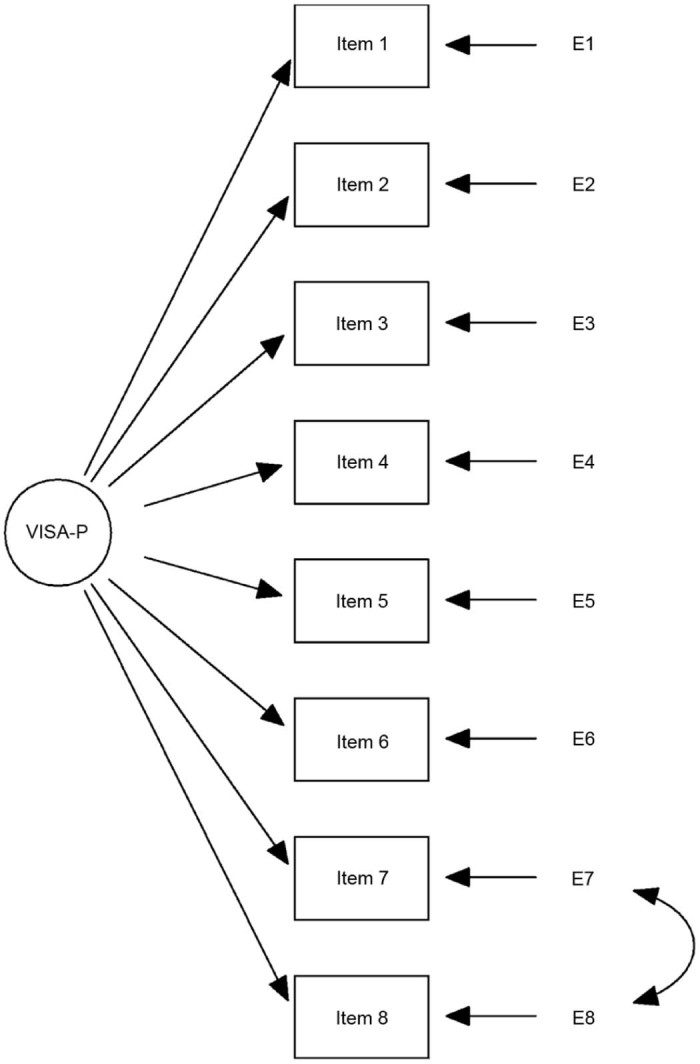
The internal consistency coefficient was 0.74. Several CFA models were examined and the 1-factor model in which errors for Items 7 and 8 were correlated showed acceptable fit in terms of comparative fit index (CFI) and goodness-of-fit index (GFI) statistics (CFI = 0.93; GFI = 0.94; standardized root mean square residual = 0.06; root mean square error of approximation = 0.10; 90% confidence interval: 0.08-0.13). This model was invariant across sexes.
The 1-factor model of the Spanish version of the VISA-P scale (VISA-P-Sp) in which errors for Items 7 and 8 were correlated demonstrated relative fit in CFA. Scores obtained via VISA-P-Sp can be compared between men and women without sexes bias. Further studies should examine the VISA-P scale and other single-score patient-reported outcome measures concurrently.
维多利亚运动协会髌股关节评估量表(VISA-P)是用于评估髌腱病运动员症状严重程度的最具针对性的患者报告结局指标。此前已经进行了探索性因素分析以评估该量表的维度,但结果不一致,量表的因素结构仍不明确。本研究的目的是使用验证性因素分析(CFA)确定VISA-P量表的因素结构,并检验性别间的测量不变性。
本研究纳入了249名患有髌腱病的西班牙运动员的便利样本。进行CFA以评估因素效度。对假设的单因素和双因素模型进行了检验。使用EQS 6.1软件通过多组CFA和几个拟合指数评估性别间的测量不变性。
内部一致性系数为0.74。检查了几个CFA模型,其中项目7和8的误差相关的单因素模型在比较拟合指数(CFI)和拟合优度指数(GFI)统计方面显示出可接受的拟合度(CFI = 0.93;GFI = 0.94;标准化根均方残差 = 0.06;近似根均方误差 = 0.10;90%置信区间:0.08 - 0.13)。该模型在性别间是不变的。
西班牙版VISA-P量表(VISA-P-Sp)中项目7和8的误差相关的单因素模型在CFA中显示出相对拟合度。通过VISA-P-Sp获得的分数可以在男性和女性之间进行比较而不存在性别偏差。进一步的研究应同时检查VISA-P量表和其他单分数患者报告结局指标。