Department of Internal Medicine, Yale School of Medicine, New Haven, CT, USA.
Department of Biostatistical Sciences, Wake Forest University Health Sciences, Winston Salem, NC, USA.
BMC Med. 2018 Oct 24;16(1):185. doi: 10.1186/s12916-018-1174-8.
Whether physical activity can reduce cognitive frailty-a relatively new "compound" phenotype proposed in 2013-and whether the effect of physical activity differs based on levels of inflammation are unknown. Therefore, this study aimed to evaluate the effect of physical activity on cognitive frailty and whether baseline interleukin-6 (IL-6) levels modified this effect.
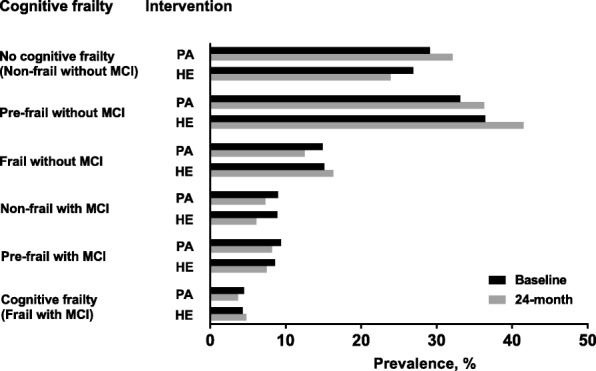
We used data from the Lifestyle Interventions and Independence for Elders (LIFE) Study, a multicenter, single-blinded randomized trial conducted at eight US field centers between February 2010 and December 2013. The main outcome was cognitive frailty at 24 months, expressed as an ordinal variable based on the six combinations of its two components: frailty (non-frail, pre-frail, and frail) and mild cognitive impairment (yes, no). Frailty and cognition were assessed by the Study of Osteoporotic Fractures (SOF) index and the Modified Mini-Mental State Examination (3MSE) scale, respectively. Plasma IL-6 was measured at baseline. Of the 1635 original randomized sedentary participants (70-89 years), this study included 1298 participants with data on both cognitive frailty and IL-6 assessments at baseline.
After adjusting for field center, sex, and baseline levels of cognitive frailty, the ordinal logistic regression model revealed that participants in the physical activity group had 21% lower odds (odds ratio, 0.79; 95% confidence interval, 0.64-0.98) of worsening cognitive frailty over 24 months than those in the health education group. The effect of physical activity on cognitive frailty did not differ according to baseline IL-6 levels (P for interaction = 0.919). The results did not change after additional adjustment for IL-6 subgroups and the inverse probability of remaining in the study. Comparable results were observed according to age, sex, ethnicity/race, and short physical performance battery score (P for interaction = 0.835, 0.536, 0.934, and 0.458, respectively).
A 24-month structured, moderate-intensity physical activity program reduced cognitive frailty compared with a health education program in sedentary older persons, and this beneficial effect did not differ according to baseline levels of inflammatory biomarker IL-6. These findings suggest that the new cognitive frailty construct is modifiable and highlight the potential of targeting cognitive frailty for promoting healthy aging.
Clinicaltrials.gov, NCT01072500.
运动是否可以减轻认知脆弱——2013 年提出的一种相对较新的“复合”表型,以及运动的效果是否因炎症水平而异尚不清楚。因此,本研究旨在评估运动对认知脆弱的影响,以及基线白细胞介素 6(IL-6)水平是否会改变这种效果。
我们使用了 Lifestyle Interventions and Independence for Elders(LIFE)研究的数据,这是一项于 2010 年 2 月至 2013 年 12 月在美国八个现场中心进行的多中心、单盲随机试验。主要结局是 24 个月时的认知脆弱,根据其两个组成部分的六个组合表示为一个有序变量:脆弱(非脆弱、脆弱前期和脆弱)和轻度认知障碍(是、否)。脆弱和认知分别由骨质疏松性骨折研究(SOF)指数和改良的简易精神状态检查(3MSE)量表评估。基线时测量了血浆 IL-6。在最初的 1635 名随机久坐参与者(70-89 岁)中,本研究包括了 1298 名在基线时同时具有认知脆弱和 IL-6 评估数据的参与者。
在调整了现场中心、性别和基线认知脆弱程度后,有序逻辑回归模型显示,与健康教育组相比,运动组参与者在 24 个月内认知脆弱恶化的可能性降低了 21%(优势比,0.79;95%置信区间,0.64-0.98)。运动对认知脆弱的影响与基线 IL-6 水平无关(交互作用 P=0.919)。进一步按 IL-6 亚组和研究中剩余的逆概率进行调整后,结果没有改变。根据年龄、性别、种族/民族和短体适能电池评分(交互作用 P=0.835、0.536、0.934 和 0.458),观察到了类似的结果。
与健康教育相比,为期 24 个月的结构化、中等强度的体育活动方案可降低久坐老年人的认知脆弱程度,而这种有益效果与基线炎症生物标志物 IL-6 水平无关。这些发现表明,新的认知脆弱结构是可改变的,并强调了针对认知脆弱来促进健康老龄化的潜力。
Clinicaltrials.gov,NCT01072500。