The Third School of Clinical Medicine, Southern Medical University, Guangzhou, China.
Department of Endocrinology and Metabolism, Diabetes Ward, Fengxian Central Hospital Affiliated to the Southern Medical University, Shanghai, China.
J Diabetes Investig. 2019 May;10(3):793-800. doi: 10.1111/jdi.12963. Epub 2018 Nov 28.
AIMS/INTRODUCTION: High plasma 3-carboxy-4-methyl-5-propyl-2-furanpropanoic acid (CMPF) levels are significantly associated with type 2 diabetes mellitus, which is usually accompanied by metabolic syndrome and non-alcoholic fatty liver disease (NAFLD) with increased triglyceride levels. Thus, we hypothesized that elevated CMPF levels might be related to lipid metabolism and NAFLD risk.
Serum CMPF levels were determined using an enzyme-linked immunosorbent assay in a total of 466 individuals, including 116 controls with no NAFLD or type 2 diabetes mellitus, 53 individuals with NAFLD but no type 2 diabetes mellitus, 151 individuals with type 2 diabetes mellitus but no NAFLD, and 146 individuals with both NAFLD and type 2 diabetes mellitus. The associations with age, blood pressure, lipid profiles, body mass index and liver injury marker levels were examined, and a meta-analysis of non-diabetic and diabetic groups was carried out to detect the combined effects.
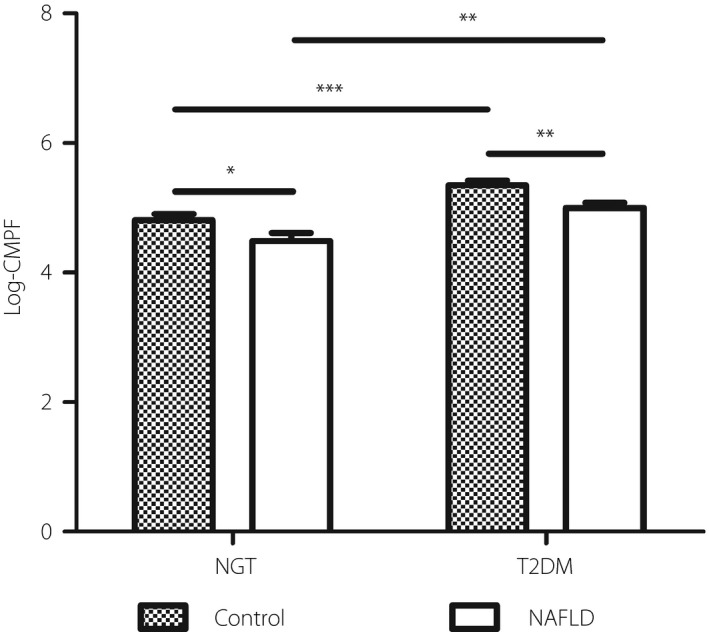
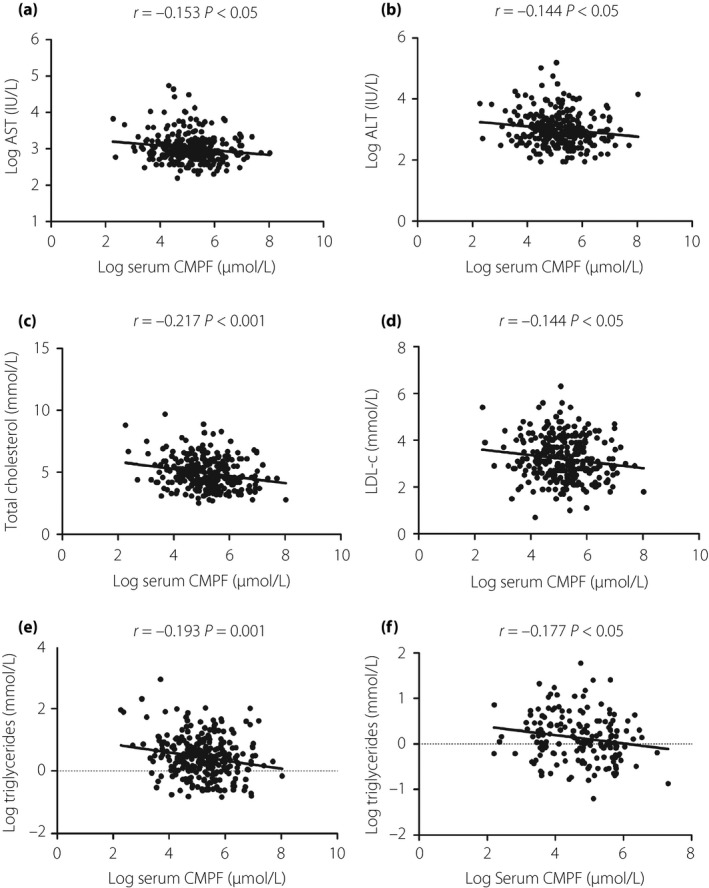
The CMPF concentration in NAFLD patients was significantly lower than individuals without NAFLD in both the non-diabetic group (P < 0.05) and diabetic group (P < 0.01), and correlated negatively with several parameters of liver function and the adiposity index. Meta-analysis showed that serum CMPF levels was associated with decreased risk of NAFLD after combining the results (odds ratio 0.677, 95% confidence interval 0.552-0.831, P < 0.001). Additionally, the CMPF concentration was independently negatively associated with triglycerides and high-density lipoprotein cholesterol in the meta-analysis. Multiple stepwise regression analysis showed that body mass index, high-density lipoprotein cholesterol, triglyceride level, age, sex and fasting plasma glucose were independently associated with CMPF (all P < 0.05).
The results suggest that serum CMPF levels are negatively related to lipid metabolism and could be used to predict NAFLD development.
目的/引言:高血浆 3-羧基-4-甲基-5-丙基-2-呋喃丙酸(CMPF)水平与 2 型糖尿病显著相关,2 型糖尿病通常伴有代谢综合征和非酒精性脂肪性肝病(NAFLD),伴有甘油三酯水平升高。因此,我们假设 CMPF 水平升高可能与脂质代谢和 NAFLD 风险有关。
采用酶联免疫吸附试验检测了 466 例个体的血清 CMPF 水平,包括 116 例无 NAFLD 或 2 型糖尿病的对照组、53 例有 NAFLD 但无 2 型糖尿病的对照组、151 例有 2 型糖尿病但无 NAFLD 的对照组和 146 例同时患有 NAFLD 和 2 型糖尿病的对照组。检测了与年龄、血压、血脂谱、体重指数和肝损伤标志物水平的相关性,并对非糖尿病组和糖尿病组进行了荟萃分析,以检测联合作用。
在非糖尿病组(P<0.05)和糖尿病组(P<0.01)中,NAFLD 患者的 CMPF 浓度均明显低于无 NAFLD 患者,且与肝功能和肥胖指数的多个参数呈负相关。荟萃分析显示,合并结果后,血清 CMPF 水平与降低 NAFLD 风险相关(比值比 0.677,95%置信区间 0.552-0.831,P<0.001)。此外,荟萃分析显示 CMPF 浓度与甘油三酯和高密度脂蛋白胆固醇呈负相关。多元逐步回归分析显示,体重指数、高密度脂蛋白胆固醇、甘油三酯水平、年龄、性别和空腹血糖与 CMPF 独立相关(均 P<0.05)。
结果表明,血清 CMPF 水平与脂质代谢呈负相关,可用于预测 NAFLD 的发生。