From the Central Florida Pain Relief Centers, Orlando (M.C.).
St. George's University Hospitals NHS Foundation Trust, London, United Kingdom (G.C.).
Stroke. 2018 Sep;49(9):2129-2137. doi: 10.1161/STROKEAHA.118.022255.
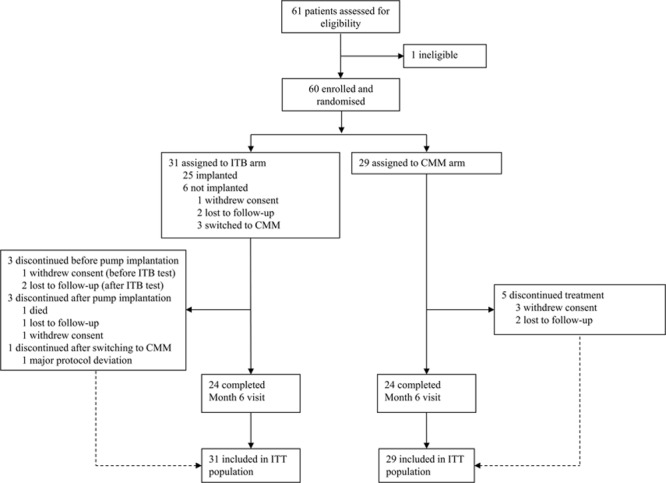
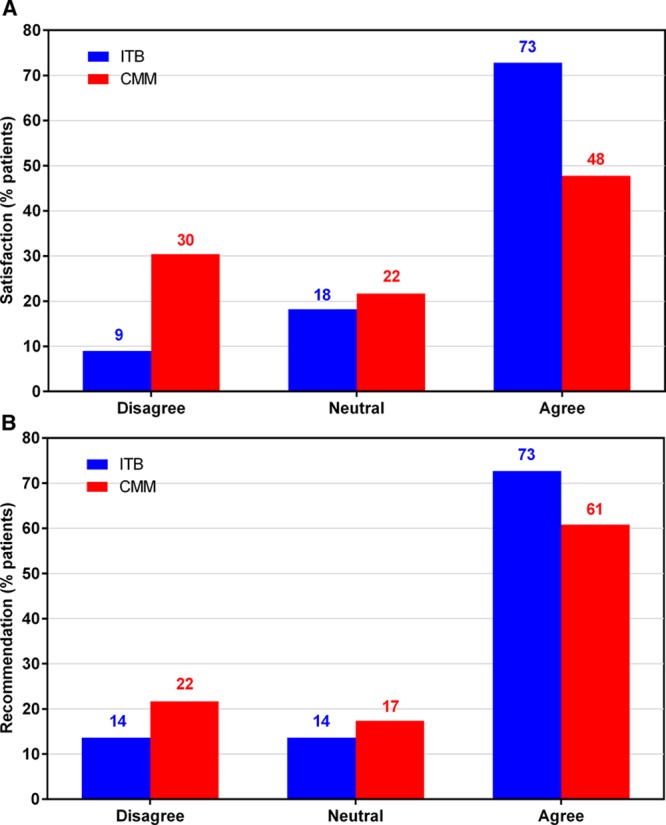
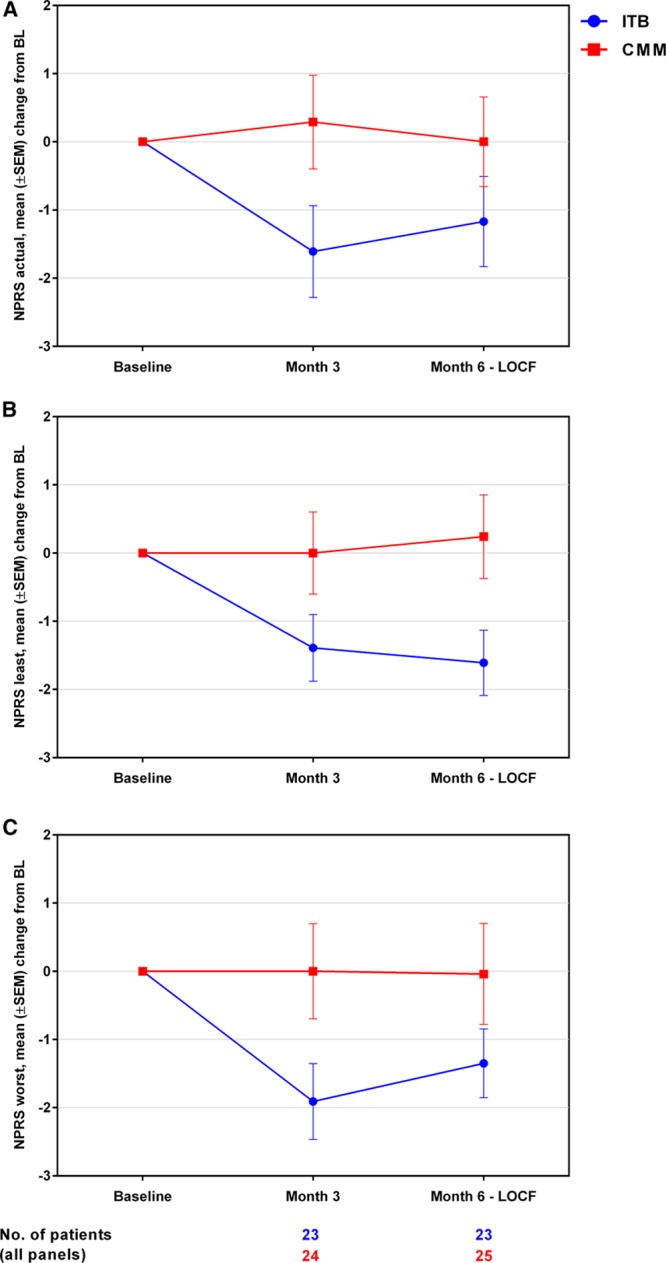
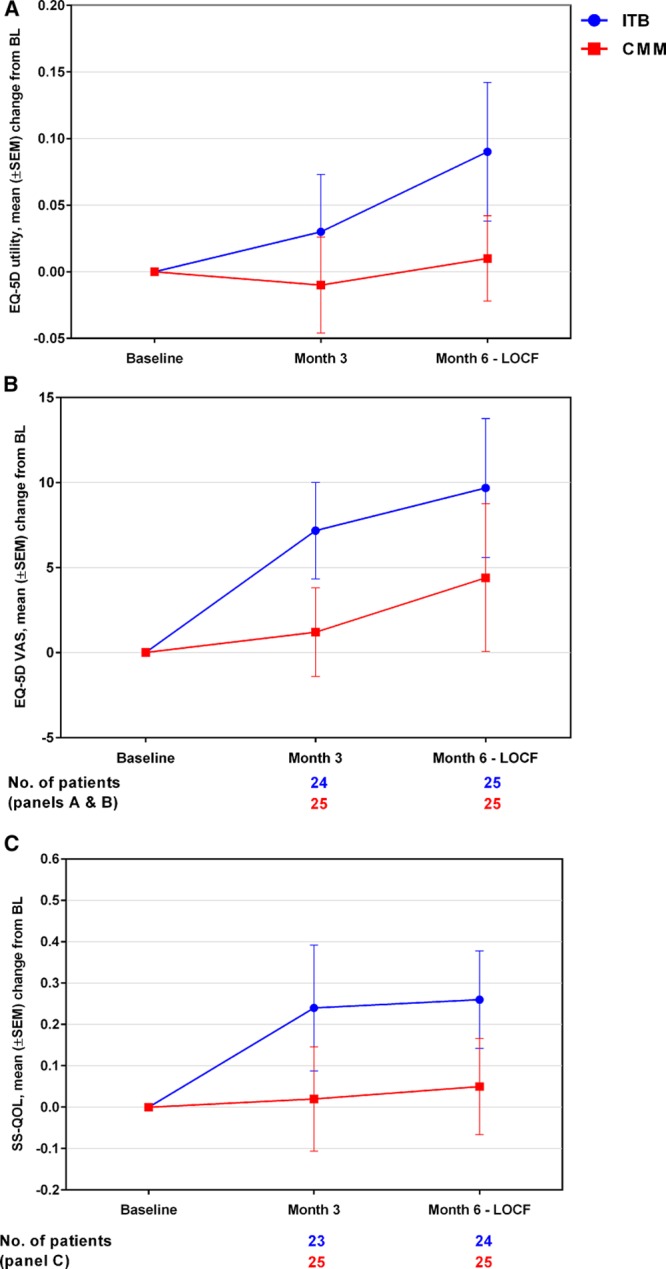
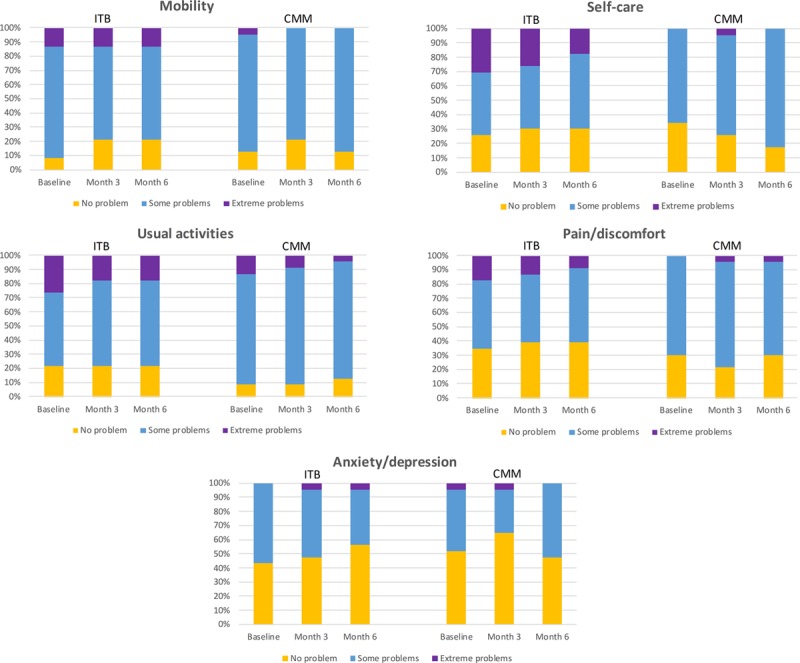
Background and Purpose- Intrathecal baclofen (ITB) is an effective treatment for managing patients with severe poststroke spasticity, who can experience continued pain and decline in their quality of life (QoL). SISTERS (Spasticity In Stroke-Randomized Study) was a randomized, controlled, open-label, multicenter, phase 4 study to evaluate ITB therapy versus conventional medical management (CMM) with oral antispastic medications for treatment of poststroke spasticity. Methods- Poststroke patients with spasticity in ≥2 extremities and an Ashworth Scale score of ≥3 in ≥2 affected lower extremity muscle groups were randomized (1:1) to ITB (N=31) or CMM (N=29). Both treatment arms received physiotherapy throughout. The primary outcome was the change in average Ashworth Scale score in the lower extremities of the affected side from baseline to month 6. Here, we report results for secondary outcomes: pain via the Numeric Pain Rating Scale, health-related QoL by the EuroQol-5 dimensional 3 level utility score and health status visual analog scale score, stroke-specific QoL, and patient satisfaction. Analyses were performed on an intention-to-treat basis. Results- We observed significant treatment effects in favor of ITB over CMM for changes from baseline to month 6 in Numeric Pain Rating Scale scores for actual pain (ITB versus CMM: mean, -1.17 [SD, 3.17] versus 0.00 [3.29]; median, -1.00 versus 0.00; P=0.0380) and least pain (mean, -1.61 [2.29] versus 0.24 [3.07]; median, -1.00 versus 0.00; P=0.0136), and EuroQol-5 dimensional 3 level utility scores (mean, +0.09 [0.26] versus +0.01 [0.16]; median, +0.07 versus 0.00; P=0.0197). Between-group differences were not statistically significant for EuroQol-5 dimensional 3 level visual analog scale, stroke-specific QoL summary, or Numeric Pain Rating Scale worst pain scores, although ITB patients showed greater numeric improvements from baseline during follow-up. More ITB patients than CMM patients (73% versus 48%) were satisfied with the spasticity reduction at month 6. Conclusions- These data support that ITB therapy is associated with improvements in pain and QoL in poststroke patients. Clinical Trial Registration- URL: https://www.clinicaltrials.gov . Unique identifier: NCT01032239.
背景与目的-鞘内注射巴氯芬(ITB)是治疗严重脑卒中后痉挛的有效方法,可缓解患者的持续疼痛,改善生活质量(QoL)。SISTERS(脑卒中后痉挛随机研究)是一项随机、对照、开放标签、多中心、4 期研究,旨在评估 ITB 治疗与口服抗痉挛药物的常规药物治疗(CMM)治疗脑卒中后痉挛的疗效。方法- 本研究纳入了四肢存在痉挛且 Ashworth 量表评分≥3 分、2 个及以上下肢肌群受累的脑卒中患者,将其随机(1:1)分为 ITB 组(n=31)或 CMM 组(n=29)。两组患者均接受物理治疗。主要结局是从基线到第 6 个月时,患侧下肢平均 Ashworth 量表评分的变化。本研究报告了次要结局的结果:采用数字疼痛评分量表评估疼痛,欧洲五维健康量表 3 级效用评分和健康状况视觉模拟评分评估健康相关生活质量(HRQoL),脑卒中患者特定生活质量量表评估脑卒中患者的生活质量,以及患者满意度。分析基于意向治疗原则进行。结果- 我们观察到,与 CMM 相比,ITB 治疗可显著改善从基线到第 6 个月时的实际疼痛(ITB 组与 CMM 组:平均差值,-1.17 [3.17] 与 0.00 [3.29];中位数,-1.00 与 0.00;P=0.0380)和最差疼痛(ITB 组与 CMM 组:平均差值,-1.61 [2.29] 与 0.24 [3.07];中位数,-1.00 与 0.00;P=0.0136)的 Numeric Pain Rating Scale 评分,以及欧洲五维健康量表 3 级效用评分(ITB 组与 CMM 组:平均差值,+0.09 [0.26] 与 +0.01 [0.16];中位数,+0.07 与 0.00;P=0.0197)。尽管 ITB 组患者在随访过程中从基线水平的数值改善更为明显,但在欧洲五维健康量表 3 级视觉模拟量表、脑卒中患者特定生活质量量表或数字疼痛评分量表最差疼痛评分方面,两组间差异无统计学意义。与 CMM 组相比,更多的 ITB 患者(73% 比 48%)对痉挛缓解程度表示满意。结论- 这些数据支持 ITB 治疗可改善脑卒中患者的疼痛和 HRQoL。临床试验注册- 网址:https://www.clinicaltrials.gov 。唯一标识符:NCT01032239。