Baskerville Neill Bruce, Struik Laura Louise, Guindon Godefroy Emmanuel, Norman Cameron D, Whittaker Robyn, Burns Catherine, Hammond David, Dash Darly, Brown K Stephen
Propel Centre for Population Health Impact, Faculty of Applied Health Sciences, University of Waterloo, Waterloo, ON, Canada.
School of Public Health and Health Systems, Faculty of Applied Health Sciences, University of Waterloo, Waterloo, ON, Canada.
JMIR Mhealth Uhealth. 2018 Oct 23;6(10):e10893. doi: 10.2196/10893.
Digital mobile technology presents a promising medium for reaching young adults with smoking cessation interventions because they are the heaviest users of this technology.
The aim of this study was to determine the efficacy of an evidence-informed smartphone app for smoking cessation, Crush the Crave (CTC), on reducing smoking prevalence among young adult smokers in comparison with an evidence-informed self-help guide, On the Road to Quitting (OnRQ).
A parallel, double-blind, randomized controlled trial with 2 arms was conducted in Canada to evaluate CTC. In total, 1599 young adult smokers (aged 19 to 29 years) intending to quit smoking in the next 30 days were recruited online and randomized to receive CTC or the control condition OnRQ for a period of 6 months. The primary outcome measure was self-reported continuous abstinence at the 6-month follow-up.
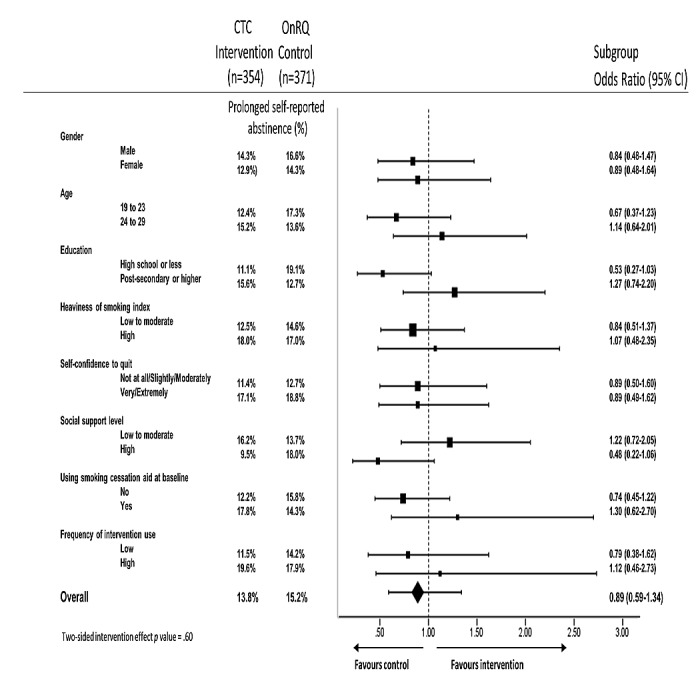
Overall follow-up rates were 57.41% (918/1599) and 60.48% (967/1599) at 3 and 6 months, respectively. Moreover, 45.34% (725/1599) of participants completed baseline, 3-, and 6-month follow-up. Intention-to-treat analysis (last observation carried forward) showed that continuous abstinence (N=1599) at 6 months was not significantly different at 7.8% (64/820) for CTC versus 9.2% (72/779) for OnRQ (odds ratio; OR 0.83, 95% CI 0.59-1.18). Similarly, 30-day point prevalence abstinence at 6 months was not significantly different at 14.4% (118/820) and 16.9% (132/779) for CTC and OnRQ, respectively (OR 0.82, 95% CI 0.63-1.08). However, these rates of abstinence were favorable compared with unassisted 30-day quit rates of 11.5% among young adults. Secondary measures of quit attempts and the number of cigarettes smoked per day at 6-month follow-up did not reveal any significant differences between groups. For those who completed the 6-month follow-up, 85.1% (359/422) of young adult smokers downloaded CTC as compared with 81.8% (346/423) of OnRQ, χ=1.6, P=.23. Furthermore, OnRQ participants reported significantly higher levels of overall satisfaction (mean 3.3 [SD 1.1] vs mean 2.6 [SD 1.3]; t=6.87, P<.001), perceived helpfulness (mean 5.8 [SD 2.4] vs mean 4.3 [SD 2.6], t=8.0, P<.001), and frequency of use (mean 3.6 [SD 1.2] vs mean 3.2 [SD 1.1], t=5.7, P<.001) compared with CTC participants.
CTC was feasible for delivering cessation support but was not superior to a self-help guide in helping motivated young adults to quit smoking. CTC will benefit from further formative research to address satisfaction and usage. As smartphone apps may not serve as useful alternatives to printed self-help guides, there is a need to conduct further research to understand how digital mobile technology smoking cessation interventions for smoking cessation can be improved.
ClinicalTrials.gov NCT01983150; http://clinicaltrials.gov/ct2/show/NCT01983150 (Archived by WebCite at http://www.webcitation.org/6VGyc0W0i).
数字移动技术为向年轻人提供戒烟干预措施提供了一个有前景的媒介,因为他们是这项技术的重度使用者。
本研究的目的是确定一款基于循证的戒烟智能手机应用程序“粉碎渴望”(CTC)与基于循证的自助指南“戒烟之路”(OnRQ)相比,在降低年轻成年吸烟者吸烟率方面的疗效。
在加拿大进行了一项双臂平行、双盲、随机对照试验以评估CTC。总共1599名打算在未来30天内戒烟的年轻成年吸烟者(年龄19至29岁)通过网络招募,并随机分为接受CTC或对照条件OnRQ,为期6个月。主要结局指标是在6个月随访时自我报告的持续戒烟情况。
3个月和6个月时的总体随访率分别为57.41%(918/1599)和60.48%(967/1599)。此外,45.34%(725/1599)的参与者完成了基线、3个月和6个月的随访。意向性分析(末次观察结转)显示,6个月时的持续戒烟率(N = 1599)在CTC组为7.8%(64/820),OnRQ组为9.2%(72/779),差异无统计学意义(优势比;OR 0.83,95%CI 0.59 - 1.18)。同样,6个月时30天的点患病率戒烟率在CTC组和OnRQ组分别为14.4%(118/820)和16.9%(132/779),差异无统计学意义(OR 0.82,95%CI 0.63 - 1.08)。然而,与年轻人11.5%的无辅助30天戒烟率相比,这些戒烟率是有利的。6个月随访时的戒烟尝试次要指标和每日吸烟支数在两组之间未显示出任何显著差异。对于完成6个月随访的人,85.1%(359/422)的年轻成年吸烟者下载了CTC,而OnRQ组为81.8%(346/423),χ = 1.6,P = 0.23。此外,OnRQ参与者报告的总体满意度(均值3.3[标准差1.1]对均值2.6[标准差1.3];t = 6.87,P < 0.001)、感知帮助程度(均值5.8[标准差2.4]对均值4.3[标准差2.6],t = 8.0,P < 0.001)和使用频率(均值3.6[标准差1.2]对均值3.2[标准差1.1],t = 5.7,P < 0.001)均显著高于CTC参与者。
CTC在提供戒烟支持方面是可行的,但在帮助有戒烟意愿的年轻成年人戒烟方面并不优于自助指南。CTC将受益于进一步的形成性研究以解决满意度和使用问题。由于智能手机应用程序可能无法作为印刷自助指南的有效替代方案,因此有必要进行进一步研究以了解如何改进用于戒烟的数字移动技术戒烟干预措施。
ClinicalTrials.gov NCT01983150;http://clinicaltrials.gov/ct2/show/NCT01983150(由WebCite存档于http://www.webcitation.org/6VGyc0W0i)。