ImFINE Research Group, Department of Health and Human Performance, Faculty of Physical Activity and Sport Science (INEF), Universidad Politécnica de Madrid, Madrid, Spain.
Clinical Laboratory Unit, Department of Sport and Health, Spanish Agency for Health Protection in Sport (AEPSAD), Madrid, Spain.
PLoS One. 2018 Oct 24;13(10):e0206307. doi: 10.1371/journal.pone.0206307. eCollection 2018.
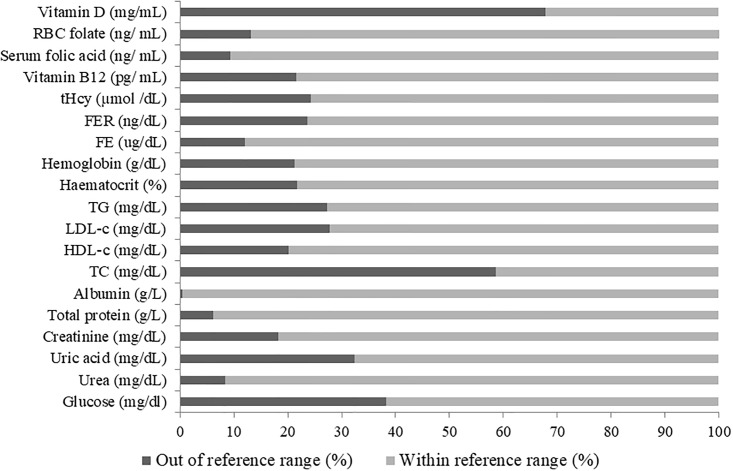
Biomarkers have been postulated as essential variables to measure the effects of exercise on the human body. To investigate the relationship between physical fitness (PF) and blood biomarkers that are associated with disease risk in Spanish older adults, four hundred and twenty-nine adults (57% females) aged older than 55 years from a cross-sectional study were included. A battery of PF test was performed, and participants were divided into 3 groups: low, medium and high fitness. Blood samples were collected, and subjects were also grouped based on a particular biomarker being within its reference range. Furthermore, drug intake and dietary intake were considered for each participant. Higher concentrations out of the reference range were observed for vitamin 25(OH)D (67.9%) and total cholesterol (TC) (58.6%). Participants from the low PF group presented lower significant concentrations out of the reference range for vitamin B12 and triglycerides; however, participants in the low PF group showed higher significant concentrations out of the reference range for total homocysteine, creatinine, TC, HDL-cholesterol and LDL-cholesterol (LDL-c) than those in the high PF group (all p<0.05). Considering drugs related to blood lipid modifications, subjects who regularly consumed lipid reducers presented higher significant concentrations out of the reference range for TC and LDL-c than participants who did not take these drugs (p<0.01). Participants from the high PF group presented better blood marker profiles, namely, lower blood markers related to disease risk out of the reference range. These blood markers could be used as a routine method for considering PF groups in older adults.
生物标志物被认为是衡量运动对人体影响的重要变量。为了研究身体适应性(PF)与与西班牙老年人疾病风险相关的血液生物标志物之间的关系,从一项横断面研究中纳入了 429 名年龄在 55 岁以上的成年人(57%为女性)。进行了一系列的 PF 测试,并将参与者分为 3 组:低、中、高适应性。采集了血液样本,并根据特定生物标志物在参考范围内的情况对参与者进行分组。此外,还考虑了每位参与者的药物摄入和饮食摄入情况。维生素 25(OH)D(67.9%)和总胆固醇(TC)(58.6%)的检测值超出参考范围的情况更高。低 PF 组的参与者维生素 B12 和甘油三酯的检测值低于参考范围的显著值;然而,低 PF 组的参与者总同型半胱氨酸、肌酐、TC、高密度脂蛋白胆固醇(HDL-cholesterol)和低密度脂蛋白胆固醇(LDL-c)的检测值超出参考范围的显著值高于高 PF 组(均 p<0.05)。考虑与血脂调节相关的药物,经常服用降脂药物的受试者 TC 和 LDL-c 的检测值超出参考范围的显著值高于未服用这些药物的受试者(p<0.01)。高 PF 组的参与者呈现出更好的血液标志物谱,即,与疾病风险相关的血液标志物在参考范围内的检测值更低。这些血液标志物可以作为考虑老年人 PF 组的常规方法。