de Rezende Barbosa Marianne P C, Júnior Jayme Netto, Cassemiro Bruna M, Bernardo Aline Fernanda B, França da Silva Anne K, Vanderlei Franciele M, Pastre Carlos Marcelo, Vanderlei Luiz Carlos M
Physiotherapy Department, University of Estadual Paulista, Presidente Prudente, SP 19060-900, Brazil.
Laboratory of Stress Physiology, Physiotherapy Department, University of Estadual Paulista, Presidente Prudente, SP 19060-900, Brazil.
J Sport Health Sci. 2016 Jun;5(2):183-189. doi: 10.1016/j.jshs.2014.12.007. Epub 2015 Apr 23.
Geometric methods provide an analysis of autonomic modulation using the geometric properties of the resulting pattern, and represent an interesting tool in the analysis of heart rate variability (HRV). The aim of this study was to evaluate the impact of functional training on cardiac autonomic modulation in healthy young women using the geometric indices of HRV.
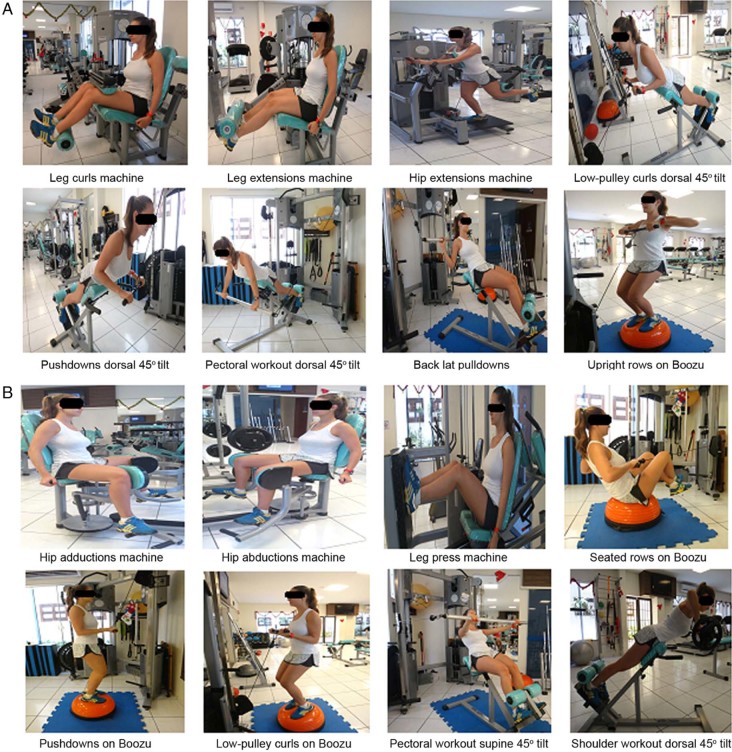
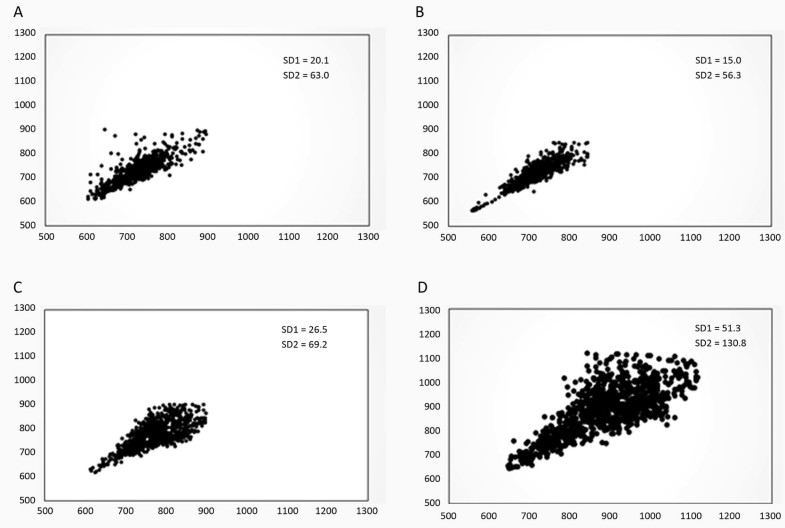
Data were analyzed from 29 women, and were stratified into a functional training group (FTG, = 13; 23.00 ± 2.51 years; 21.90 ± 2.82 kg/m) and a control group (CG, = 16; 20.56 ± 1.03 years; 22.12 ± 3.86 kg/m). The FTG received periodized functional training for 12 weeks. The cardiac autonomic modulation of both groups was evaluated before and after this training, and a qualitative analysis was performed using the Poincaré plot.
There was a significant increase in the difference of the triangular index (RRTri), SD1, SD2, and RR intervals in the FTG as compared to the CG, and the qualitative analysis from the Poincaré plot showed an increase in the dispersion of beat-to-beat and long-term RR intervals in the functional group after training. No changes were observed in the triangular interpolation of RR interval histogram (TINN) or SD1/SD2.
Functional training had a beneficial impact on autonomic modulation, as characterized by increased parasympathetic activity and overall variability, thus highlighting the clinical usefulness of this type of training.
几何方法利用所得模式的几何特性对自主神经调制进行分析,是心率变异性(HRV)分析中一种有趣的工具。本研究旨在使用HRV的几何指标评估功能训练对健康年轻女性心脏自主神经调制的影响。
分析了29名女性的数据,并将其分为功能训练组(FTG,n = 13;23.00 ± 2.51岁;21.90 ± 2.82 kg/m²)和对照组(CG,n = 16;20.56 ± 1.03岁;22.12 ± 3.86 kg/m²)。FTG接受了为期12周的周期性功能训练。在训练前后评估两组的心脏自主神经调制,并使用庞加莱图进行定性分析。
与CG相比,FTG的三角指数(RRTri)、SD1、SD2和RR间期差异显著增加,庞加莱图的定性分析显示,训练后功能组逐搏和长期RR间期的离散度增加。RR间期直方图的三角插值(TINN)或SD1/SD2未观察到变化。
功能训练对自主神经调制有有益影响,表现为副交感神经活动增加和总体变异性增加,从而突出了这类训练的临床实用性。