Ma Yiming, Guo Zhicheng, Wang Xiaohui
School of Kinesiology, Shanghai University of Sport, Shanghai 200438, China.
J Sport Health Sci. 2017 Dec;6(4):474-481. doi: 10.1016/j.jshs.2015.12.003. Epub 2015 Dec 14.
To investigate the effects of (TT) extracts on muscle mass, muscle damage, and anaerobic performances of trained male boxers and its mechanisms: roles of plasma androgen, insulin growth factor 1 (IGF-1), and IGF-1 binding protein-3 (IGFBP-3).
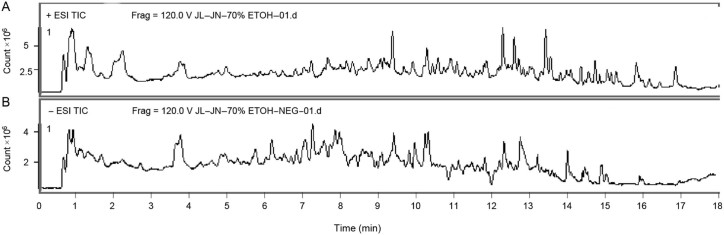
Fifteen male boxers were divided into exercise group (E, = 7) and exercise plus TT group (E + TT, = 8). The 2 groups both undertook 3-week high-intensity and 3-week high-volume trainings separated by a 4-week rest. TT extracts (1250 mg/day) were orally administered by boxers in E + TT group. TT extract compositions were detected by UHPLC-Q-TOF/MS. Before and at the end of the 2 trainings, muscle mass, anaerobic performance, and blood indicators were explored.
Compared with E group, decreases of plasma CK (1591.5 ± 909.6 U/L 2719.9 ± 832.5 U/L) and IGFBP-3 (3075.5 ± 1072.5 ng/mL 3950.8 ± 479.3 ng/mL) as well as increases of mean power (MP, 459.4 ± 122.3 W 434.6 ± 69.5 W) and MP/body weight (MP/BW, 7.5 ± 0.9 W/kg 7.1 ± 1.1 W/kg) were detected in E + TT group after a high-intensity training. For high-volume training, reduction of IGFBP-3 (2946.4 ± 974.1 ng/mL . 3632.7 ± 470.1 ng/mL) and increases of MP (508.7 ± 103.2 W . 477.8 ± 49.9 W) and MP/BW (8.2 ± 0.3 W/kg . 7.5 ± 0.9 W/kg) were detected in E + TT group, compared with E group. Muscle mass, blood levels of testosterone, dihydrotestosterone (DHT), and IGF-1 were not signifiantly changed between the 2 groups.
Taking 1250 mg capsules containing TT extracts did not change muscle mass and plasma levels of testosterone, DHT, and IGF-1 but significantly alleviated muscle damage and promoted anaerobic performance of trained male boxers, which may be related to the decrease of plasma IGFBP-3 rather than androgen in plasma.
研究(TT)提取物对训练有素的男性拳击手肌肉质量、肌肉损伤和无氧运动能力的影响及其机制:血浆雄激素、胰岛素生长因子1(IGF-1)和IGF-1结合蛋白-3(IGFBP-3)的作用。
15名男性拳击手分为运动组(E组,n = 7)和运动加TT组(E + TT组,n = 8)。两组均进行为期3周的高强度训练和为期3周的高运动量训练,中间间隔4周休息。E + TT组的拳击手口服TT提取物(1250毫克/天)。通过超高效液相色谱-四极杆飞行时间质谱联用仪(UHPLC-Q-TOF/MS)检测TT提取物的成分。在两次训练前后,检测肌肉质量、无氧运动能力和血液指标。
与E组相比,高强度训练后,E + TT组血浆肌酸激酶(CK)(1591.5±909.6 U/L对2719.9±832.5 U/L)和IGFBP-3(3075.5±1072.5 ng/mL对3950.8±479.3 ng/mL)降低,平均功率(MP,459.4±122.3 W对434.6±69.5 W)和MP/体重(MP/BW,7.5±0.9 W/kg对7.1±1.1 W/kg)增加。对于高运动量训练,与E组相比,E + TT组IGFBP-3降低(2946.4±974.1 ng/mL对3632.7±470.1 ng/mL),MP(508.7±103.2 W对477.8±49.9 W)和MP/BW(8.2±0.3 W/kg对7.5±0.9 W/kg)增加。两组之间的肌肉质量、血浆睾酮、双氢睾酮(DHT)和IGF-1水平无显著变化。
服用含1250毫克TT提取物的胶囊未改变肌肉质量以及血浆睾酮、DHT和IGF-1水平,但显著减轻了训练有素的男性拳击手的肌肉损伤并提高了其无氧运动能力,这可能与血浆IGFBP-3的降低而非血浆雄激素有关。