Mehrali Mehdi, Bagherifard Sara, Akbari Mohsen, Thakur Ashish, Mirani Bahram, Mehrali Mohammad, Hasany Masoud, Orive Gorka, Das Paramita, Emneus Jenny, Andresen Thomas L, Dolatshahi-Pirouz Alireza
Technical University of Denmark DTU Nanotech Center for Nanomedicine and Theranostics 2800 Kgs Denmark.
Department of Mechanical Engineering Politecnico di Milano 20156 Milan Italy.
Adv Sci (Weinh). 2018 Aug 1;5(10):1700931. doi: 10.1002/advs.201700931. eCollection 2018 Oct.
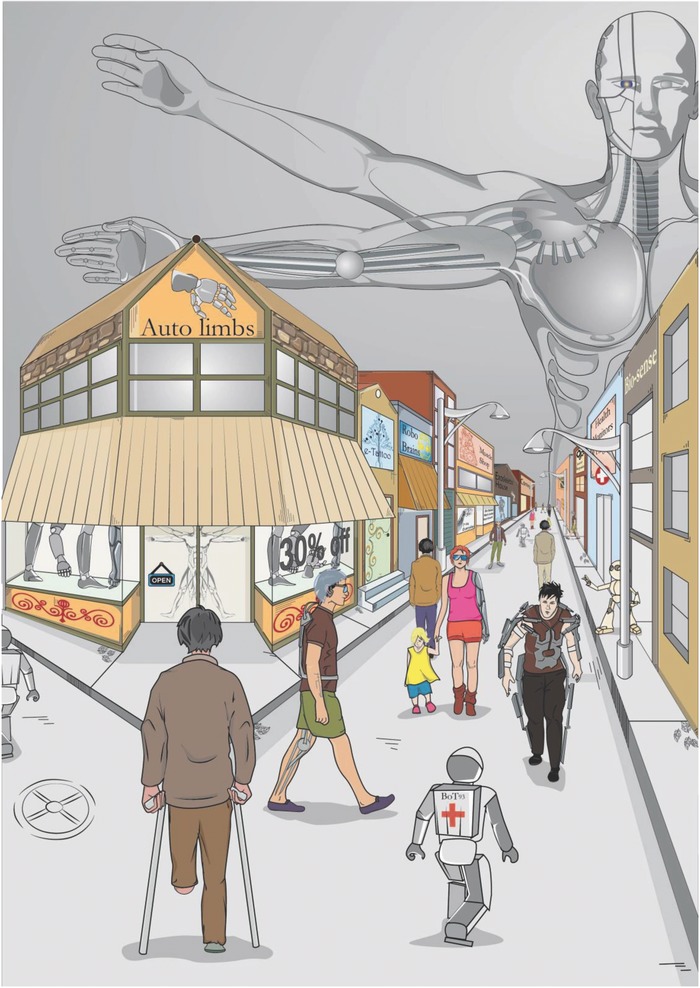
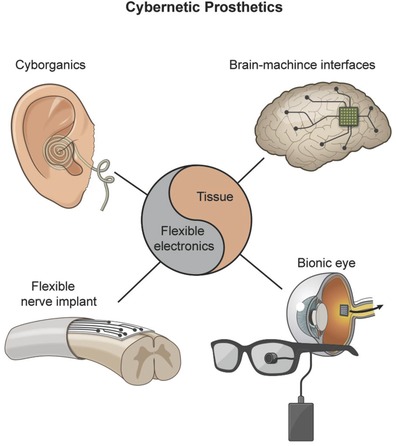
At the crossroads of chemistry, electronics, mechanical engineering, polymer science, biology, tissue engineering, computer science, and materials science, electrical devices are currently being engineered that blend directly within organs and tissues. These sophisticated devices are mediators, recorders, and stimulators of electricity with the capacity to monitor important electrophysiological events, replace disabled body parts, or even stimulate tissues to overcome their current limitations. They are therefore capable of leading humanity forward into the age of cyborgs, a time in which human biology can be hacked at will to yield beings with abilities beyond their natural capabilities. The resulting advances have been made possible by the emergence of conformal and soft electronic materials that can readily integrate with the curvilinear, dynamic, delicate, and flexible human body. This article discusses the recent rapid pace of development in the field of cybernetics with special emphasis on the important role that flexible and electrically active materials have played therein.
在化学、电子学、机械工程、聚合物科学、生物学、组织工程、计算机科学和材料科学的交叉领域,目前正在设计能够直接融入器官和组织的电子设备。这些精密的设备是电的介质、记录器和刺激器,能够监测重要的电生理事件、替代残疾的身体部位,甚至刺激组织克服当前的局限。因此,它们有能力引领人类进入半机械人时代,在这个时代,人类生物学可以被随意改造,从而产生具有超越其自然能力的生物。共形和柔性电子材料的出现使这些进展成为可能,这些材料能够轻松地与曲线形、动态、脆弱且灵活的人体集成。本文讨论了控制论领域最近的快速发展,特别强调了柔性和电活性材料在其中所起的重要作用。