School of Medicine and Surgery, University of Milan-Bicocca, Monza, Italy.
Lung Biology Group, Regenerative Medicine Institute (REMEDI) at CÚRAM Centre for Research in Medical Devices, Biomedical Sciences Building, National University of Ireland Galway, Galway, Ireland.
PLoS One. 2018 Oct 25;13(10):e0206403. doi: 10.1371/journal.pone.0206403. eCollection 2018.
ABO blood type A was reported to correlate with an increased risk of acute respiratory distress syndrome (ARDS) in white patients with severe sepsis and major trauma compared with patients with other blood types. Information regarding ABO phenotypes and major outcomes in patients with ARDS is unavailable. The primary aim was to determine the relationship between ABO blood type A and intensive care unit (ICU) mortality in patients with acute hypoxemic respiratory failure (AHRF). The secondary aim was to describe the association between ABO blood type A and ICU length of stay (LOS) in this study population.
In a multicenter, retrospective cohort study, we collected the clinical records of patients admitted from January 2012 to December 2014 in five ICUs of Northern Italy. We included adult white patients admitted to the ICU who were diagnosed with AHRF requiring mechanical ventilation.
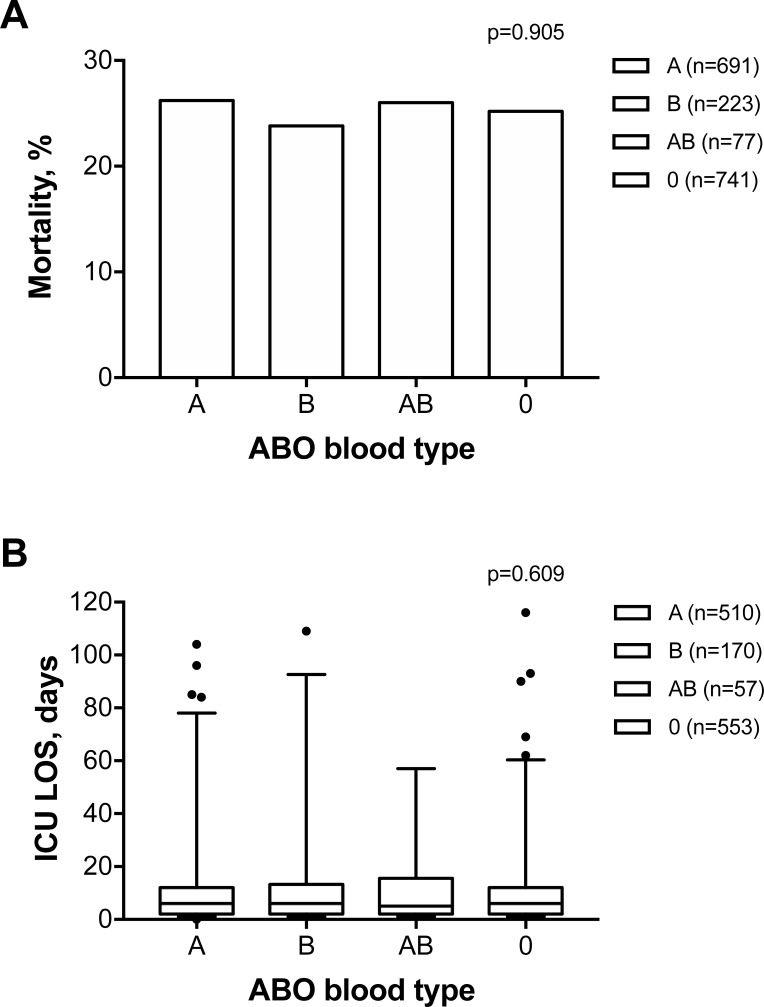
The electronic records of 1732 patients with AHRF were reviewed. The proportion of patients with ABO blood type A versus other blood types was 39.9% versus 60.1%. ICU mortality (25%) and ICU LOS (median [interquartile range], 5 [2-12] days) were not different when stratified by ABO blood type (ICU mortality, overall p value = 0.905; ICU LOS, overall p value = 0.609). SAPSII was a positive predictor of ICU mortality (odds ration [OR], 32.80; 95% confidence interval [CI], 18.80-57.24; p < 0.001) and ICU LOS (β coefficient, 0.55; 95% CI, 0.35-0.75; p < 0.001) at multivariate analyses, whereas ABO blood type did not predict ICU outcome when forced into the model.
ABO blood type did not correlate with ICU mortality and ICU LOS in adult patients with AHRF who were mechanically ventilated.
与其他血型相比,ABO 血型 A 与严重脓毒症和重大创伤的白人患者的急性呼吸窘迫综合征(ARDS)风险增加相关。目前尚无关于 ARDS 患者 ABO 表型和主要结局的信息。主要目的是确定 ABO 血型 A 与急性低氧性呼吸衰竭(AHRF)患者的重症监护病房(ICU)死亡率之间的关系。次要目的是在该研究人群中描述 ABO 血型 A 与 ICU 住院时间(LOS)之间的关系。
在一项多中心回顾性队列研究中,我们收集了 2012 年 1 月至 2014 年 12 月期间意大利北部 5 个 ICU 收治的成人白人患者的临床记录。我们纳入了因 AHRF 而入住 ICU 并需要机械通气的成年白人患者。
共回顾了 1732 例 AHRF 患者的电子病历。ABO 血型 A 患者与其他血型患者的比例分别为 39.9%和 60.1%。按 ABO 血型分层,ICU 死亡率(25%)和 ICU LOS(中位数[四分位间距],5[2-12]天)无差异(ICU 死亡率,总体 p 值=0.905;ICU LOS,总体 p 值=0.609)。SAPSII 是 ICU 死亡率的阳性预测因子(比值比[OR],32.80;95%置信区间[CI],18.80-57.24;p<0.001)和 ICU LOS(β系数,0.55;95%CI,0.35-0.75;p<0.001),而 ABO 血型在多变量分析中并未预测 ICU 结局。
在接受机械通气的 AHRF 成年患者中,ABO 血型与 ICU 死亡率和 ICU LOS 无关。