Netherlands Food and Consumer Product Safety Authority, Directorate Enforcement, Laboratories division, Laboratory for Feed and Food Safety & Product Safety, Wageningen, the Netherlands.
PLoS One. 2018 Oct 25;13(10):e0206316. doi: 10.1371/journal.pone.0206316. eCollection 2018.
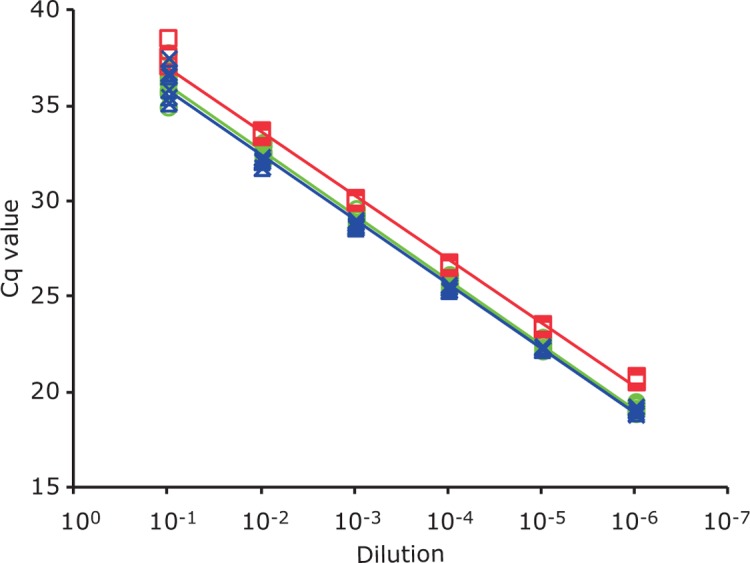
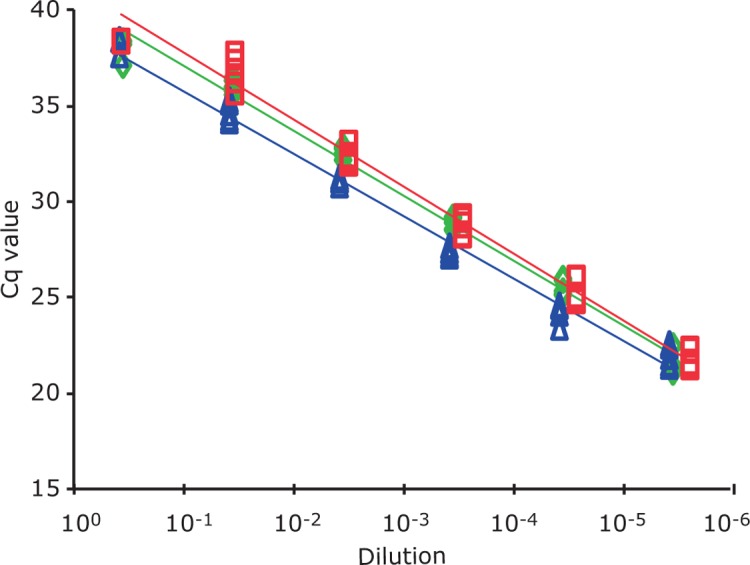
A multiplex quantitative PCR (qPCR) was developed and evaluated for the simultaneous detection of Salmonella spp., S. enterica serovar Typhimurium and S. enterica serovar Enteritidis in various (food) matrices. Early and fast detection of these pathogens facilitates effective intervention and prevents further distribution of contaminated food products on the market. Three primer and probe sets were designed to target the invA gene, the STM4200 gene, and the SEN1392 gene to detect and differentiate Salmonella spp., S. Typhimurium, and S. Enteritidis, respectively. The multiplex qPCR targeting these three genes was optimized for efficiency and linearity. By testing 225 Salmonella isolates and 34 non-Salmonella isolates from various sources the inclusivity and exclusivity were determined. The inclusivity of the multiplex qPCR was 100% for all Salmonella isolates, including 72 S. Typhimurium isolates, and 53 S. Enteritidis isolates. The exclusivity for Salmonella spp., S. Typhimurium, and S. Enteritidis was 100%, 94.6%, and 100%, respectively. No positive results were reported for non-Salmonella isolates. The limit of detection (LOD) for the qPCR was determined for the matrices poultry, minced meat, egg, herbs/spices, powdered milk, fish, animal feed, boot-socks with chicken feces and chicken down. LOD values for qPCR and the conventional culture methods were similar, except for the matrix boot-socks and down, for which the LOD for the conventional culture methods performed better than the qPCR method. In conclusion, the multiplex qPCR assay developed allows for rapid screening of Salmonella spp., S. Typhimurium, and S. Enteritidis in various (food) matrices.
建立并评估了一种多重实时荧光定量 PCR(qPCR)方法,用于同时检测各种(食品)基质中的沙门氏菌、肠炎沙门氏菌血清型 Typhimurium 和肠炎沙门氏菌血清型 Enteritidis。早期和快速检测这些病原体有助于有效干预,并防止受污染的食品产品在市场上进一步传播。设计了三套引物和探针组,以靶向 invA 基因、STM4200 基因和 SEN1392 基因,分别用于检测和区分沙门氏菌、肠炎沙门氏菌血清型 Typhimurium 和肠炎沙门氏菌血清型 Enteritidis。针对这三个基因的多重 qPCR 进行了优化,以提高效率和线性度。通过测试来自不同来源的 225 株沙门氏菌分离株和 34 株非沙门氏菌分离株,确定了包容性和排他性。该多重 qPCR 对所有沙门氏菌分离株的包容性为 100%,包括 72 株肠炎沙门氏菌血清型 Typhimurium 分离株和 53 株肠炎沙门氏菌血清型 Enteritidis 分离株。沙门氏菌、肠炎沙门氏菌血清型 Typhimurium 和肠炎沙门氏菌血清型 Enteritidis 的排他性分别为 100%、94.6%和 100%。非沙门氏菌分离株未报告阳性结果。该 qPCR 的检测限(LOD)在禽肉、肉末、鸡蛋、草药/香料、奶粉、鱼、动物饲料、鸡粪和鸡毛靴以及鸡毛等基质中进行了测定。qPCR 和传统培养方法的 LOD 值相似,除了基质靴和鸡毛,传统培养方法的 LOD 值优于 qPCR 方法。总之,开发的多重 qPCR 检测方法可用于快速筛查各种(食品)基质中的沙门氏菌、肠炎沙门氏菌血清型 Typhimurium 和肠炎沙门氏菌血清型 Enteritidis。