Iannaccone Marco, Elgendy Ramy, Giantin Mery, Martino Camillo, Giansante Daniele, Ianni Andrea, Dacasto Mauro, Martino Giuseppe
Faculty of Bioscience and Technology for Food, Agriculture, and Environment, University of Teramo, Via R. Balzarini 1, 64100 Teramo, Italy.
Department of Comparative Biomedicine and Food Science, University of Padua, viale dell'Università 16, 35020 Legnaro (Padua), Italy.
Animals (Basel). 2018 Oct 23;8(11):188. doi: 10.3390/ani8110188.
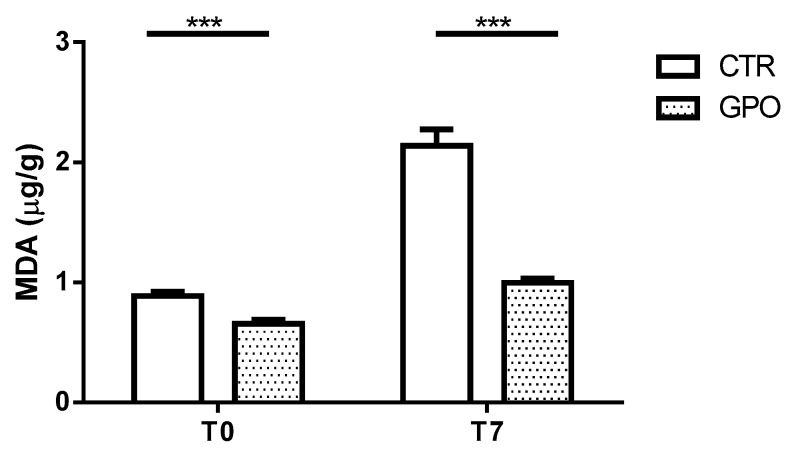
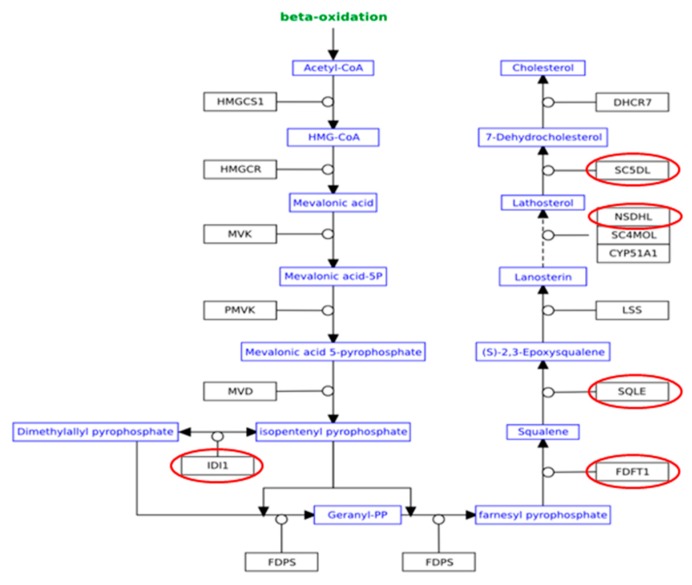
Grape pomace (GPO), the main by-product of the wine making process, is a rich source of polyphenols with potent antioxidant properties. Recently, GPO has emerged as a potential feed additive in livestock nutrition, with several reports describing its beneficial effects on animals' overall health status or production traits. However, little is known about it from a molecular biology standpoint. In the present study, we report the first RNA sequencing-based whole-transcriptome profiling of Friesian calves fed with a GPO-supplemented diet. We identified 367 differentially expressed genes ( < 0.05) in the GPO-supplemented calves ( = 5), when compared with unsupplemented control group ( = 5). The pathway analysis showed that 'cholesterol lipid biosynthesis' was the most negatively-enriched ( < 0.001) pathway in the GPO-supplemented animals. In specific terms, five important genes coding for cholesterol biosynthesis enzymes, namely the Farnesyl-diphosphate Farnesyltransferase 1 (FDFT-1), Squalene Epoxidase (SQLE), NAD(P)-dependent Steroid Dehydrogenase-like (NSDHL), Methylsterol Monooxygenase (MSMO)-1, and Sterol-C5-desaturase (SC5D), two major transcription factors (the Sterol Regulatory Element-binding Transcription Factor 1 and 2), as well as the Low-Density Lipoprotein Receptor (LDLR), were all downregulated following GPO supplementation. Such an effect was mirrored by a reduction of blood cholesterol levels ( = 0.07) and a lowered ( < 0.001) Malondialdehyde (lipid oxidation marker) level in carcasses. We provide evidence on the effects of GPO-supplemented diets on the whole-transcriptome signature in veal calves, which mainly reflects an antioxidant activity.
葡萄皮渣(GPO)是酿酒过程的主要副产品,富含具有强大抗氧化特性的多酚。最近,GPO已成为家畜营养中一种潜在的饲料添加剂,有几份报告描述了其对动物整体健康状况或生产性能的有益影响。然而,从分子生物学角度对其了解甚少。在本研究中,我们报告了首次对喂食添加GPO日粮的弗里斯兰犊牛进行基于RNA测序的全转录组分析。与未添加GPO的对照组(n = 5)相比,我们在添加GPO的犊牛(n = 5)中鉴定出367个差异表达基因(P < 0.05)。通路分析表明,“胆固醇脂质生物合成”是添加GPO的动物中负富集程度最高(P < 0.001)的通路。具体而言,编码胆固醇生物合成酶的五个重要基因,即法尼基二磷酸法尼基转移酶1(FDFT - 1)、鲨烯环氧酶(SQLE)、NAD(P) - 依赖性类固醇脱氢酶样蛋白(NSDHL)、甲基甾醇单加氧酶(MSMO)- 1和甾醇 - C5 - 去饱和酶(SC5D),两个主要转录因子(甾醇调节元件结合转录因子1和2),以及低密度脂蛋白受体(LDLR),在添加GPO后均下调。这种效应反映在血液胆固醇水平降低(P = 0.07)和胴体中丙二醛(脂质氧化标志物)水平降低(P < 0.001)。我们提供了关于添加GPO日粮对犊牛全转录组特征影响的证据,这主要反映了一种抗氧化活性。