Min Kyoungmin, Choi Byungjin, Park Kwangjin, Cho Eunseog
Platform Technology Lab, Samsung Advanced Institute of Technology, 130 Samsung-ro, Suwon, Gyeonggi-do, 16678, Republic of Korea.
Energy Lab, Samsung Advanced Institute of Technology, 130 Samsung-ro, Suwon, Gyeonggi-do, 16678, Republic of Korea.
Sci Rep. 2018 Oct 25;8(1):15778. doi: 10.1038/s41598-018-34201-4.
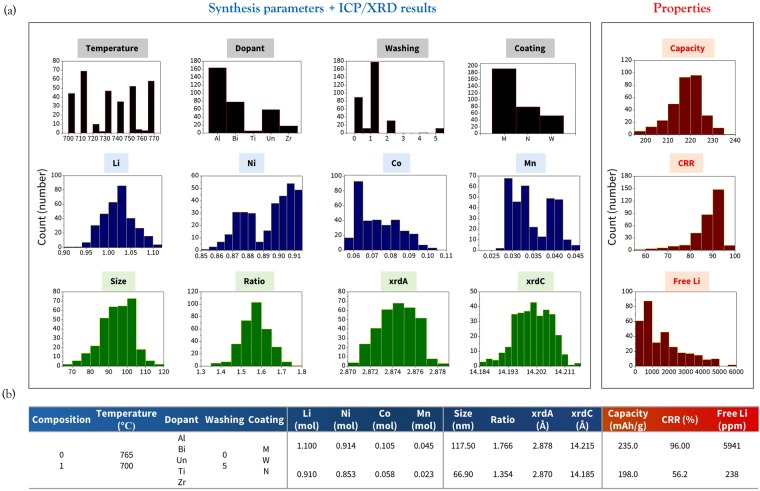
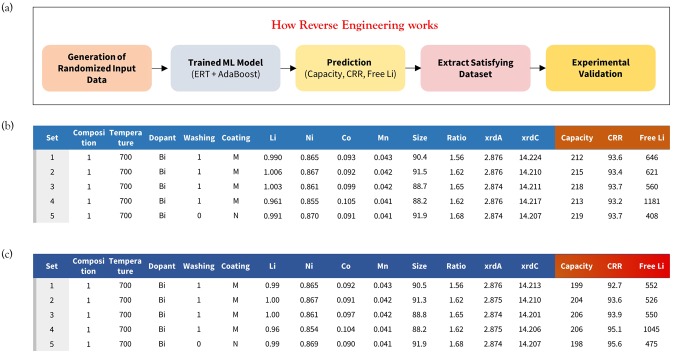
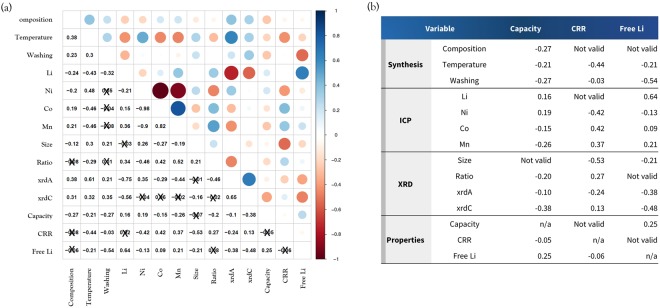
Optimizing synthesis parameters is the key to successfully design ideal Ni-rich cathode materials that satisfy principal electrochemical specifications. We herein implement machine learning algorithms using 330 experimental datasets, obtained from a controlled environment for reliability, to construct a predictive model. First, correlation values showed that the calcination temperature and the size of the particles are determining factors for achieving a long cycle life. Then, we compared the accuracy of seven different machine learning algorithms for predicting the initial capacity, capacity retention rate, and amount of residual Li. Remarkable predictive capability was obtained with the average value of coefficient of determinant, R = 0.833, from the extremely randomized tree with adaptive boosting algorithm. Furthermore, we propose a reverse engineering framework to search for experimental parameters that satisfy the target electrochemical specification. The proposed results were validated by experiments. The current results demonstrate that machine learning has great potential to accelerate the optimization process for the commercialization of cathode materials.
优化合成参数是成功设计出满足主要电化学规格的理想富镍阴极材料的关键。我们在此使用从可控环境中获得的330个实验数据集(为确保可靠性)实施机器学习算法,以构建预测模型。首先,相关性值表明煅烧温度和颗粒尺寸是实现长循环寿命的决定因素。然后,我们比较了七种不同机器学习算法预测初始容量、容量保持率和残余锂含量的准确性。通过使用自适应增强算法的极端随机树,得到了显著的预测能力,决定系数R的平均值为0.833。此外,我们提出了一个逆向工程框架,以寻找满足目标电化学规格的实验参数。所提出的结果通过实验得到了验证。当前结果表明,机器学习在加速阴极材料商业化的优化过程方面具有巨大潜力。