Institute of Immunology, Centre for Biomedical Education and Research (ZBAF), School of Medicine, Faculty of Health, Witten/Herdecke University, Witten, Germany.
Department of Prosthodontics, School of Dentistry, Faculty of Health, Witten/Herdecke University, Witten, Germany.
PLoS One. 2018 Oct 26;13(10):e0202352. doi: 10.1371/journal.pone.0202352. eCollection 2018.
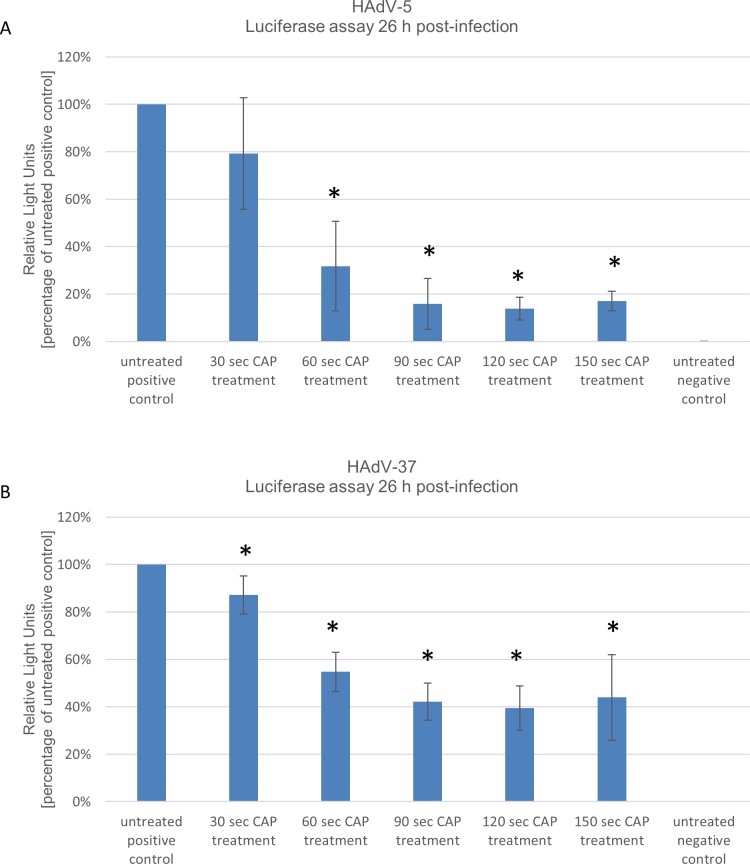
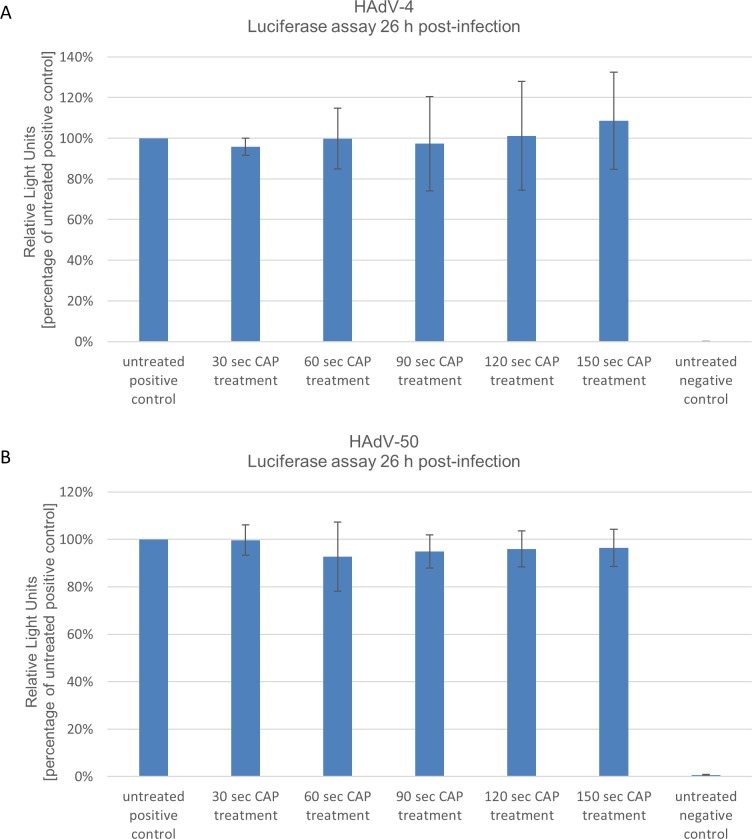
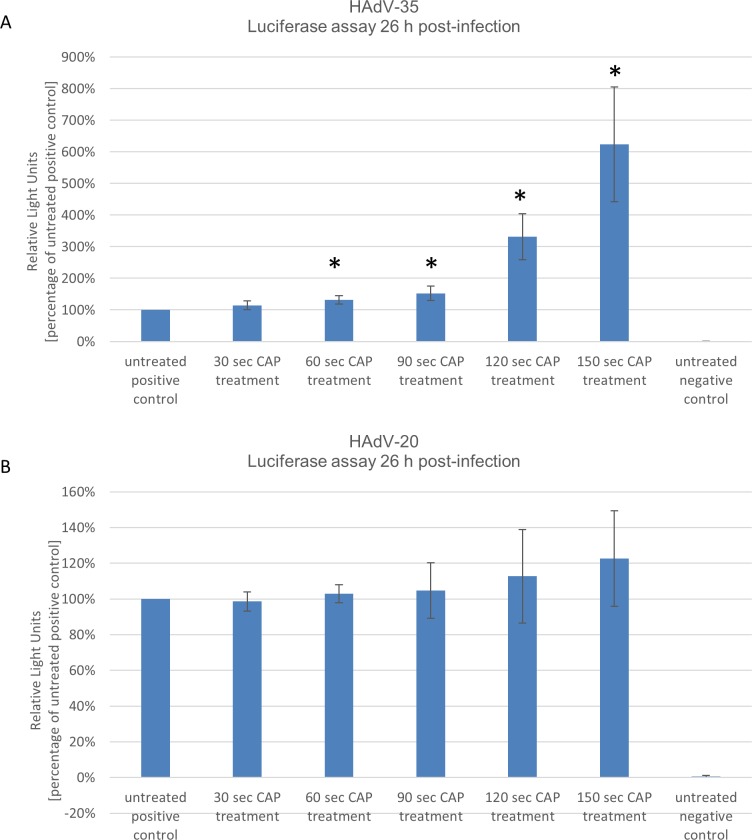
More than 70 human adenovirus types were identified divided into 7 different species (A-G). Diseases caused by human adenoviruses are type-dependent and can range from mild to severe respiratory infections, gastrointestinal infections or eye infections such as epidemic keratoconjunctivitis. Unfortunately there is no specific anti-adenovirus therapy available. Here we addressed the question whether treatment with cold atmospheric plasma (CAP) for anti-adenoviral therapy such as virus-mediated ulcerations may be feasible. CAP has already been explored for the treatment of dermatological diseases such as chronic wounds. To investigate whether CAP is an effective antiviral tool, purified human adenovirus types derived from different human adenovirus species (HAdV -4, -5, -20, -35, -37, -50) tagged with luciferase were treated with defined dosages of plasma. The CAP treatment was varied by incrementally increasing the time span of CAP treatment. After CAP treatment, the virus containing solution was added to eukaryotic cells and the viral load was determined by measurement of luciferase expression levels. Through the plasma treatment the adenovirus driven luciferase expression directly correlating with adenovirus transduction efficiencies could be reduced for HAdV-5 and HAdV-37. Plasma treatment had no influence on adenovirus derived luciferase expression levels for HAdV-4 and HAdV-50 and it even had a positive effect on luciferase expression levels for HAdV-20 and HAdV-35. These results suggest that CAP has a type dependent effect on adenoviruses and that infectivity can be even increased for certain adenovirus types. Further studies should address the mechanisms behind this phenomenon. In summary we demonstrate that CAP may represent an interesting option for antiviral treatment in a virus type dependent manner.
已鉴定出超过 70 种人类腺病毒类型,分为 7 个不同的种(A-G)。人类腺病毒引起的疾病取决于病毒类型,范围从轻度到重度呼吸道感染、胃肠道感染或眼部感染,如流行性角膜结膜炎。不幸的是,目前尚无针对腺病毒的特效治疗方法。在这里,我们探讨了使用冷等离子体(CAP)治疗腺病毒介导的溃疡等抗病毒治疗是否可行的问题。CAP 已被探索用于治疗皮肤病,如慢性伤口。为了研究 CAP 是否是一种有效的抗病毒工具,我们用荧光素酶标记了来自不同人类腺病毒种(HAdV-4、-5、-20、-35、-37、-50)的纯化人类腺病毒,并用不同剂量的等离子体进行处理。通过逐步增加 CAP 处理时间来改变 CAP 处理。CAP 处理后,将含有病毒的溶液添加到真核细胞中,并通过测量荧光素酶表达水平来确定病毒载量。通过等离子体处理,与腺病毒转导效率直接相关的腺病毒驱动的荧光素酶表达可以降低 HAdV-5 和 HAdV-37 的表达。对于 HAdV-4 和 HAdV-50,等离子体处理对腺病毒衍生的荧光素酶表达水平没有影响,甚至对 HAdV-20 和 HAdV-35 的荧光素酶表达水平有积极影响。这些结果表明,CAP 对腺病毒具有依赖于病毒类型的作用,并且某些腺病毒类型的感染性甚至可以增强。进一步的研究应该探讨这种现象背后的机制。总之,我们证明 CAP 可能是一种具有病毒类型依赖性的抗病毒治疗的有趣选择。