Department of Pediatrics, Dalhousie University, IWK Health Centre, Halifax, NS B3K 6R8, Canada.
Department of Pediatrics, Dalhousie University, IWK Health Centre, Halifax, NS B3K 6R8, Canada
Dis Model Mech. 2018 Oct 24;11(10):dmm037515. doi: 10.1242/dmm.037515.
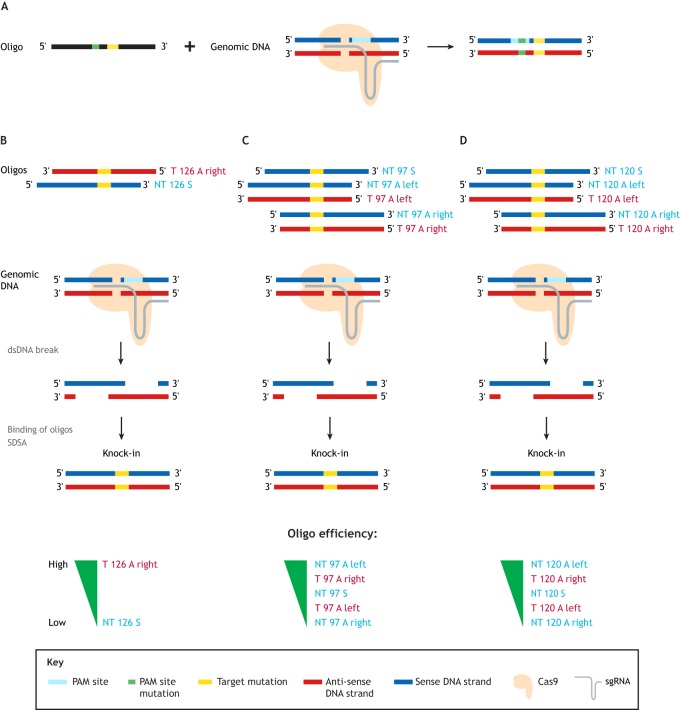
The zebrafish is an increasingly popular model organism for human genetic disease research. CRISPR/Cas9-based approaches are currently used for multiple gene-editing purposes in zebrafish, but few studies have developed reliable ways to introduce precise mutations. Point mutation knock-in using CRISPR/Cas9 and single-stranded oligodeoxynucleotides (ssODNs) is currently the most promising technology for this purpose. Despite some progress in applying this technique to zebrafish, there is still a great need for improvements in terms of its efficiency, optimal design of sgRNA and ssODNs and broader applicability. The papers discussed in this Editorial provide excellent case studies on identifying problems inherent in the mutation knock-in technique, quantifying these issues and proposing strategies to overcome them. These reports also illustrate how the procedures for introducing specific mutations can be straightforward, such that ssODNs with only the target mutation are sufficient for generating the intended knock-in animals. Two of the studies also develop interesting point mutant knock-in models for cardiac diseases, validating the translational relevance of generating knock-in mutations and opening the door to many possibilities for their further study.
斑马鱼是一种越来越受欢迎的人类遗传疾病研究模式生物。基于 CRISPR/Cas9 的方法目前被用于斑马鱼的多种基因编辑目的,但很少有研究开发出可靠的方法来引入精确的突变。使用 CRISPR/Cas9 和单链寡脱氧核苷酸 (ssODN) 的点突变敲入目前是实现这一目的最有前途的技术。尽管在将该技术应用于斑马鱼方面取得了一些进展,但在提高其效率、sgRNA 和 ssODN 的最佳设计以及更广泛的适用性方面仍有很大的改进空间。本期社论中讨论的论文提供了极好的案例研究,这些研究确定了突变敲入技术中固有的问题,对这些问题进行了量化,并提出了克服这些问题的策略。这些报告还说明了如何使引入特定突变的过程变得简单,只需具有目标突变的 ssODN 即可生成预期的敲入动物。其中两项研究还开发了用于心脏疾病的有趣的点突变敲入模型,验证了生成敲入突变的转化相关性,并为进一步研究打开了许多可能性的大门。