Korstjens Amanda H, Lehmann Julia, Dunbar R I M
1Department of Life and Environmental Sciences, Bournemouth University, Poole, BH14 5BB UK.
2Department of Life Sciences, University of Roehampton, London, SW15 5PJ UK.
Int J Primatol. 2018;39(4):511-531. doi: 10.1007/s10764-018-0048-4. Epub 2018 Jul 11.
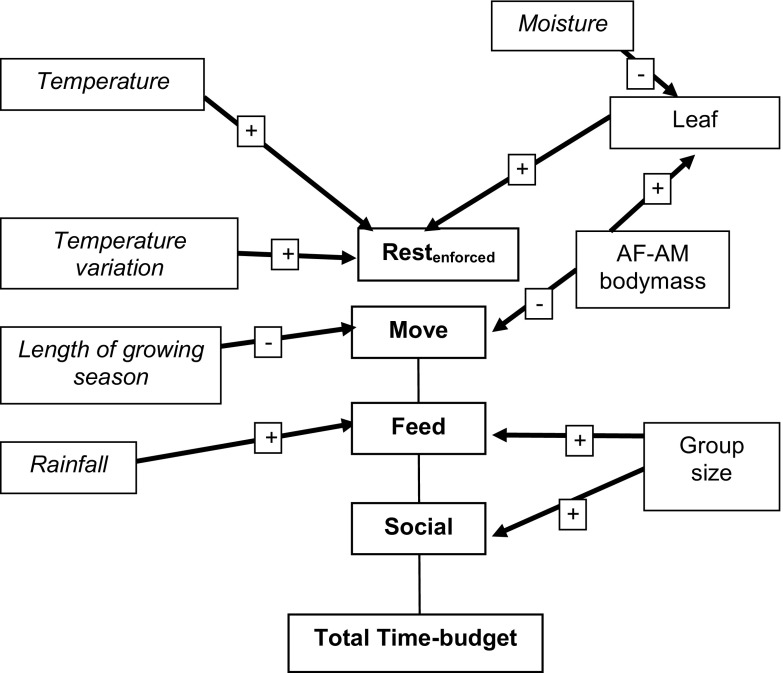
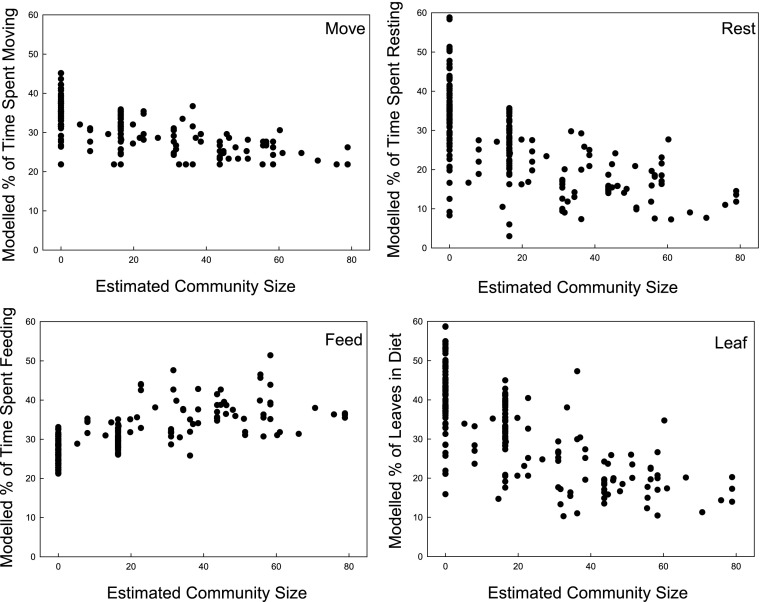
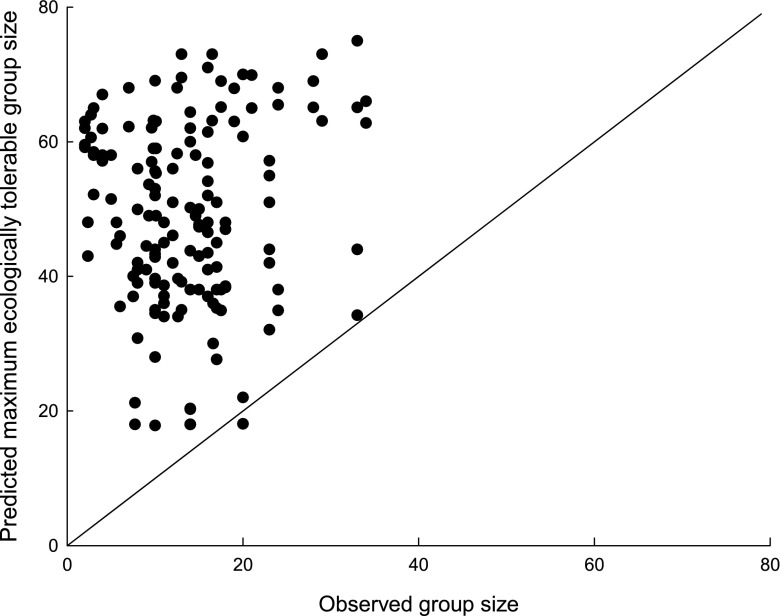
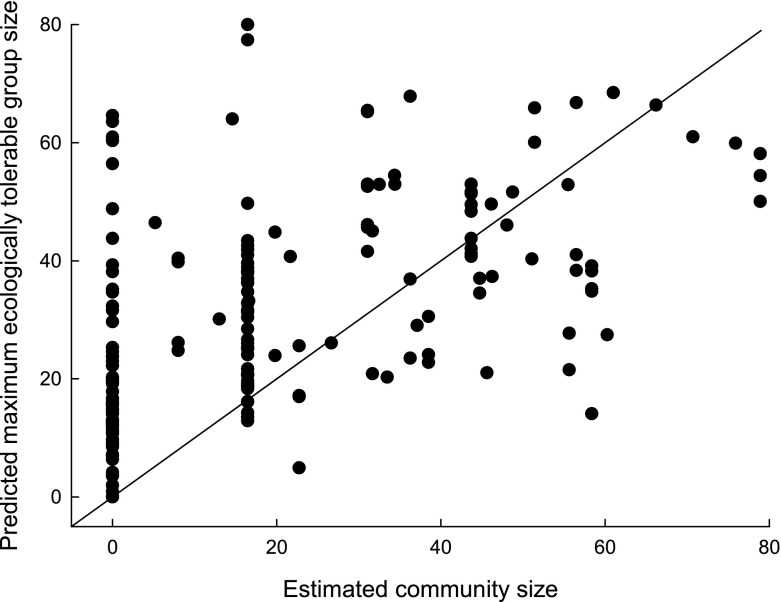
To understand how species will respond to environmental changes, it is important to know how those changes will affect the ecological stress that animals experience. Time constraints can be used as indicators of ecological stress. Here we test whether time constraints can help us understand group sizes, distribution patterns, and community sizes of forest guenons (). Forest guenons typically live in small to medium sized one-male-multifemale groups and often live in communities with multiple forest guenon species. We developed a time-budget model using published data on time budgets, diets, body sizes, climate, and group sizes to predict maximum ecologically tolerable group and community sizes of forest guenons across 202 sub-Saharan African locations. The model correctly predicted presence/absence at 83% of these locations. Feeding-foraging time (an indicator of competition) limited group sizes, while resting and moving time constraints shaped guenon biogeography. Predicted group sizes were greater than observed group sizes but comparable to community sizes, suggesting community sizes are set by competition among guenon individuals irrespective of species. We conclude that time constraints and intraspecific competition are unlikely to be the main determinants of relatively small group sizes in forest guenons. Body mass was negatively correlated with moving time, which may give larger bodied species an advantage over smaller bodied species under future conditions when greater fragmentation of forests is likely to lead to increased moving time. Resting time heavily depended on leaf consumption and is likely to increase under future climatic conditions when leaf quality is expected to decrease.
为了解物种将如何应对环境变化,了解这些变化将如何影响动物所经历的生态压力很重要。时间限制可作为生态压力的指标。在此,我们测试时间限制是否能帮助我们理解森林疣猴的群体大小、分布模式和群落大小。森林疣猴通常生活在小型到中型的单雄多雌群体中,且常与多种森林疣猴物种生活在群落中。我们利用已发表的关于时间分配、饮食、体型、气候和群体大小的数据,开发了一个时间预算模型,以预测撒哈拉以南非洲202个地点的森林疣猴的最大生态可容忍群体和群落大小。该模型在这些地点的83%正确预测了存在/不存在情况。觅食时间(竞争指标)限制了群体大小,而休息和移动时间限制塑造了疣猴生物地理学。预测的群体大小大于观察到的群体大小,但与群落大小相当,这表明群落大小是由疣猴个体间的竞争决定的,而与物种无关。我们得出结论,时间限制和种内竞争不太可能是森林疣猴相对较小群体大小的主要决定因素。体重与移动时间呈负相关,这可能使体型较大的物种在未来条件下比体型较小的物种具有优势,因为那时森林碎片化加剧可能导致移动时间增加。休息时间严重依赖于树叶消耗,并且在未来气候条件下,预计树叶质量下降时可能会增加。