Division of Pulmonary and Critical Care Medicine, Department of Internal Medicine, College of Medicine, Ewha Womans University, Seoul, Republic of Korea.
Medical Research Institute, Kangbuk Samsung Hospital, Sungkyunkwan University, School of Medicine, Seoul, South Korea.
Sci Rep. 2018 Oct 30;8(1):16031. doi: 10.1038/s41598-018-34398-4.
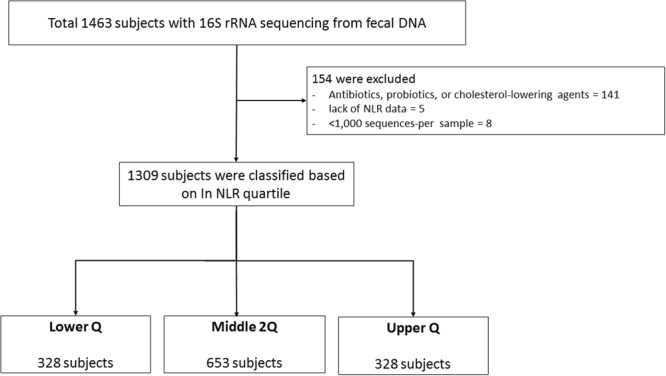
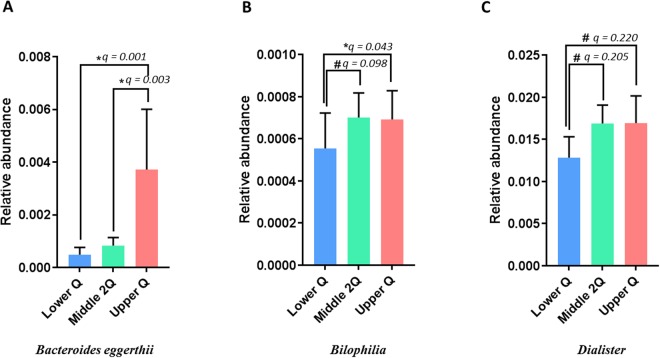
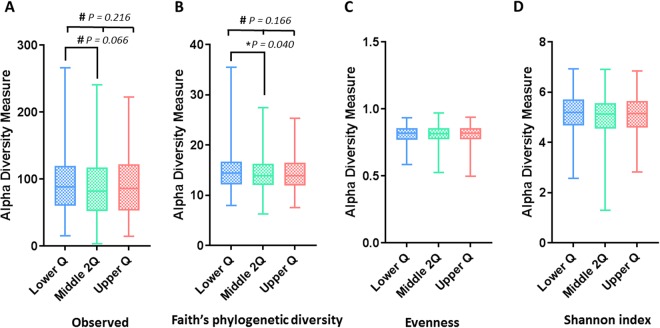
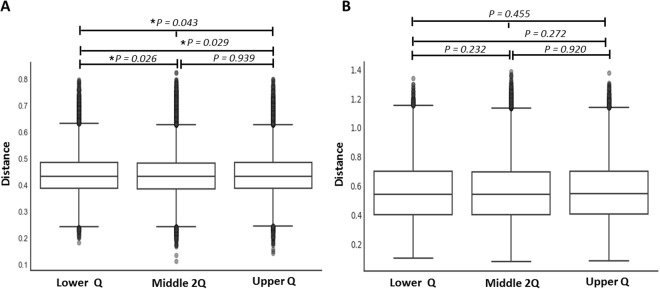
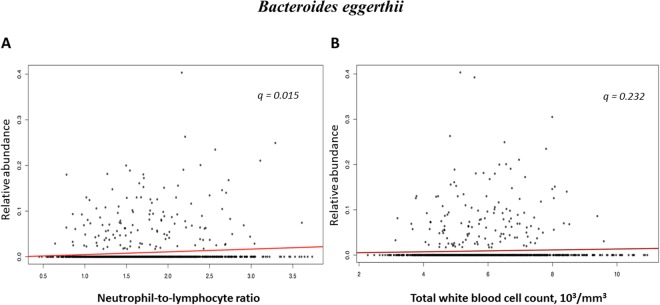
Gut microbiota and blood neutrophil-to-lymphocyte ratio (NLR) are associated with systemic inflammation; however, data on the association between gut microbiota and NLR are lacking. We investigated the association between gut microbiota and NLR. A total of 1,309 subjects who had available data on NLR and 16 S rRNA sequencing of gut microbiota were included in this study. They were grouped according to NLR quartile (Q) as follows: lower Q (n = 328, <25% of NLR range), middle 2Q (n = 653, ≥25% to <75%) and upper Q (n = 328, ≥75%). The diversity and composition of the human gut microbiota in the groups were calculated. The phylogenetic diversity of gut microbiota in the lower group was significantly higher than in the middle 2Q group (P = 0.040). The beta-diversity was significantly different among the three groups (P = 0.043), between the lower and middle 2Q groups (P = 0.029), and between the lower and upper groups (P = 0.026). Bacteroides eggerthii showed a positive correlation with NLR (q = 0.015). The diversity and composition of the gut microbiome were different between the NLR groups. Particularly, patients with a lower NLR had a greater diversity of gut microbiota.
肠道微生物群和血液中性粒细胞与淋巴细胞比值(NLR)与全身炎症有关;然而,关于肠道微生物群与 NLR 之间的关系的数据尚缺乏。我们研究了肠道微生物群与 NLR 之间的关系。共有 1309 名受试者,他们的 NLR 和肠道微生物群 16S rRNA 测序数据可用,根据 NLR 四分位数(Q)将他们分为以下几组:低 Q 组(n=328,<NLR 范围的 25%)、中 2Q 组(n=653,≥25%至<75%)和高 Q 组(n=328,≥75%)。计算各组肠道微生物群的多样性和组成。低 Q 组肠道微生物群的系统发育多样性显著高于中 2Q 组(P=0.040)。三组之间的β多样性有显著差异(P=0.043),低 Q 组与中 2Q 组之间(P=0.029),低 Q 组与高 Q 组之间(P=0.026)。Eggerthii 拟杆菌与 NLR 呈正相关(q=0.015)。NLR 组之间的肠道微生物组的多样性和组成不同。特别是,NLR 较低的患者肠道微生物群多样性更大。