Research Institute of Forest Ecology, Environment and Protection, Chinese Academy of Forestry/Key Laboratory of Forest Ecology and Environment of State Forestry Administration, Haidian, Beijing, China.
Institute of Desertification Studies, Chinese Academy of Forestry, Beijing, China.
Am J Primatol. 2018 Nov;80(11):e22929. doi: 10.1002/ajp.22929.
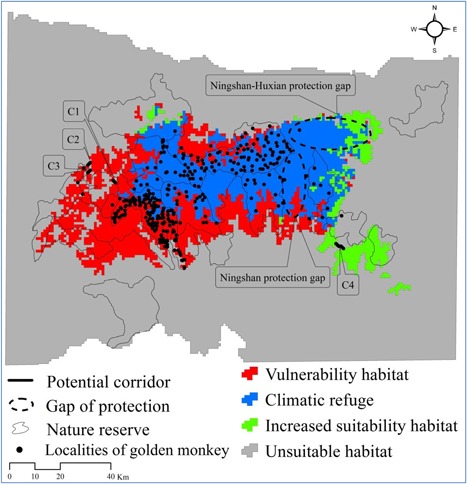
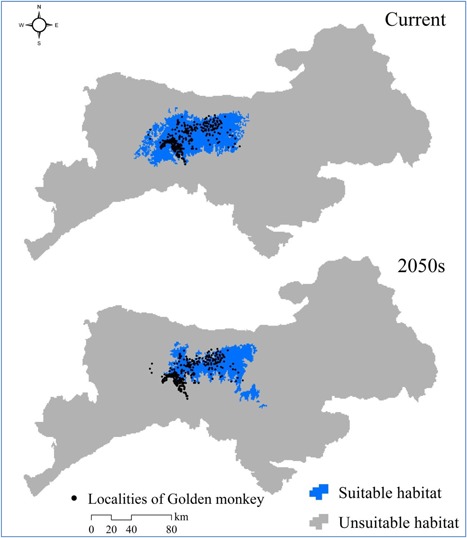
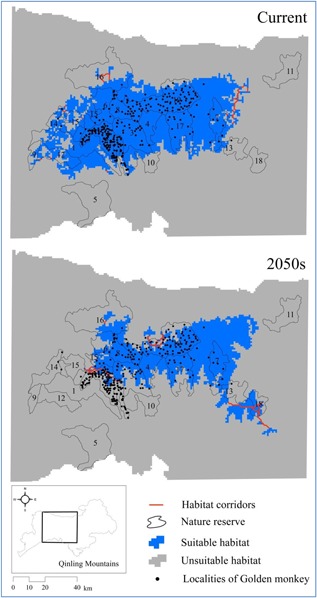
Climate change threatens endangered species and challenges current conservation strategies. Effective conservation requires vulnerability assessments for species susceptible to climate change and adaptive strategies to mitigate threats associated with climate. In this paper, we used the Maxent to model the impacts of climate change on habitat suitability of Sichuan golden monkey Rhinopithecus roxellana. Our results showed that (i) suitable habitat for Sichuan golden monkey was predicted to decrease by 37% in 2050s under climate change; (ii) the mean elevations of suitable habitat in the 2050s was estimated to shift 160 m higher; (iii) nature reserves protect 62% of current suitable habitat and 56% of future suitable habitat; and (iv) 49% of current suitable habitat was predicted to be vulnerable to future climate change. Given these results, we proposed conservation implications to mitigate the impacts of climate change on Sichuan golden monkey, including adjusting range of national park, establishing habitat corridors, and conducting long-term monitoring.
气候变化威胁濒危物种,挑战当前的保护策略。有效的保护需要对易受气候变化影响的物种进行脆弱性评估,并制定适应策略来减轻与气候相关的威胁。在本文中,我们使用 Maxent 模型来模拟气候变化对川金丝猴(Rhinopithecus roxellana)栖息地适宜性的影响。研究结果表明:(i)在未来几十年中,川金丝猴的适宜栖息地预计将减少 37%;(ii)适宜栖息地的平均海拔预计将升高 160 米;(iii)自然保护区保护了 62%的现有适宜栖息地和 56%的未来适宜栖息地;(iv)49%的现有适宜栖息地预计将容易受到未来气候变化的影响。鉴于这些结果,我们提出了保护建议,以减轻气候变化对川金丝猴的影响,包括调整国家公园的范围、建立栖息地走廊和进行长期监测。