Cotin Geoffrey, Kiefer Céline, Perton Francis, Ihiawakrim Dris, Blanco-Andujar Cristina, Moldovan Simona, Lefevre Christophe, Ersen Ovidiu, Pichon Benoit, Mertz Damien, Bégin-Colin Sylvie
Institut de Physique et Chimie des Matériaux de Strasbourg, UMR 7504, University of Strasbourg, CNRS, F-67034 Strasbourg, France.
Labex CSC, Fundation IcFRC/University of Strasbourg, 8 allée Gaspard Monge BP 70028 F, 67083 Strasbourg CEDEX, France.
Nanomaterials (Basel). 2018 Oct 29;8(11):881. doi: 10.3390/nano8110881.
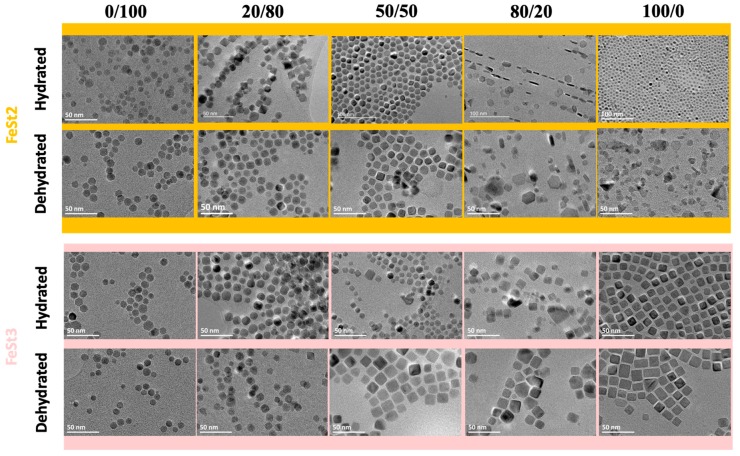
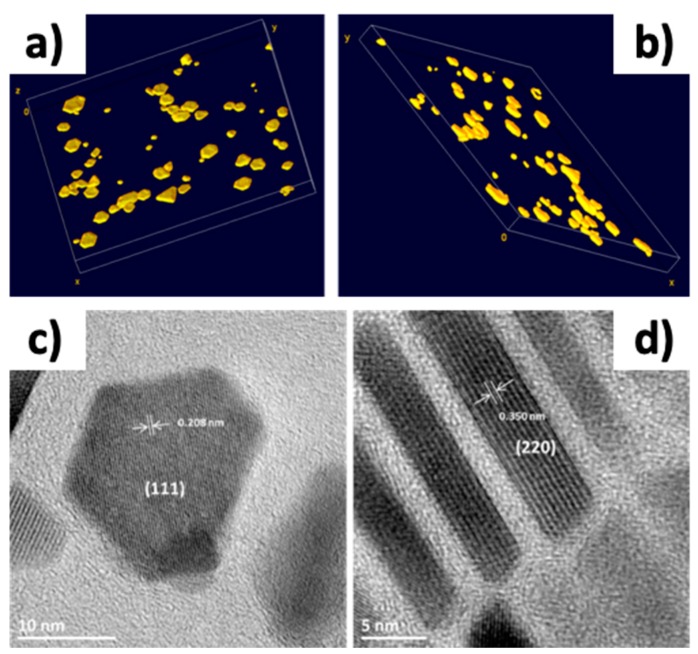
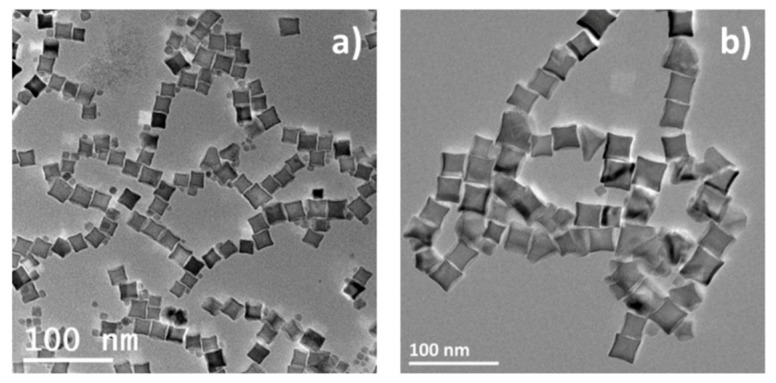
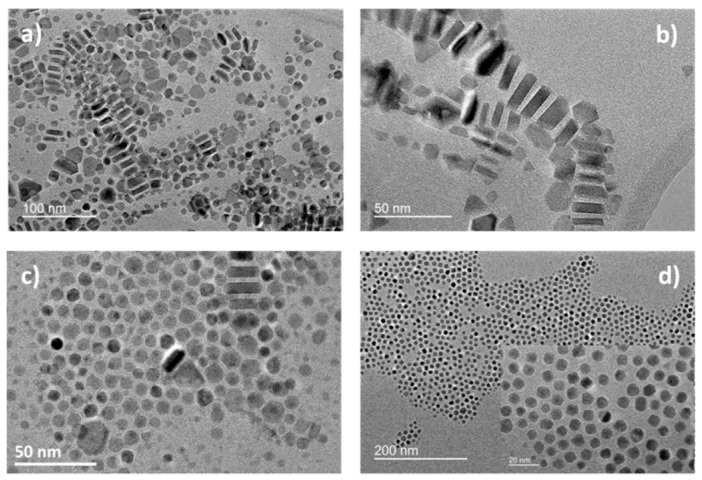
Iron oxide nanoparticles are widely used as a contrast agent in magnetic resonance imaging (MRI), and may be used as therapeutic agent for magnetic hyperthermia if they display in particular high magnetic anisotropy. Considering the effect of nanoparticles shape on anisotropy, a reproducible shape control of nanoparticles is a current synthesis challenge. By investigating reaction parameters, such as the iron precursor structure, its water content, but also the amount of the surfactant (sodium oleate) reported to control the shape, iron oxide nanoparticles with different shape and composition were obtained, in particular, iron oxide nanoplates. The effect of the surfactant coming from precursor was taking into account by using iron stearates bearing either two or three stearate chains and the negative effect of water on shape was confirmed by considering these precursors after their dehydration. Iron stearates with three chains in presence of a ratio sodium oleate/oleic acid 1:1 led mainly to nanocubes presenting a core-shell FeO@FeO₄ composition. Nanocubes with straight faces were only obtained with dehydrated precursors. Meanwhile, iron stearates with two chains led preferentially to the formation of nanoplates with a ratio sodium oleate/oleic acid 4:1. The rarely reported flat shape of the plates was confirmed with 3D transmission electronic microscopy (TEM) tomography. The investigation of the synthesis mechanisms confirmed the major role of chelating ligand and of the heating rate to drive the cubic shape of nanoparticles and showed that the nanoplate formation would depend mainly on the nucleation step and possibly on the presence of a given ratio of oleic acid and chelating ligand (oleate and/or stearate).
氧化铁纳米颗粒被广泛用作磁共振成像(MRI)中的造影剂,如果它们表现出特别高的磁各向异性,则可作为磁热疗的治疗剂。考虑到纳米颗粒形状对各向异性的影响,可重现地控制纳米颗粒的形状是当前合成面临的挑战。通过研究反应参数,如铁前驱体结构、其含水量,以及据报道可控制形状的表面活性剂(油酸钠)的用量,获得了具有不同形状和组成的氧化铁纳米颗粒,特别是氧化铁纳米板。通过使用带有两条或三条硬脂酸链的硬脂酸铁来考虑前驱体中表面活性剂的影响,并且通过对这些前驱体脱水后进行研究,证实了水对形状的负面影响。在油酸钠/油酸比例为1:1的情况下,具有三条链的硬脂酸铁主要导致呈现核壳结构FeO@FeO₄的纳米立方体。只有使用脱水前驱体才能获得具有直面的纳米立方体。同时,具有两条链的硬脂酸铁在油酸钠/油酸比例为4:1时优先导致纳米板的形成。通过三维透射电子显微镜(TEM)断层扫描证实了极少报道的平板形状。对合成机制的研究证实了螯合配体和加热速率在驱动纳米颗粒立方形状方面的主要作用,并表明纳米板的形成主要取决于成核步骤,可能还取决于特定比例的油酸和螯合配体(油酸盐和/或硬脂酸盐)的存在。