Decoene Klaas W, Vannecke Willem, Passioura Toby, Suga Hiroaki, Madder Annemieke
Department of Organic and Macromolecular Chemistry, Ghent University, Krijgslaan 281 S4, 9000 Ghent, Belgium.
Department of Chemistry, Graduate School of Science, The University of Tokyo, 7-3-1 Bunkyo-ku, Tokyo 113-0033, Japan.
Biomedicines. 2018 Oct 30;6(4):99. doi: 10.3390/biomedicines6040099.
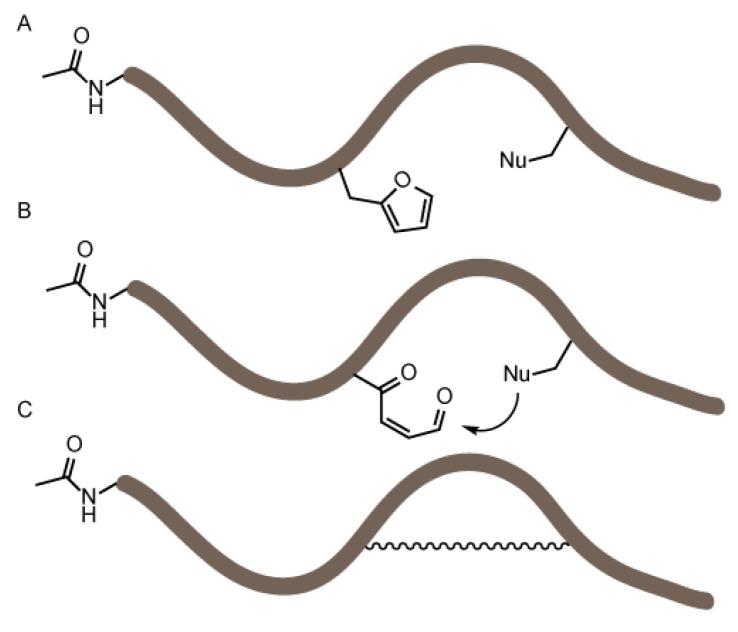
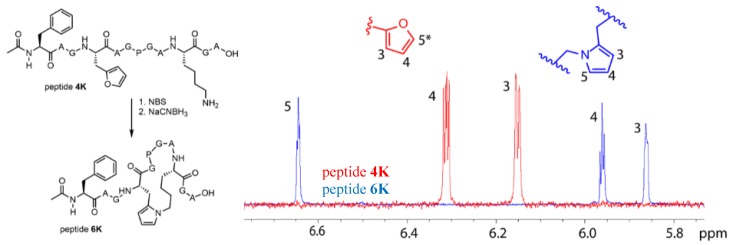
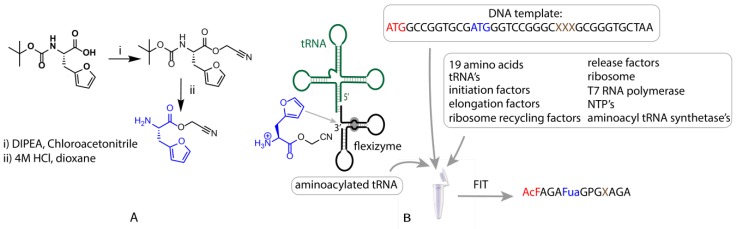
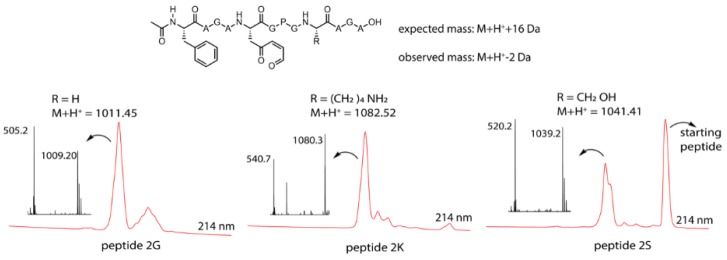
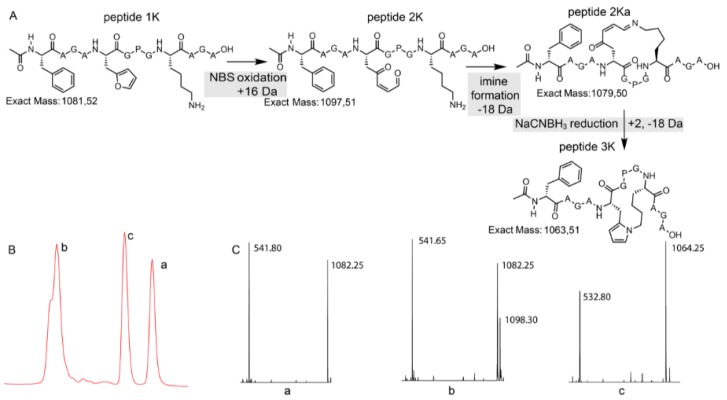
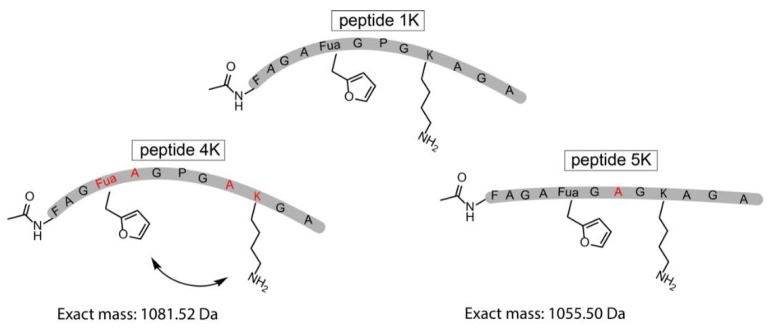
Flexible in vitro translation (FIT) was used as a screening method to uncover a new methodology for peptide constraining based on the attack of a nucleophilic side-chain functionality onto an oxidized furylalanine side chain. A set of template peptides, each containing furylalanine as furan-modified amino acid and a nucleophilic residue (Cys, His, Lys, Arg, Ser, or Tyr), was produced through FIT. The translation mixtures were treated with -bromosuccinimide (NBS) to achieve selective furan oxidation and subsequent MALDI analysis demonstrated Lys and Ser as promising residues for cyclisation. Solid-phase peptide synthesis (SPPS) was used to synthesize suitable amounts of material for further in-depth analysis and characterisation. It was found that in the case of the peptide containing lysine next to a furylalanine residue, a one-pot oxidation and reduction reaction leads to the generation of a cyclic peptide featuring a pyrrole moiety as cyclisation motif, resulting from the attack of the lysine side chain onto the oxidized furylalanine side chain. Structural evidence was provided via NMR and the generality of the methodology was explored. We hereby expand the scope of our previously developed furan-based peptide labeling and crosslinking strategy.
灵活的体外翻译(FIT)被用作一种筛选方法,以揭示一种基于亲核侧链官能团攻击氧化的呋喃丙氨酸侧链的肽环化新方法。通过FIT制备了一组模板肽,每个肽都含有作为呋喃修饰氨基酸的呋喃丙氨酸和一个亲核残基(半胱氨酸、组氨酸、赖氨酸、精氨酸、丝氨酸或酪氨酸)。翻译混合物用N-溴代琥珀酰亚胺(NBS)处理以实现选择性呋喃氧化,随后的基质辅助激光解吸电离(MALDI)分析表明赖氨酸和丝氨酸是有前景的环化残基。使用固相肽合成(SPPS)来合成适量的材料用于进一步的深入分析和表征。发现在呋喃丙氨酸残基旁边含有赖氨酸的肽的情况下,一锅氧化还原反应导致生成一种以吡咯部分为环化基序的环肽,这是由于赖氨酸侧链攻击氧化的呋喃丙氨酸侧链所致。通过核磁共振(NMR)提供了结构证据,并探索了该方法的通用性。我们在此扩展了我们之前开发的基于呋喃的肽标记和交联策略的范围。