Becic Tarik, Studenik Christian, Hoffmann Georg
Department of Pharmacology and Toxicology, Faculty of Life Sciences, University of Vienna, Althanstraße 14, 1090 Vienna, Austria.
Department of Nutritional Sciences, Faculty of Life Sciences, University of Vienna, Althanstraβe 14, 1090 Vienna, Austria.
Med Sci (Basel). 2018 Oct 30;6(4):97. doi: 10.3390/medsci6040097.
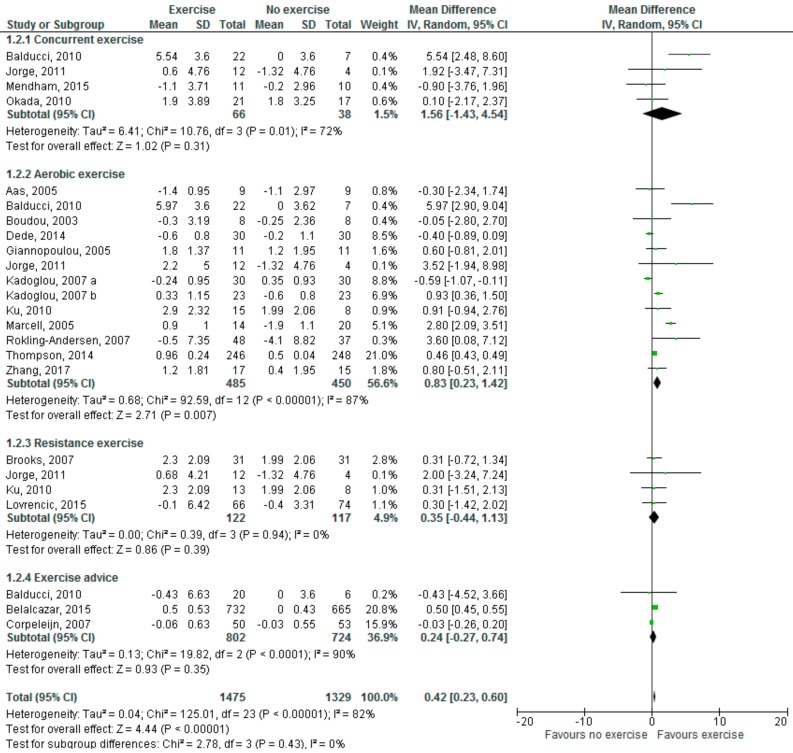
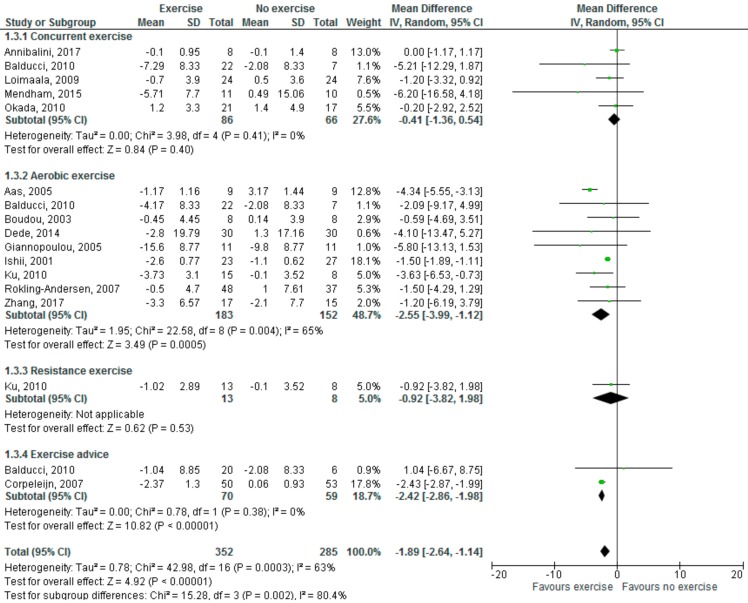
It is speculated that lifestyle interventions known to improve diabetic metabolic state may exert their effects via adipokines. The aim of this systematic review and meta-analysis was to evaluate the chronic effects of physical exercise on adiponectin and leptin levels in adult prediabetic and diabetic individuals. PubMed, Embase, Scopus, The Cochrane Library, clinicaltrials.gov, and WHO Clinical Trials Registry were searched for randomized controlled trials. Pooled effects of interventions were assessed as mean difference (MD) with random effects model. Sensitivity analysis was conducted to test data robustness and subgroup analysis for study heterogeneity. Twenty-two trials with 2996 individuals were included in the meta-analysis. Physical exercise increased levels of adiponectin (MD: 0.42 µg/mL; 95% confidence interval (CI), 0.23, 0.60, < 0.00001, = 19 trials) and reduced leptin levels (MD: -1.89 ng/mL; 95% CI, -2.64, -1.14, < 0.00001, = 14 trials). These results were robust and remained significant after sensitivity analysis. Study heterogeneity was generally high. As for physical exercise modalities, aerobic exercise, but not other modalities, increased adiponectin and reduced leptin levels. In conclusion, physical exercise and, specifically, aerobic exercise, leads to higher adiponectin and lower leptin levels in prediabetic and diabetic adults. However, cautious interpretation of current findings is warranted.
据推测,已知可改善糖尿病代谢状态的生活方式干预可能通过脂肪因子发挥作用。本系统评价和荟萃分析的目的是评估体育锻炼对成年糖尿病前期和糖尿病个体脂联素和瘦素水平的长期影响。检索了PubMed、Embase、Scopus、Cochrane图书馆、clinicaltrials.gov和世界卫生组织临床试验注册库中的随机对照试验。采用随机效应模型将干预的合并效应评估为平均差(MD)。进行敏感性分析以检验数据的稳健性,并进行亚组分析以研究异质性。荟萃分析纳入了22项试验,共2996名个体。体育锻炼可提高脂联素水平(MD:0.42µg/mL;95%置信区间(CI),0.23,0.60,P<0.00001,n = 19项试验)并降低瘦素水平(MD:-1.89 ng/mL;95%CI,-2.64,-1.14,P<0.00001,n = 14项试验)。这些结果是稳健的,在敏感性分析后仍然显著。研究异质性普遍较高。至于体育锻炼方式,有氧运动而非其他方式可提高脂联素水平并降低瘦素水平。总之,体育锻炼,特别是有氧运动,可使糖尿病前期和糖尿病成年个体的脂联素水平升高,瘦素水平降低。然而,对当前研究结果的解读仍需谨慎。