Navarrabiomed, Public University of Navarra (UPNA), Health Research Institute of Navarra (IdiSNA), University Hospital of Navarra, Pamplona 310008, Spain; CIBER of Frailty and Healthy Aging (CIBERFES), Carlos III Institute of Health, Madrid 28029, Spain.
Navarrabiomed, Public University of Navarra (UPNA), Health Research Institute of Navarra (IdiSNA), University Hospital of Navarra, Pamplona 310008, Spain; CIBER of Frailty and Healthy Aging (CIBERFES), Carlos III Institute of Health, Madrid 28029, Spain; Institute for Health Research of Navarra (IDISNA), Pamplona 31008, Spain.
J Sport Health Sci. 2023 Mar;12(2):147-157. doi: 10.1016/j.jshs.2022.11.003. Epub 2022 Nov 6.
This study investigates the effects of exercise training on exerkines in patients with type 2 diabetes mellitus to determine the optimal exercise prescription.
A systematic search for relevant studies was performed in 3 databases. Randomized controlled trials investigating the effects of exercise training on at least one of the following exerkines were included: adiponectin, apelin, brain-derived neurotrophic factor, fetuin-A, fibroblast growth factor-21, follistatin, ghrelin, interleukin (IL)-6, IL-8, IL-10, IL-15, IL-18, leptin, myostatin, omentin, resistin, retinol-binding protein 4, tumor necrosis factor-α, and visfatin.
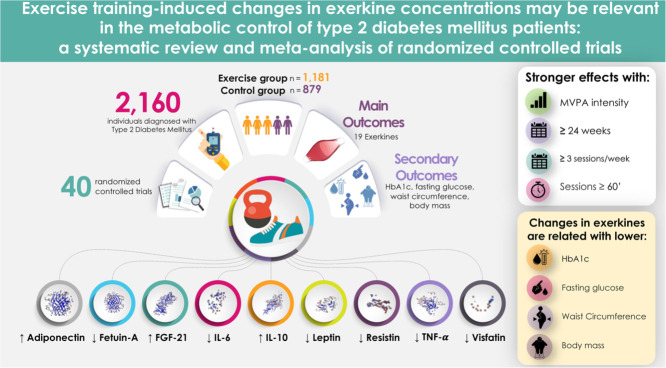
Forty randomized controlled trials were selected for data extraction (n = 2160). Exercise training induces changes in adiponectin, fetuin-A, fibroblast growth factor-21, IL-6, IL-10, leptin, resistin, and tumor necrosis factor-α levels but has no significant effects on apelin, IL-18, and ghrelin compared to controls. Physical exercise training favored large and positive changes in pooled exerkines (i.e., an overall effect size calculated from several exerkines) (Hedge's g = 1.02, 95% confidence interval (95%CI): 0.76-1.28), which in turn were related to changes in glycated hemoglobin (mean difference (MD) = -0.81%, 95%CI: -0.95% to -0.67%), fasting glucose (MD = -23.43 mg/dL, 95%CI: -30.07 mg/dL to -16.80 mg/dL), waist circumference (MD = -3.04 cm, 95%CI: -4.02 cm to -2.07 cm), and body mass (MD = -1.93 kg, 95%CI: -2.00 kg to -1.86 kg). Slightly stronger effects were observed with aerobic, resistance, or high-intensity interval protocols at moderate- to vigorous-intensity and with programs longer than 24 weeks that comprise at least 3 sessions per week and more than 60 min per session.
Exercise training represents an anti-inflammatory therapy and metabolism-improving strategy with minimal side effects for patients with type 2 diabetes mellitus.
本研究旨在探讨运动训练对 2 型糖尿病患者外泌体的影响,以确定最佳的运动处方。
在 3 个数据库中进行了相关研究的系统检索。纳入了研究运动训练对以下至少一种外泌体影响的随机对照试验:脂联素、apelin、脑源性神经营养因子、胎球蛋白 A、成纤维细胞生长因子 21、卵泡抑素、胃饥饿素、白细胞介素 (IL)-6、IL-8、IL-10、IL-15、IL-18、瘦素、肌肉生长抑制素、网膜素、抵抗素、视黄醇结合蛋白 4、肿瘤坏死因子-α和内脏脂肪素。
选择了 40 项随机对照试验进行数据提取(n=2160)。与对照组相比,运动训练可引起脂联素、胎球蛋白 A、成纤维细胞生长因子 21、IL-6、IL-10、瘦素、抵抗素和肿瘤坏死因子-α水平的变化,但对 apelin、IL-18 和胃饥饿素无显著影响。与对照组相比,身体运动训练有利于外泌体的大而正向变化(即从几种外泌体计算得到的总效应大小)(Hedge's g=1.02,95%置信区间(95%CI):0.76-1.28),而外泌体的变化又与糖化血红蛋白(平均差值(MD)=-0.81%,95%CI:-0.95%至-0.67%)、空腹血糖(MD=-23.43 mg/dL,95%CI:-30.07 mg/dL 至-16.80 mg/dL)、腰围(MD=-3.04 cm,95%CI:-4.02 cm 至-2.07 cm)和体重(MD=-1.93 kg,95%CI:-2.00 kg 至-1.86 kg)的变化相关。在中等至剧烈强度下进行有氧、抗阻或高强度间歇训练,以及每周进行至少 3 次、每次持续 60 分钟以上的方案时,效果略强。
对于 2 型糖尿病患者,运动训练是一种具有抗炎作用和改善代谢的治疗策略,副作用极小。