1Department of Geriatric Care, Orthogeriatrics and Rehabilitation, EO Galliera Hospital, National Relevance and High Specialization Hospital, Genova, Italy.
2FICYT Foundation for Applied Scientific Research and Technology in Asturias, Oviedo, Spain.
Rejuvenation Res. 2019 Aug;22(4):299-305. doi: 10.1089/rej.2018.2103. Epub 2018 Dec 28.
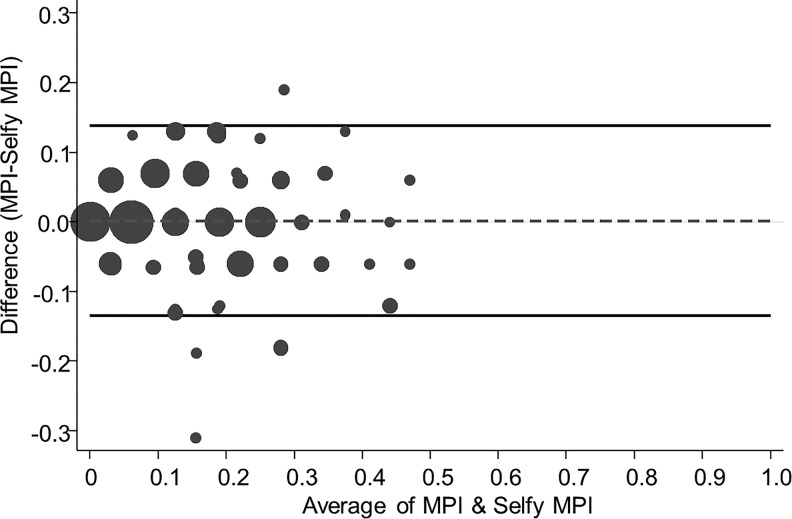
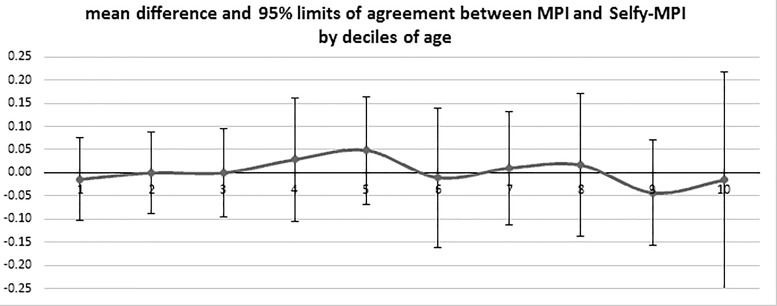
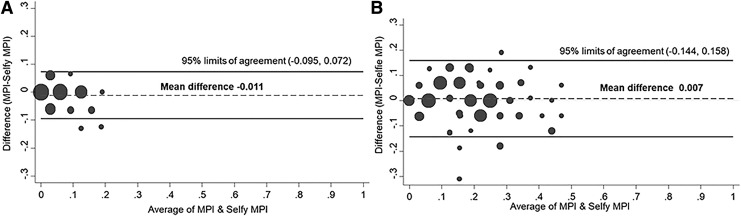
The multidimensional prognostic index (MPI) is a comprehensive geriatric assessment (CGA)-based tool that accurately predicts negative health outcomes in older subjects with different diseases and settings. To calculate the MPI several validated tools are assessed by health care professionals according to the CGA, whereas self-reported information by the patients is not available, but it could be of importance for the early identification of frailty. We aimed to develop and validate a self-administered MPI (SELFY-MPI) in community-dwelling subjects. For this reason, we enrolled 167 subjects (mean age = 67.3, range = 20-88 years, 51% = men). All subjects underwent a CGA-based assessment to calculate the MPI and the SELFY-MPI. The SELFY-MPI included the assessment of (1) basic and instrumental activities of daily living, (2) mobility, (3) memory, (4) nutrition, (5) comorbidity, (6) number of medications, and (7) socioeconomic situation. The Bland-Altman methodology was used to measure the agreement between MPI and SELFY-MPI. The mean MPI and SELFY-MPI values were 0.147 and 0.145, respectively. The mean difference was +0.002 ± standard deviation of 0.07. Lower and upper 95% limits of agreement were -0.135 and +0.139, respectively, with only 5 of 167 (3%) of observations outside the limits. Stratified analysis by age provided similar results for younger (≤65 years old, = 45) and older subjects (>65 years, = 122). The analysis of variances in subjects subdivided according to different year decades showed no differences of agreement according to age. In conclusion, the SELFY-MPI can be used as a prognostic tool in subjects of different ages.
多维预后指数(MPI)是一种基于全面老年评估(CGA)的工具,可准确预测不同疾病和环境下老年患者的负面健康结果。计算 MPI 需要根据 CGA 由医疗保健专业人员评估多个经过验证的工具,而患者的自我报告信息则不可用,但对于早期识别虚弱可能很重要。我们旨在为居住在社区的患者开发和验证一种自我管理的 MPI(SELFY-MPI)。为此,我们招募了 167 名受试者(平均年龄=67.3 岁,范围=20-88 岁,51%=男性)。所有受试者均接受了基于 CGA 的评估,以计算 MPI 和 SELFY-MPI。SELFY-MPI 包括以下评估:(1)基本和工具性日常生活活动,(2)活动能力,(3)记忆力,(4)营养状况,(5)合并症,(6)用药数量,和(7)社会经济状况。我们使用 Bland-Altman 方法来衡量 MPI 和 SELFY-MPI 之间的一致性。MPI 和 SELFY-MPI 的平均分值分别为 0.147 和 0.145。平均差值为+0.002±0.07 的标准差。下限和上限 95%一致性界限分别为-0.135 和+0.139,只有 167 个观测值中的 5 个(3%)超出了界限。按年龄进行分层分析,对于较年轻(≤65 岁,n=45)和较年长(>65 岁,n=122)的受试者提供了类似的结果。根据不同的十年细分受试者的方差分析显示,年龄无差异。总之,SELFY-MPI 可用于不同年龄段的患者的预后评估。