ISGlobal, Hospital Clinic - Universitat de Barcelona, Barcelona, Spain.
Department of Microbiology, Hospital Clinic - Universitat de Barcelona, Barcelona, Spain.
Sci Rep. 2018 Oct 31;8(1):16112. doi: 10.1038/s41598-018-34436-1.
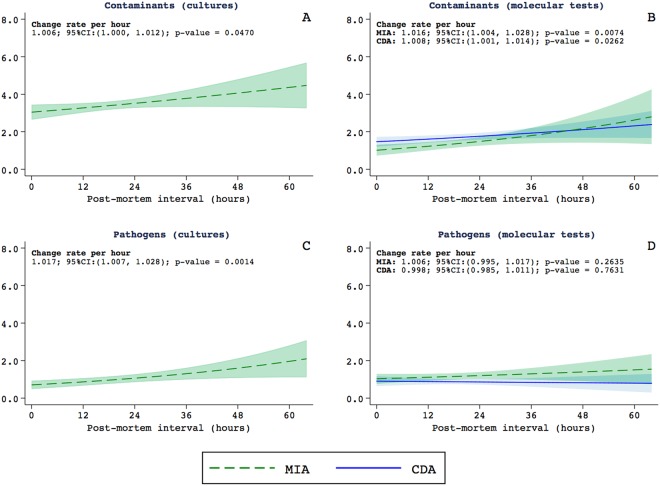
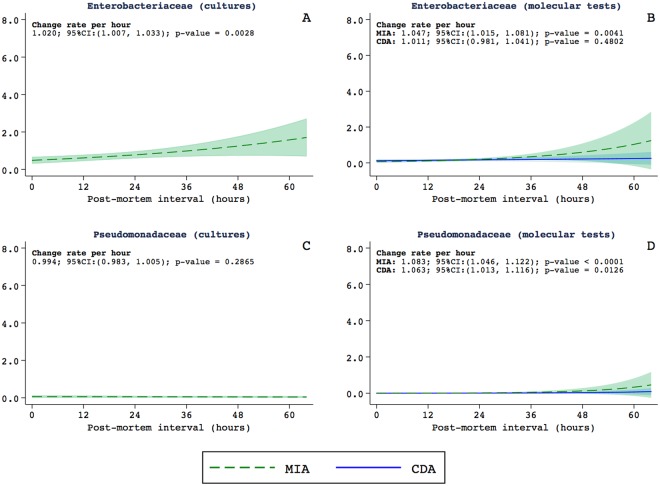
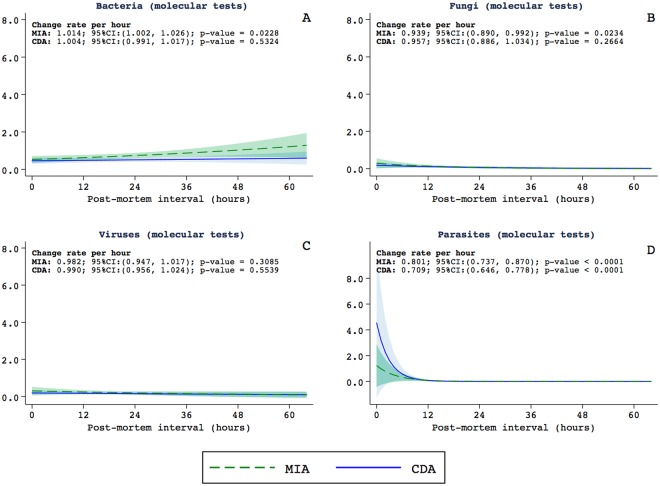
Postmortem studies, including the complete diagnostic autopsy (CDA) and the minimally invasive autopsy (MIA), an innovative approach to post-mortem sampling and cause of death investigation, are commonly performed within 24 hours after death because the quality of the tissues deteriorates over time. This short timeframe may hamper the feasibility of the procedure. In this study, we compared the diagnostic performance of the two postmortem procedures when carried out earlier and later than 24 hours after death, as well as the impact of increasing postmortem intervals (PMIs) on the results of the microbiological tests in a series of 282 coupled MIA/CDA procedures performed at the Maputo Central Hospital in Mozambique between 2013 and 2015. 214 procedures were conducted within 24 hours of death (early autopsies), and 68 after 24 hours of death (late autopsies). No significant differences were observed in the number of non-conclusive diagnoses (2/214 [1%] vs. 1/68 [1%] p = 0.5645 for the CDA; 27/214 [13%] vs. 5/68 [7%] p = 0.2332 for the MIA). However, increasing PMIs were associated with a raise in the number of bacteria identified (rate: 1.014 per hour [95%CI: 1.002-1.026]; p = 0.0228). This increase was mainly due to rising numbers of bacteria of the Enterobacteriaceae family and Pseudomonas genus strains. Thus, performing MIA or CDA more than 24 hours after death can still render reliable diagnostic results, not only for non-infectious conditions but also for many infectious diseases, although, the contribution of Enterobacteriaceae and Pseudomonas spp. as etiological agents of infections leading to death may be overestimated.
尸检研究,包括完整诊断性尸检(CDA)和微创尸检(MIA),是一种创新的死后取样和死因调查方法,通常在死亡后 24 小时内进行,因为随着时间的推移,组织的质量会恶化。这个短暂的时间窗口可能会影响程序的可行性。在这项研究中,我们比较了两种尸检程序在死亡后 24 小时内和 24 小时后进行时的诊断性能,以及随着死后时间间隔(PMI)的增加对微生物学检测结果的影响,这是在 2013 年至 2015 年期间在莫桑比克马普托中央医院进行的 282 例 MIA/CDA 联合尸检中进行的一系列研究。214 例在死亡后 24 小时内进行(早期尸检),68 例在死亡后 24 小时后进行(晚期尸检)。在非明确诊断的数量方面,两种尸检方法均未观察到显著差异(CDA 为 2/214[1%]与 1/68[1%],p=0.5645;MIA 为 27/214[13%]与 5/68[7%],p=0.2332)。然而,随着 PMI 的增加,鉴定出的细菌数量也会增加(速度:每小时增加 1.014[95%CI:1.002-1.026];p=0.0228)。这种增加主要是由于肠杆菌科和假单胞菌属菌株的细菌数量增加所致。因此,在死亡后 24 小时以上进行 MIA 或 CDA 仍能提供可靠的诊断结果,不仅适用于非传染性疾病,也适用于许多传染病,尽管肠杆菌科和假单胞菌属作为导致死亡的感染的病原体可能被高估了。