Kishida Naoki, Nishiura Hiroshi
Graduate School of Medicine, Hokkaido University, Kita 15 Jo Nishi 7 Chome, Kita-ku, Sapporo-shi, Hokkaido, 060-8638, Japan.
CREST, Japan Science and Technology Agency, Honcho 4-1-8, Kawaguchi, Saitama, 332-0012, Japan.
Theor Biol Med Model. 2018 Nov 1;15(1):19. doi: 10.1186/s12976-018-0091-z.
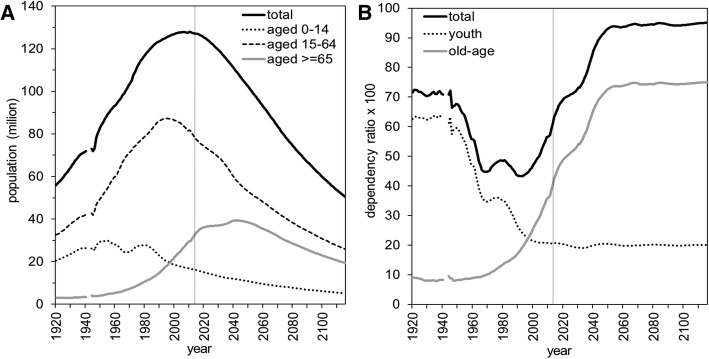
Japan has a rapidly decreasing population, with ultra-low fertility and extremely fast aging. The rapid dynamics constitute a warning that change in the industrial structure may be unable to meet the changing pace of age-dependent demand.
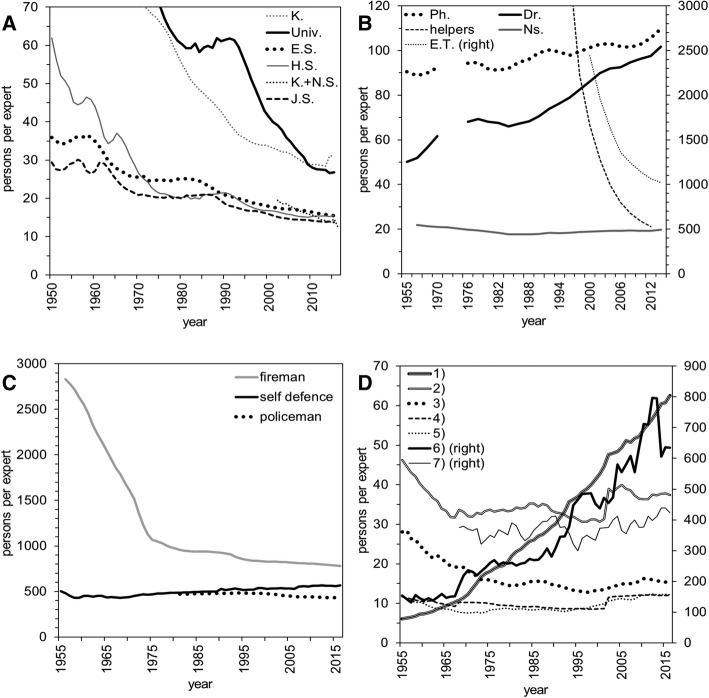
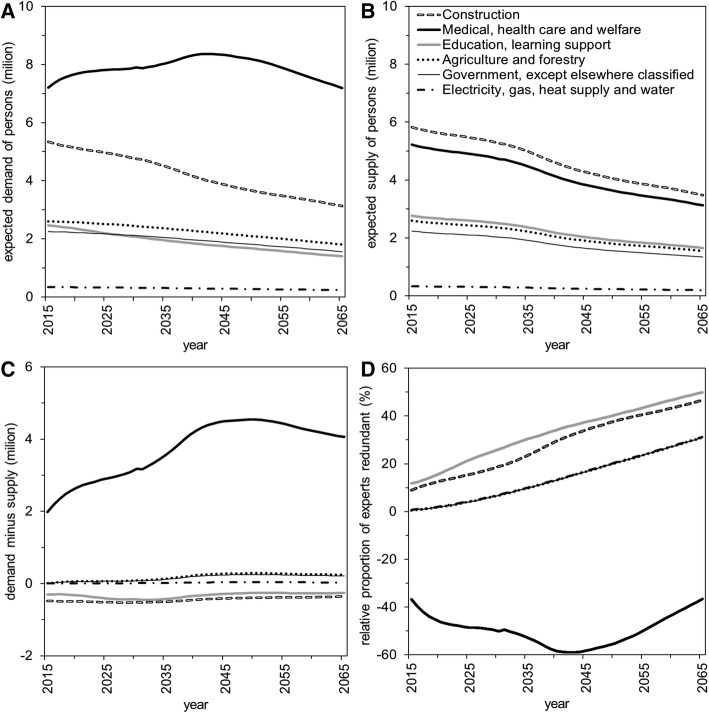
The present study estimated the supply-demand imbalance by industrial sector, and we investigated the effectiveness of possible countermeasures. To quantify the demographic burden of different industry experts, we employed the dependency ratio to calculate the supply and demand of each industrial sector and occupation.
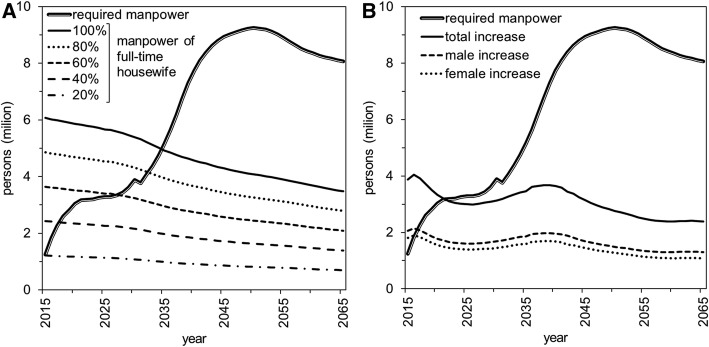
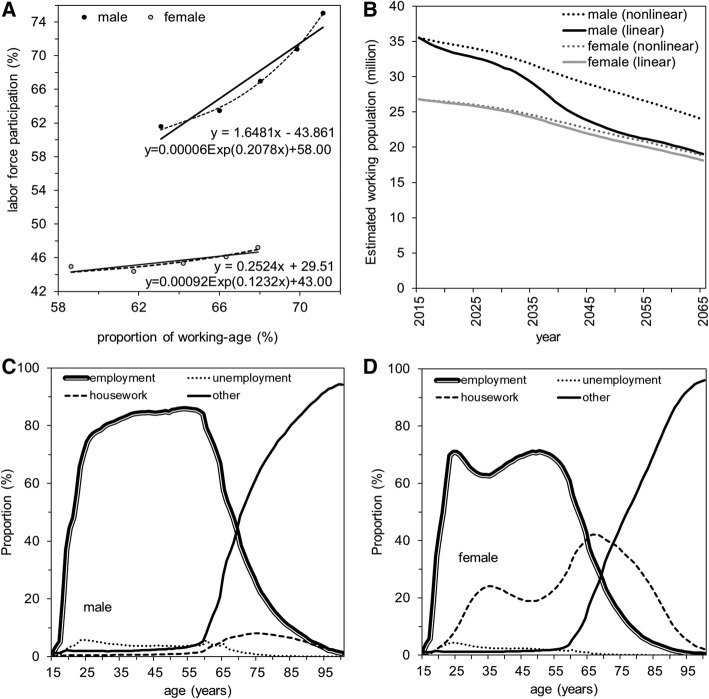
We identified an expected excess of demand in the health-care sector; the growth in that deficiency is likely to continue until 2045, when the elderly population is likely to reach a peak. By contrast, oversupply is expected in the education and construction sectors. An overall shortage of full-time workers is likely to continue until 2050, when we predict that Japan will lack 3.1-9.3 million full-time workers to satisfy the baseline demand level.
Considering that the imbalance is evident over different sectors, interministerial regulation of occupational choice may need to be imposed, e.g., by drastically changing student sizes in different area of higher education. Japan may have to decide to downgrade its social services and potentially consider increasing immigrant workers.
日本人口迅速减少,生育率超低且老龄化极快。这种快速变化警示着产业结构的改变可能无法跟上与年龄相关需求的变化步伐。
本研究估计了各产业部门的供需失衡情况,并调查了可能对策的有效性。为量化不同行业专家的人口负担,我们采用抚养比来计算各产业部门和职业的供需情况。
我们发现医疗保健部门预计需求过剩;这种短缺的增长可能会持续到2045年,届时老年人口可能达到峰值。相比之下,教育和建筑部门预计供应过剩。全职劳动力的总体短缺可能会持续到2050年,届时我们预计日本将缺少310万至930万全职劳动力以满足基准需求水平。
鉴于不同部门的失衡明显,可能需要进行跨部门职业选择监管,例如大幅改变不同高等教育领域的学生规模。日本可能不得不决定降低其社会服务水平,并可能考虑增加移民工人。