Tianjin Institute of Environmental & Operational Medcine, Key Laboratory of Risk Assessment and Control for Environment & Food Safety, Tianjin, 300050, China.
Research Institution of Chemical Defense, Beijing, 102205, China.
BMC Infect Dis. 2018 Nov 1;18(1):542. doi: 10.1186/s12879-018-3438-5.
Enteric viruses in surface water pose considerable risk to morbidity in populations living around water catchments and promote outbreaks of waterborne diseases. However, due to poor understanding of the correlation between water quality and the presence of human enteric viruses, the failure to assess viral contamination through alternative viral indicators makes it difficult to control disease transmission.
We investigated the occurrence of Enteroviruses (EnVs), Rotaviruses (HRVs), Astroviruses (AstVs), Noroviruses GII (HuNoVs GII) and Adenoviruses (HAdVs) from Jinhe River over 4 years and analyzed their correlation with physicochemical and bacterial parameters in water samples.
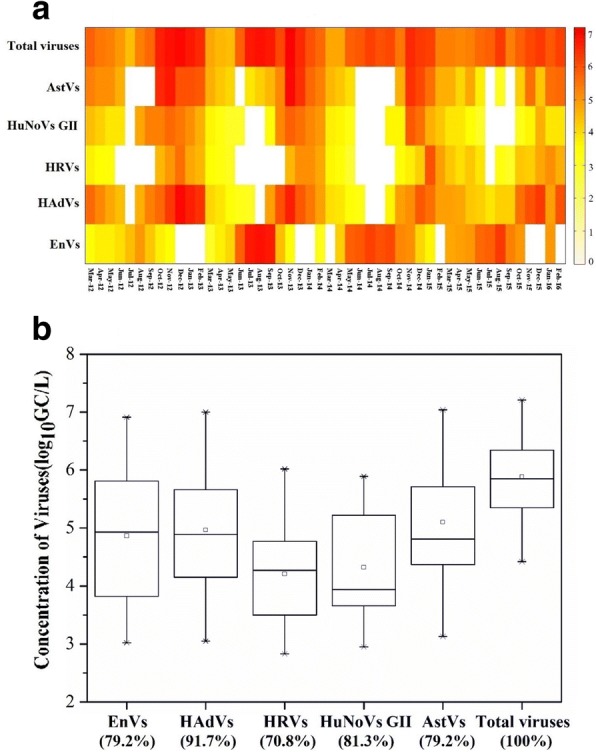
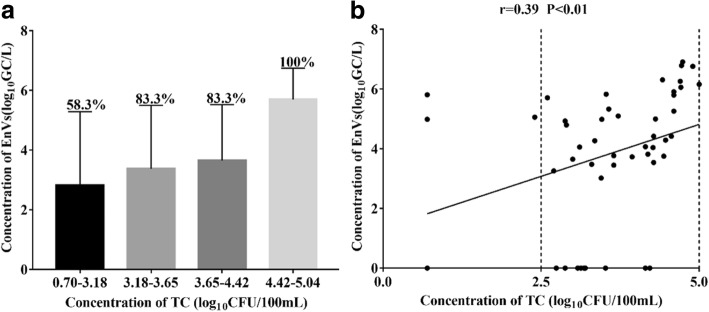
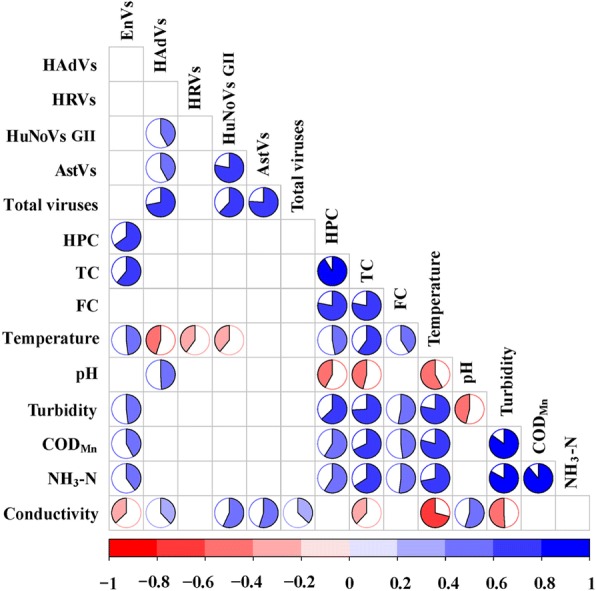
The findings showed that all target viruses were detected in water at frequencies of 91.7% for HAdVs, 81.3% for HuNoVs GII, 79.2% for EnVs and AstVs, and 70.8% for HRVs. These viruses had a seasonal pattern, which showed that EnVs were abundant in summer but rare in winter, while HAdVs, HRVs, AstVs, and HuNoVs GII exhibited opposite seasonal trends. Pearson correlation analysis showed that total coliforms (TC) was significantly positively correlated with EnVs concentrations while no consistent significant correlations were observed between bacterial indices and viruses that precipitate acute gastroenteritis.
Taken together, the findings provide insights into alternative viral indicators, suggesting that TC is a potentially promising candidate for assessment of EnVs contamination. However, it failed to predict the presence of HAdVs, HRVs, AstVs, and HuNoVs GΙΙ in surface water across the city of Tianjin.
地表水中的肠病毒对流域周围人群的发病率构成了相当大的风险,并促进了水传播疾病的爆发。然而,由于对水质与人类肠道病毒存在之间的相关性缺乏了解,未能通过替代病毒指标评估病毒污染,这使得疾病传播的控制变得困难。
我们在 4 年时间里调查了锦河水中肠道病毒(EnVs)、轮状病毒(HRVs)、星状病毒(AstVs)、诺如病毒 GII(HuNoVs GII)和腺病毒(HAdVs)的发生情况,并分析了它们与水样中理化和细菌参数的相关性。
研究结果表明,所有目标病毒在水中的检出频率分别为 HAdVs 为 91.7%、HuNoVs GII 为 81.3%、EnVs 和 AstVs 为 79.2%、HRVs 为 70.8%。这些病毒具有季节性模式,表明 EnVs 在夏季丰富而冬季稀少,而 HAdVs、HRVs、AstVs 和 HuNoVs GII 则呈现相反的季节性趋势。Pearson 相关分析显示,总大肠菌群(TC)与 EnVs 浓度呈显著正相关,而细菌指标与引起急性胃肠炎的病毒之间没有一致的显著相关性。
综上所述,这些发现为替代病毒指标提供了一些见解,表明 TC 是评估 EnVs 污染的一个潜在有希望的候选指标。然而,它未能预测 HAdVs、HRVs、AstVs 和 HuNoVs GΙΙ 在天津市地表水的存在。