de Roda Husman Ana Maria, Bartram Jamie
National Institute of Public Health (RIVM), Centre for Infectious Disease Control (CIb), WHO Collaborating Centre for Risk Assessment of Pathogens in Food and Water, Antonie van Leeuwenhoeklaan 9, 3720 BA Bilthoven, The Netherlands.
World Health Organization, Geneva, Switzerland.
Perspect Med Virol. 2007;17:127-162. doi: 10.1016/S0168-7069(07)17007-5. Epub 2007 Sep 6.
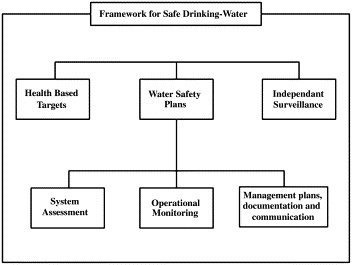
This chapter illustrates the recommendations and guidelines of the World Health Organization (WHO) concerning water, sanitation, and health. The recommendations and guidelines are evaluated in the light of disease caused by human pathogenic viruses. The guidelines outline a preventive management framework for safe drinking water. The framework includes health-based targets to assist national authorities who are normally responsible to set the targets for the protection of public health from risks by exposure to drinking water. Assessing the adequacy of systems, defining and monitoring control measures, and establishing management plans are the three components of the so-called water safety plans. Achievement of health-based targets may be verified by independent surveillance to assess the safety of the drinking water through additional verification or audit-based approaches. This framework for safe drinking water can be adapted according to environmental, social, economic, and cultural circumstances of drinking water provision on the national, regional, and local level. The chapter concludes that viruses could be considered as biocolloids with specific properties such as size, shape, structure, charge, composition, and genome. These viral characteristics determine their behavior in the environment, resistance to natural inactivation and treatment, and disinfection processes. For each (re-)emerging virus these properties may be known or could be assessed predicting the effectiveness of possible intervention measures for prevention of waterborne disease.
本章阐述了世界卫生组织(WHO)关于水、环境卫生与健康的建议和准则。这些建议和准则是根据人类致病病毒引发的疾病来评估的。这些准则概述了安全饮用水的预防性管理框架。该框架包括基于健康的目标,以协助通常负责设定保护公众健康免受饮用水暴露风险目标的国家当局。评估系统的充分性、定义和监测控制措施以及制定管理计划是所谓水安全计划的三个组成部分。基于健康的目标的实现可通过独立监测来验证,以通过额外的验证或基于审核的方法评估饮用水的安全性。这个安全饮用水框架可根据国家、区域和地方层面饮用水供应的环境、社会、经济和文化情况进行调整。本章得出结论认为,病毒可被视为具有特定特性(如大小、形状、结构、电荷、组成和基因组)的生物胶体。这些病毒特性决定了它们在环境中的行为、对自然灭活和处理以及消毒过程的抗性。对于每种(重新)出现的病毒,这些特性可能是已知的,或者可以进行评估,以预测预防水传播疾病的可能干预措施的有效性。