Department of Biomolecular Sciences, University of Urbino "Carlo Bo", Urbino, PU, Italy.
Istituto Zooprofilattico Sperimentale of Sicily "A Mirri", Palermo, PA, Italy.
Parasit Vectors. 2018 Nov 1;11(1):572. doi: 10.1186/s13071-018-3143-7.
Leishmania infantum is the aetiological agent of visceral leishmaniasis (VL) and cutaneous leishmaniasis (CL). Numerous strains and/or zymodemes have been identified and characterized by multilocus enzyme electrophoresis (MLEE). MLEE is considered the reference method for L. infantum parasite typing and it is based upon enzyme electrophoretic mobility analysis from promastigote cultures. However, the MLEE technique is cumbersome, time-consuming and does not detect silent genetic mutations or nucleotide changes that give rise to amino acid changes that do not alter electrophoretic mobility. As a result of these difficulties, many DNA-based typing methods have been developed over the past few years. However, relative to the enzymes utilized in MLEE analysis, we observed a shortage of DNA sequences available in the GenBank database or an absolute lack of sequences belonging to specific zymodemes. The aims of the present study were to (i) implement the number of sequences coding for metabolic enzymes used in MLEE; (ii) identify polymorphisms that characterize L. infantum zymodemes most prevalent in the Mediterranean basin; and (iii) exploit these polymorphisms to develop a rapid screening test that would give results comparable with existing MLEE typing.
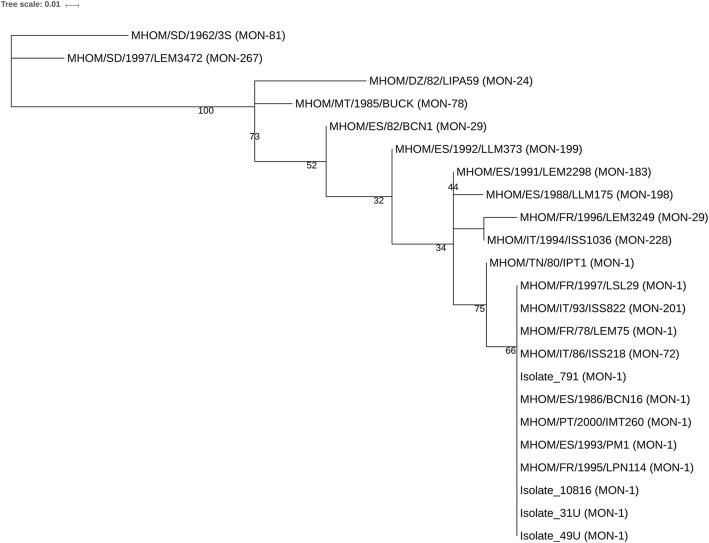
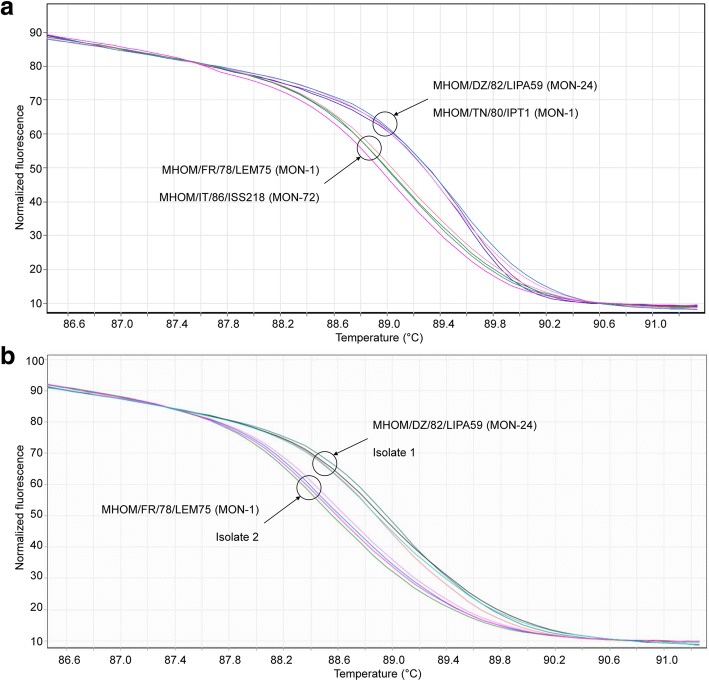
Partial sequences of seven metabolic enzyme genes (malic enzyme, 6-phosphogluconate dehydrogenase, mitochondrial isocitrate dehydrogenase, glucose-6-phosphate isomerase, glucose-6-phosphate dehydrogenase, phosphoglucomutase and mannose phosphate isomerase) were obtained from 11 L. infantum strains. The comparison of these sequences with those obtained from GenBank allowed for the identification of a few polymorphisms that could distinguish several zymodemes. In particular, the polymorphism 390T>G in the malic enzyme gene has been exploited to develop a high-resolution melt (HRM)-based assay to rapidly differentiate the genotype 390T, associated with zymodemes MON-1, MON-72 and MON-201, evidencing a partial agreement between genotyping results and MLEE. The assay has been successfully applied to L. infantum clinical isolates and clinical samples.
A HRM-based assay for rapid identification of genotypes associated with the most common L. infantum zymodemes in the Mediterranean basin has been developed and its potential application in epidemiological research for L. infantum population screening, without parasite isolation and culturing, has been demonstrated.
利什曼原虫是内脏利什曼病(VL)和皮肤利什曼病(CL)的病原体。已经通过多位点酶电泳(MLEE)鉴定和表征了许多株系和/或同工酶型。MLEE 被认为是利什曼原虫寄生虫分型的参考方法,它基于前鞭毛体培养物的酶电泳迁移率分析。然而,MLEE 技术繁琐、耗时,并且不能检测到导致氨基酸变化而不改变电泳迁移率的沉默遗传突变或核苷酸变化。由于这些困难,过去几年已经开发了许多基于 DNA 的分型方法。然而,与 MLEE 分析中使用的酶相比,我们观察到可用的 GenBank 数据库中的 DNA 序列数量不足,或者绝对缺乏属于特定同工酶型的序列。本研究的目的是:(i)实施 MLEE 中使用的代谢酶编码的序列数量;(ii)鉴定表征地中海盆地最流行的利什曼原虫同工酶型的多态性;(iii)利用这些多态性开发一种快速筛选测试,该测试将产生与现有 MLEE 分型相当的结果。
从 11 株利什曼原虫中获得了 7 种代谢酶基因(苹果酸酶、6-磷酸葡萄糖酸脱氢酶、线粒体异柠檬酸脱氢酶、葡萄糖-6-磷酸异构酶、葡萄糖-6-磷酸脱氢酶、磷酸葡萄糖变位酶和甘露糖磷酸异构酶)的部分序列。将这些序列与从 GenBank 获得的序列进行比较,发现了一些可以区分几个同工酶型的多态性。特别是,苹果酸酶基因中的 390T>G 多态性已被用于开发一种基于高分辨率熔解(HRM)的检测方法,以快速区分与同工酶型 MON-1、MON-72 和 MON-201 相关的 390T 基因型,这表明基因型分型结果与 MLEE 之间存在部分一致性。该检测方法已成功应用于利什曼原虫临床分离株和临床样本。
已经开发了一种基于 HRM 的快速鉴定与地中海盆地最常见的利什曼原虫同工酶型相关基因型的检测方法,并证明了其在寄生虫分离和培养的情况下,在利什曼原虫人群筛查中的流行病学研究中的潜在应用。