Department of Psychiatry, The First Affiliated Hospital of Chongqing Medical University, Chongqing, China.
Department of Neurology, The Second Affiliated Hospital of Chongqing Medical University, Chongqing, China.
JAMA Psychiatry. 2019 Jan 1;76(1):41-50. doi: 10.1001/jamapsychiatry.2018.3070.
Anxiety disorders are common in children and adolescents, and uncertainty remains regarding the optimal strategy of psychotherapies in this population.
To compare and rank the different types of psychotherapies and the different ways of delivering psychological treatments for anxiety disorders in children and adolescents.
PubMed, Cochrane Central Register of Controlled Trials, EMBASE, PsycINFO, Web of Science, CINAHL (Cumulative Index to Nursing and Allied Health Literature), ProQuest Dissertations, LILACS (Literatura Latino Americana em Ciências da Saúde), international trial registers, and US Food and Drug Administration reports were searched from inception to November 30, 2017.
Randomized clinical trials that compared any structured psychotherapy with another psychotherapy or a control condition for anxiety disorders in children and adolescents were selected.
Four researchers independently performed data extraction and quality assessment. Pairwise meta-analyses and Bayesian network meta-analysis within the random-effects model were used to synthesize data.
Efficacy (change in anxiety symptoms) posttreatment and at follow-up, acceptability (all-cause discontinuation), and quality of life and functional improvement were measured. The certainty of evidence was assessed using the Grading of Recommendations Assessment, Development and Evaluation framework.
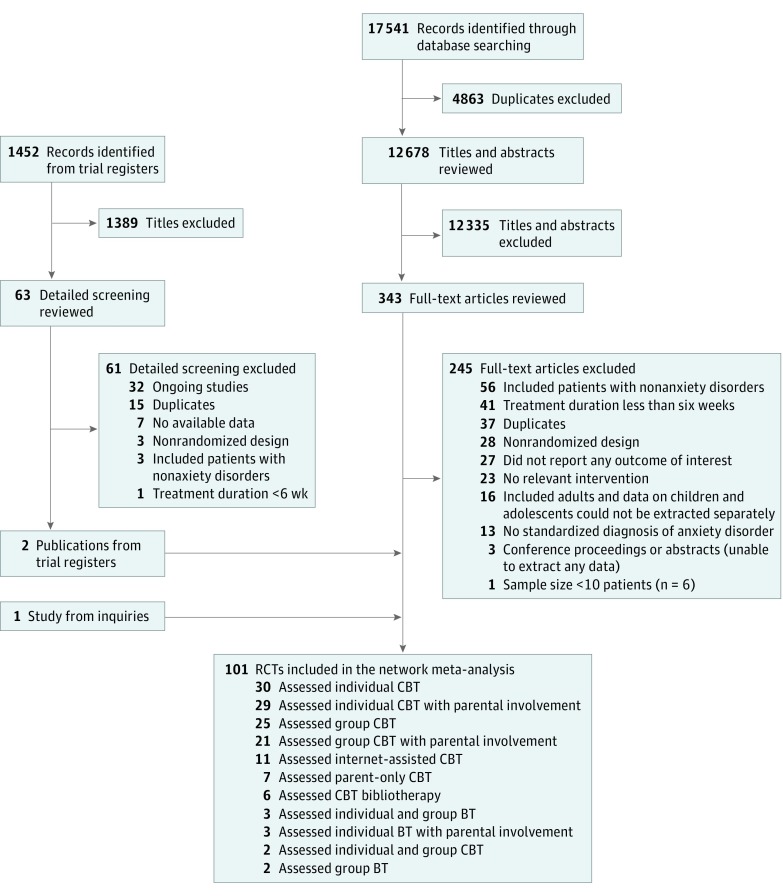
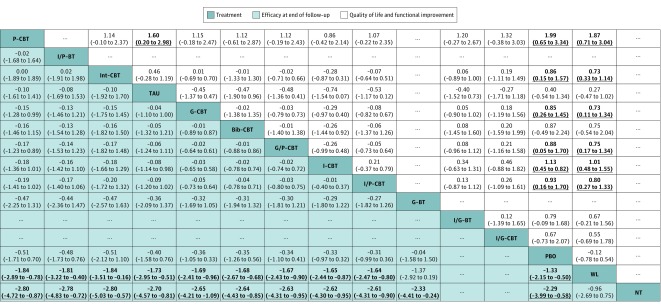
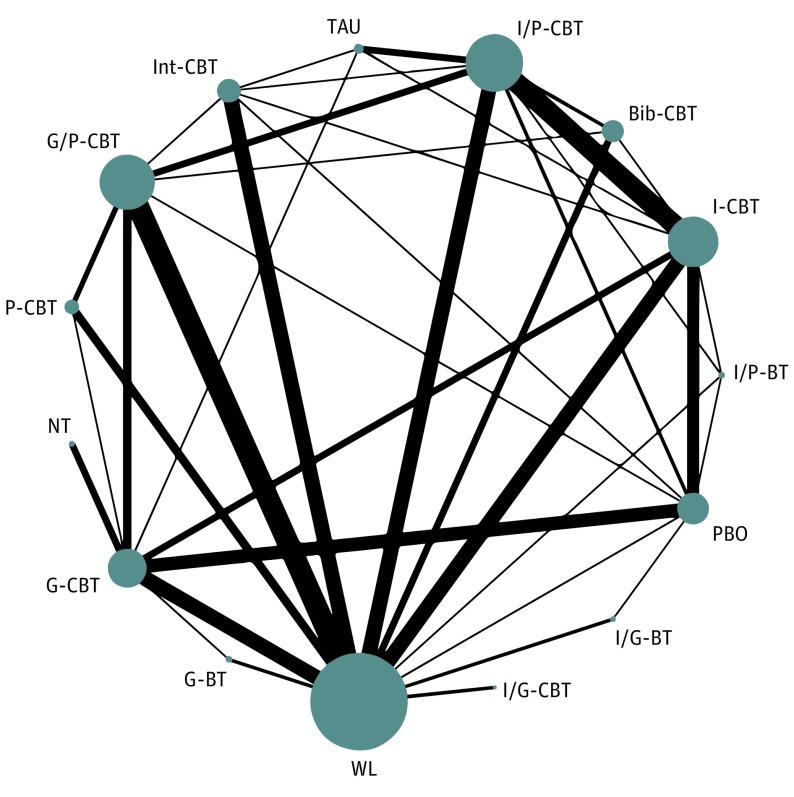
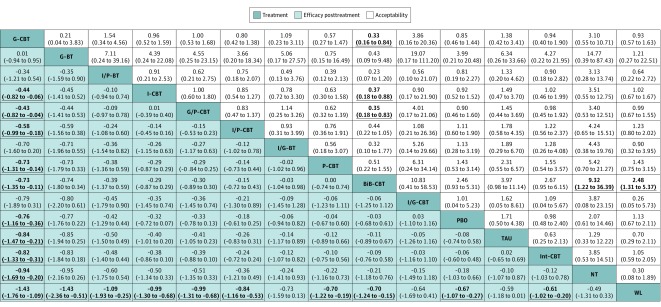
A total of 101 unique trials including 6625 unique participants compared 11 different psychotherapies with 4 specific control conditions. The certainty of evidence was rated as low or very low for most comparisons. For efficacy, most psychotherapies were significantly more effective than the wait list condition posttreatment (standardized mean difference [SMD], -1.43 to -0.61) and at the longest follow-up (SMD, -1.84 to -1.64). However, only group cognitive behavioral therapy (CBT) was significantly more effective than the other psychotherapies and all control conditions posttreatment. For acceptability, bibliotherapy CBT had significantly more all-cause discontinuations than some psychotherapies and control conditions (range of odds ratios, 2.48-9.32). In terms of quality of life and functional improvement, CBT (delivered in different ways) was significantly beneficial compared with psychological placebo and the wait list condition (SMDs, 0.73 to 1.99).
Group CBT would be the more appropriate choice of psychotherapy for anxiety disorders in children and adolescents, based on these findings. Other types of psychotherapies and different ways of delivering psychological treatment can be alternative options. Further research is needed to explore specific anxiety disorders, disorder-specific psychotherapy, and moderators of treatment effect.
PROSPERO Identifier: CRD42015016283.
焦虑障碍在儿童和青少年中很常见,但对于该人群的最佳心理治疗策略仍存在不确定性。
比较和排列不同类型的心理疗法以及为儿童和青少年提供心理治疗的不同方式。
从建库至 2017 年 11 月 30 日,PubMed、Cochrane 对照试验中心注册库、EMBASE、PsycINFO、Web of Science、CINAHL(护理与联合健康文献累积索引)、ProQuest 论文全文数据库、LILACS(拉丁美洲健康科学文献)、国际试验注册库和美国食品药品监督管理局报告被检索。
选择了比较任何结构化心理治疗与另一种心理治疗或儿童和青少年焦虑障碍对照条件的随机临床试验。
四名研究人员独立进行数据提取和质量评估。使用随机效应模型中的成对荟萃分析和贝叶斯网络荟萃分析来综合数据。
治疗后和随访时的疗效(焦虑症状的变化)、可接受性(所有原因停药)以及生活质量和功能改善。使用推荐评估、制定和评估框架评估证据的确定性。
共有 101 项独特的试验,包括 6625 名独特的参与者,将 11 种不同的心理疗法与 4 种特定的对照条件进行了比较。大多数比较的证据确定性被评为低或极低。对于疗效,大多数心理疗法在治疗后(posttreatment)(标准化均数差[SMD],-1.43 至-0.61)和最长随访时(SMD,-1.84 至-1.64)都明显比等待名单条件更有效。然而,只有团体认知行为疗法(CBT)在治疗后(posttreatment)明显比其他心理疗法和所有对照条件更有效。对于可接受性,图书疗法 CBT 与某些心理疗法和对照条件相比,停药的比例明显更高(比值比范围,2.48-9.32)。在生活质量和功能改善方面,CBT(以不同的方式提供)与心理安慰剂和等待名单条件相比具有显著的益处(SMD,0.73 至 1.99)。
根据这些发现,团体 CBT 将成为儿童和青少年焦虑障碍的更合适的心理治疗选择。其他类型的心理疗法和提供心理治疗的不同方式可以作为替代选择。需要进一步研究来探索特定的焦虑障碍、特定于障碍的心理疗法以及治疗效果的调节因素。
PROSPERO 标识符:CRD42015016283。