Department of Medicine, University of Crete, Heraklion, Crete, Greece.
Computational Bio-Medicine Laboratory, Institute of Computer Science, Foundation for Research and Technology-Hellas, Heraklion, Crete, Greece.
Sci Rep. 2018 Nov 1;8(1):16200. doi: 10.1038/s41598-018-34521-5.
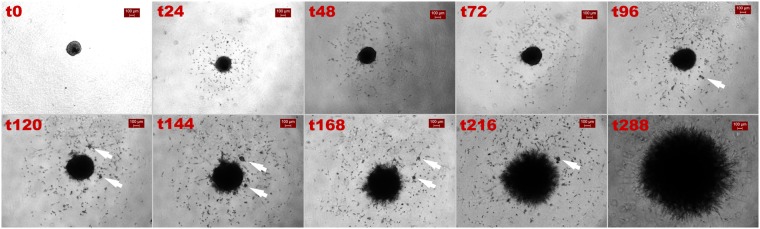
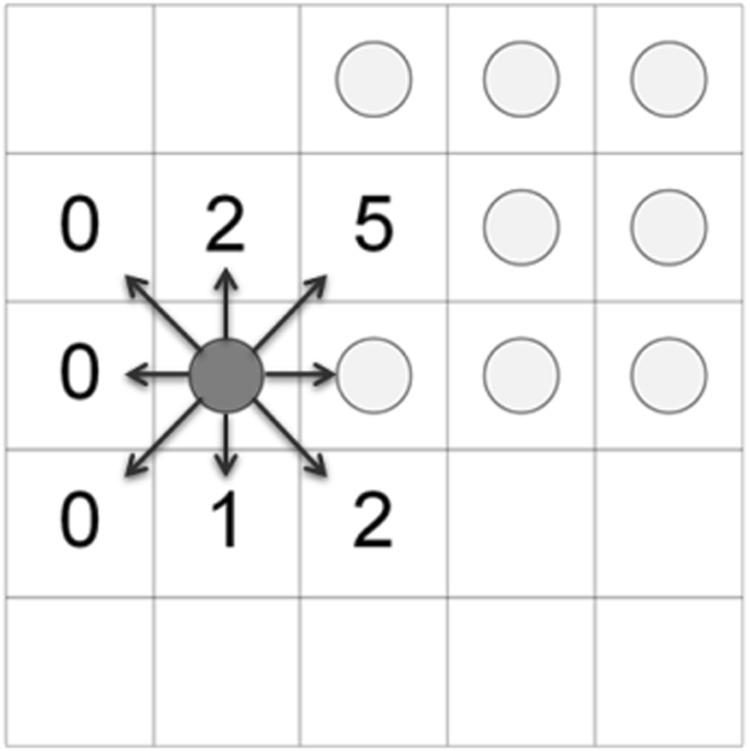
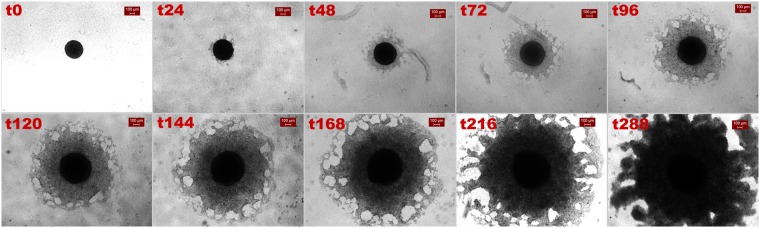
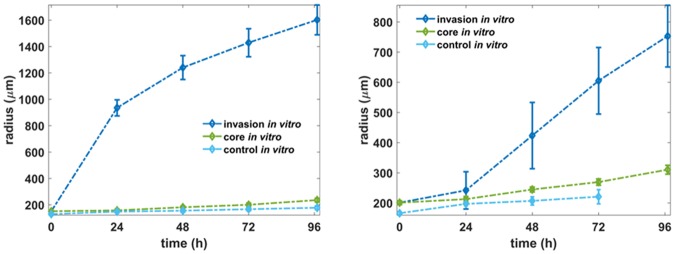
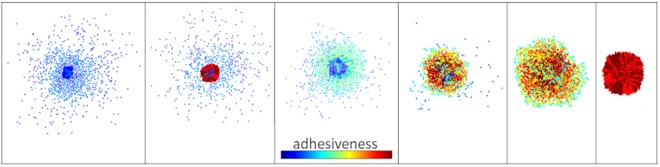
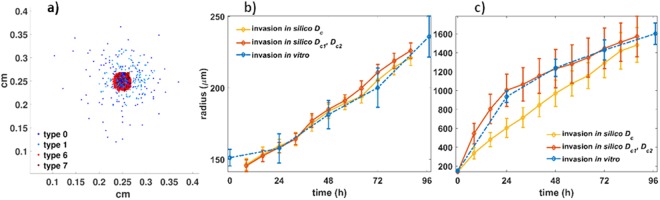
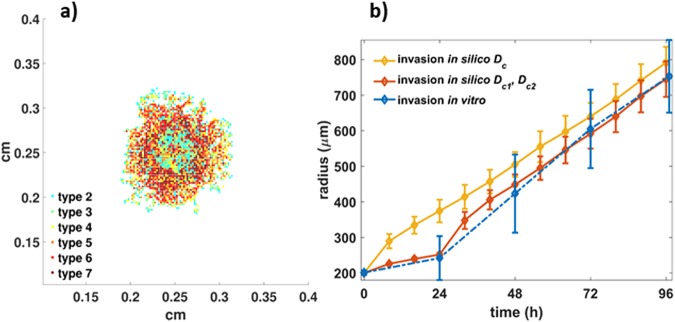
Glioblastoma cells adopt migration strategies to invade into the brain parenchyma ranging from individual to collective mechanisms, whose role and dynamics are not yet fully understood. In this work, we explore Glioblastoma heterogeneity and recapitulate its invasive patterns both in vitro, by utilizing primary cells along with the U87MG cell line, and in silico, by adopting discrete, individual cell-based mathematics. Glioblastoma cells are cultured three-dimensionally in an ECM-like substrate. The primary Glioblastoma spheroids adopt a novel cohesive pattern, mimicking perivascular invasion in the brain, while the U87MG adopt a typical, starburst invasive pattern under the same experimental setup. Mathematically, we focus on the role of the intrinsic heterogeneity with respect to cell-to-cell adhesion. Our proposed mathematical approach mimics the invasive morphologies observed in vitro and predicts the dynamics of tumour expansion. The role of the proliferation and migration is also explored showing that their effect on tumour morphology is different per cell type. The proposed model suggests that allowing cell-to-cell adhesive heterogeneity within the tumour population is sufficient for variable invasive morphologies to emerge which remain originally undetectable by conventional imaging, indicating that exploration in pathological samples is needed to improve our understanding and reveal potential patient-specific therapeutic targets.
胶质母细胞瘤细胞通过从个体到集体机制的迁移策略侵入脑实质,但其作用和动态尚不完全清楚。在这项工作中,我们通过利用原代细胞和 U87MG 细胞系,在体外探索胶质母细胞瘤的异质性并再现其侵袭模式,并通过采用离散的、基于单个细胞的数学方法在计算机上进行探索。胶质母细胞瘤细胞在类似于细胞外基质的基质中进行三维培养。原代胶质母细胞瘤球体采用一种新的黏附模式,模拟血管周围侵袭,而 U87MG 在相同的实验设置下采用典型的星爆侵袭模式。从数学角度来看,我们专注于细胞间黏附的内在异质性的作用。我们提出的数学方法模拟了体外观察到的侵袭形态,并预测了肿瘤扩张的动力学。还探讨了增殖和迁移的作用,表明它们对肿瘤形态的影响因细胞类型而异。所提出的模型表明,允许肿瘤群体中的细胞间黏附异质性足以出现可变的侵袭形态,这些形态最初是无法通过常规成像检测到的,这表明需要对病理样本进行探索,以提高我们的理解并揭示潜在的患者特异性治疗靶点。