KAVI-Institute of Clinical Research, University of Nairobi, Nairobi, Kenya.
Department of Microbiology, School of Medicine, College of Health Sciences, University of Nairobi, Nairobi, Kenya.
PLoS One. 2018 Nov 2;13(11):e0206656. doi: 10.1371/journal.pone.0206656. eCollection 2018.
To evaluate initial reported willingness to participate in a hypothetical HIV vaccine clinical trial and actual participation of volunteers in a longitudinal observational study.
We recruited HIV negative male and female volunteers aged 18-45 years into a longitudinal observational study at KAVI-ICR Kangemi in Kenya, to serve as a pool from which to draw participants into a phase I HIV vaccine clinical trial. A structured questionnaire was used to collect information regarding willingness to join a HIV vaccine clinical trial in the future. Study follow-up visits were every 6 months.
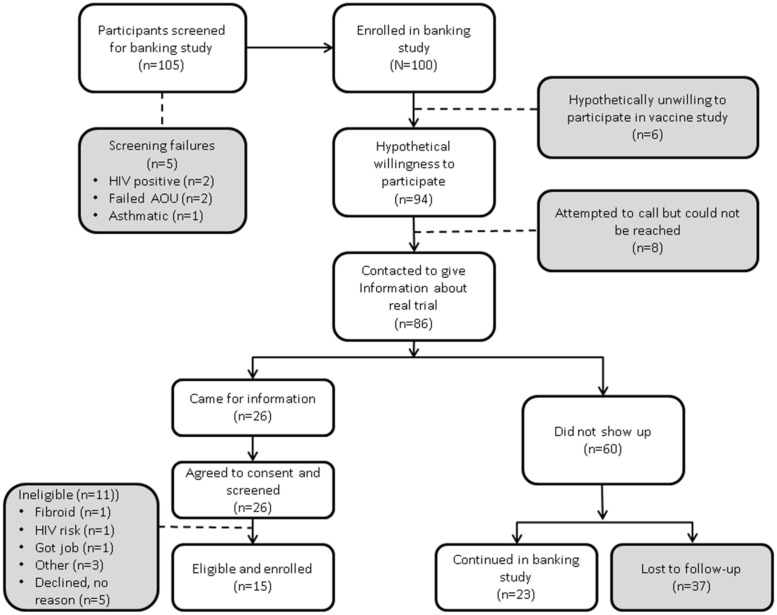
A total of 105 participants were screened and 100 (M46:F54) were enrolled into the observational study. Ninety- four per cent of those enrolled expressed willingness to participate in a future HIV vaccine trial. Altruism and desire to learn the body's response to the vaccine were the most motivating factors at 40% and 25% respectively. At the onset of a 40-person phase I HIV vaccine trial, 86 observational study participants who had previously expressed willingness to participate were contacted but only 26 (30%) came for information. All 26 consented to participate and after screening for eligibility, 24 were eligible. Of the 24, 15 were enrolled. These numbers were not adequate; hence the vaccine trial employed other recruitment methods to meet the deficit.
Observational "pools" of cohorts may not provide adequate number of participants into vaccine clinical trials even if they report willingness; therefore supplementary recruitment methods such as direct community recruitment, passive approach, and snowballing need to be in place.
评估最初报告的参与假设性 HIV 疫苗临床试验的意愿以及志愿者在纵向观察性研究中的实际参与情况。
我们在肯尼亚 KAVI-ICR Kangemi 招募了年龄在 18-45 岁之间的 HIV 阴性男性和女性志愿者,将他们纳入一项纵向观察性研究,作为从中招募参与者参加 HIV 疫苗 I 期临床试验的人员库。使用结构化问卷收集有关未来加入 HIV 疫苗临床试验的意愿的信息。研究随访每 6 个月进行一次。
共筛选了 105 名参与者,其中 100 名(M46:F54)被纳入观察性研究。入组的 94%表示愿意参加未来的 HIV 疫苗试验。利他主义和渴望了解身体对疫苗的反应是最具激励性的因素,分别占 40%和 25%。在一项 40 人的 HIV 疫苗 I 期临床试验开始时,联系了之前表示愿意参加的 86 名观察性研究参与者,但只有 26 人(30%)前来获取信息。所有 26 人均同意参加,经过资格筛选后,有 24 人符合条件。在 24 人中,有 15 人被纳入。这些数字不足;因此,疫苗试验采用了其他招募方法来弥补不足。
即使观察性“队列”报告愿意参加疫苗临床试验,但可能无法为疫苗临床试验提供足够数量的参与者;因此,需要有其他的招募方法,如直接社区招募、被动方法和滚雪球效应。