Galaal Khadra, Lopes Alberto, Pritchard Colin, Barton Andrew, Wingham Jennifer, Marques Elsa M R, Faulds John, Palmer Joanne, Vickery Patricia Jane, Ralph Catherine, Ferreira Nicole, Ewings Paul
Gynaeoncology, Royal Cornwall Hospitals NHS Trust, Truro, UK.
Medical School, University of Exeter, Exeter, UK.
BMJ Open. 2018 Nov 1;8(11):e024108. doi: 10.1136/bmjopen-2018-024108.
Ovarian cancer is the leading cause of death from gynaecological cancer, with more than 7000 new cases registered in the UK in 2014. In patients suitable for surgery, the National Institute of Health and Care Excellence guidance for treatment recommends surgical resection of all macroscopic tumour, followed by chemotherapy. The surgical procedure can be extensive and associated with substantial blood loss which is conventionally replaced with a donor blood transfusion. While often necessary and lifesaving, the use of donor blood is associated with increased risks of complications and adverse surgical outcomes. Intraoperative cell salvage (ICS) is a blood conservation strategy in which red cells collected from blood lost during surgery are returned to the patient thus minimising the use of donor blood. This is the protocol for a feasibility randomised controlled trial with an embedded qualitative study and feasibility economic evaluation. If feasible, a later definitive trial will test the effectiveness and cost-effectiveness of ICS reinfusion versus donor blood transfusion in ovarian cancer surgery.
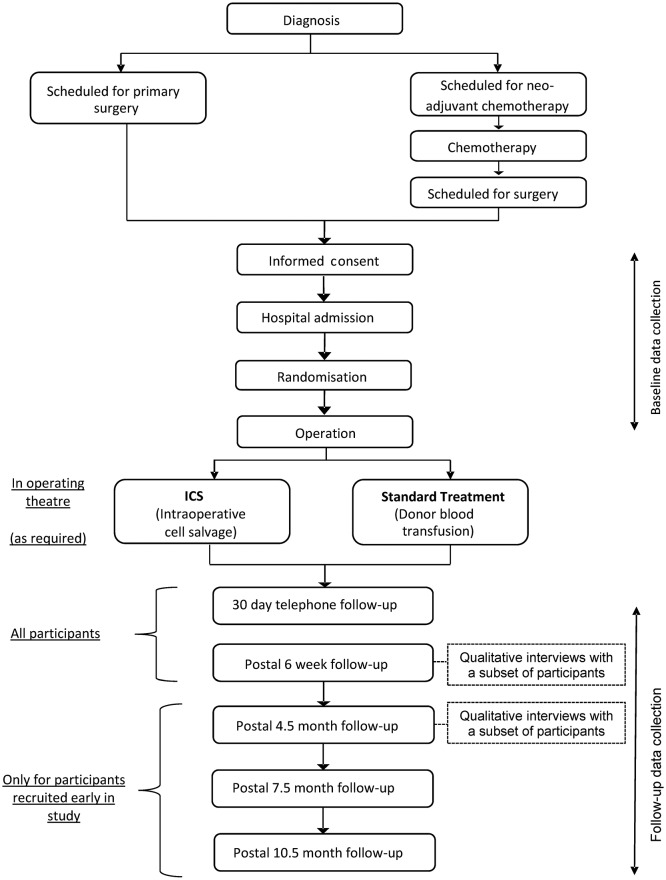
Sixty adult women scheduled for primary or interval ovarian cancer surgery at participating UK National Health Service Trusts will be recruited and individually randomised in a 1:1 ratio to receive ICS reinfusion or donor blood (as required) during surgery. Participants will be followed up by telephone at 30 days postoperatively for adverse events monitoring and by postal questionnaire at 6 weeks and 3 monthly thereafter, to capture quality of life and resource use data. Qualitative interviews will capture participants' and clinicians' experiences of the study.
This study has been granted ethical approval by the South West-Exeter Research Ethics Committee (ref: 16/SW/0256). Results will be disseminated via peer-reviewed publications and will inform the design of a larger trial.
ISRCTN19517317.
卵巢癌是妇科癌症致死的主要原因,2014年英国登记的新病例超过7000例。对于适合手术的患者,英国国家卫生与临床优化研究所的治疗指南建议手术切除所有肉眼可见的肿瘤,随后进行化疗。手术过程可能范围广泛且伴有大量失血,传统上会通过输入供血来补充。虽然供血输血通常是必要且能挽救生命的,但使用供血会增加并发症风险和不良手术结局。术中细胞回收(ICS)是一种血液保护策略,即把手术中流失血液里收集的红细胞回输给患者,从而尽量减少供血的使用。这是一项可行性随机对照试验的方案,其中包含一项定性研究和可行性经济评估。如果可行,后续的确定性试验将检验ICS回输与供血输血在卵巢癌手术中的有效性和成本效益。
将招募60名计划在参与研究的英国国民健康服务信托机构接受原发性或间歇性卵巢癌手术的成年女性,并按照1:1的比例进行个体随机分组,使其在手术期间接受ICS回输或供血输血(按需)。术后30天通过电话对参与者进行随访以监测不良事件,术后6周及之后每3个月通过邮寄问卷进行随访,以获取生活质量和资源使用数据。定性访谈将了解参与者和临床医生对该研究的体验。
本研究已获得西南埃克塞特研究伦理委员会的伦理批准(参考号:16/SW/0256)。研究结果将通过同行评审出版物进行传播,并为更大规模试验的设计提供参考。
ISRCTN19517317