Hosseini S A, Amouei A, Sharif M, Sarvi Sh, Galal L, Javidnia J, Pagheh A S, Gholami S, Mizani A, Daryani A
Toxoplasmosis Research Center, Mazandaran University of Medical Sciences, Mazandaran, Sari, Iran.
Student Research Committee, Mazandaran University of Medical Sciences, Mazandaran, Sari, Iran.
Epidemiol Infect. 2018 Nov 5;147:e36. doi: 10.1017/S0950268818002947.
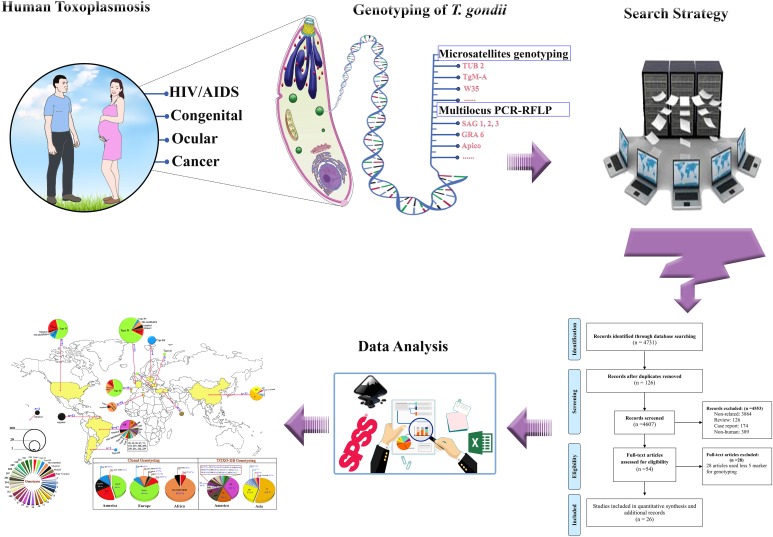
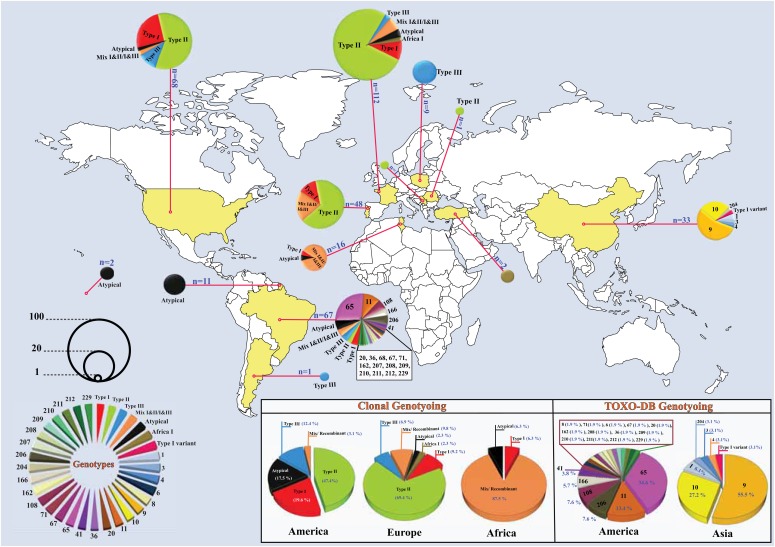
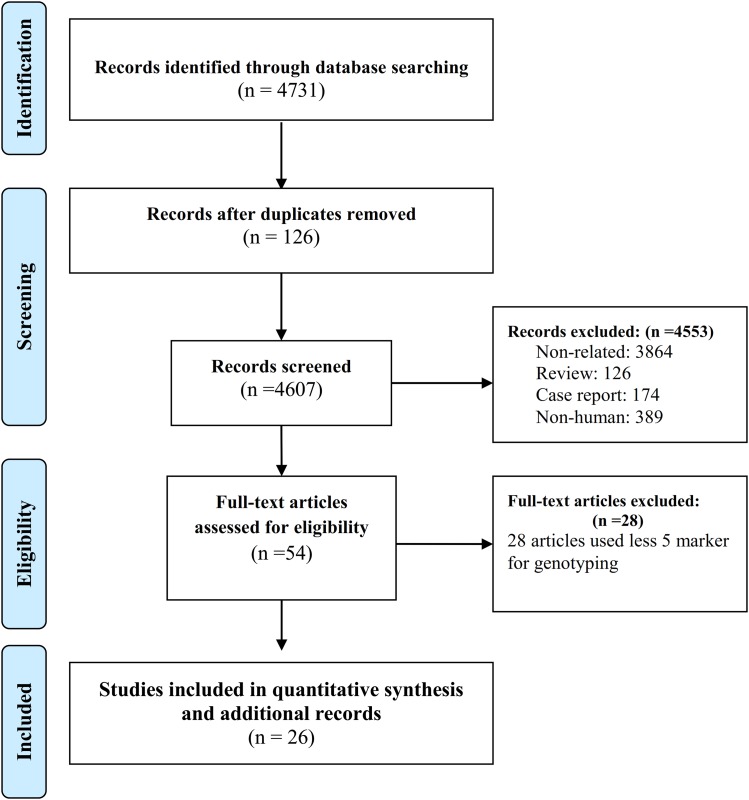
Toxoplasma gondii (T. gondii) as an obligate intracellular protozoan with a worldwide distribution can infect virtually all warm-blooded animals and humans. This study aims to provide a summary of the available data on genotypes of T. gondii in human. Five databases including MEDLINE in PubMed, Scopus, Science Direct, Web of Science and Google Scholar were searched for the T. gondii genotyping in human during 1995-August 2017. Next, we screened all the articles based on the inclusion and exclusion criteria. Overall, 26 studies were eligible regarding genotyping T. gondii in human samples. In clonal genotyping, 167 out of 286 cases (58%) were infected with type II. Genetic characterisation of T. gondii isolates displayed that type II was the most predominant genotype in human with the prevalence of 64.3%, 62.1% and 41.7% in patients with AIDS, congenital and ocular toxoplasmosis, respectively. In ToxoDB genotyping, most individuals were infected with genotypes #9 and #65 (21.2%). Based on these results, genotype profile of T. gondii isolates is different throughout the world. The strains in Asian and African countries are characterised by low genetic diversity, while in North and South America a wide diversity of this parasite is found. In countries without any data (e.g. Australia, Western and Southern Africa and Western Asia), identification of T. gondii genotypes might discover higher genetic diversity.
刚地弓形虫作为一种全球分布的专性细胞内原生动物,几乎可以感染所有温血动物和人类。本研究旨在总结关于人类刚地弓形虫基因型的现有数据。在PubMed中的MEDLINE、Scopus、Science Direct、Web of Science和Google Scholar这五个数据库中,检索了1995年至2017年8月期间人类刚地弓形虫基因分型的相关内容。接下来,我们根据纳入和排除标准筛选了所有文章。总体而言,有26项研究符合人类样本中刚地弓形虫基因分型的要求。在克隆基因分型中,286例病例中有167例(58%)感染了II型。刚地弓形虫分离株的基因特征显示,II型是人类中最主要的基因型,在艾滋病患者、先天性和眼部弓形虫病患者中的患病率分别为64.3%、62.1%和41.7%。在ToxoDB基因分型中,大多数个体感染的是#9和#65基因型(21.2%)。基于这些结果,刚地弓形虫分离株的基因型分布在世界各地有所不同。亚洲和非洲国家的菌株遗传多样性较低,而在北美洲和南美洲发现了这种寄生虫的广泛多样性。在没有任何数据的国家(如澳大利亚、非洲西部和南部以及西亚),刚地弓形虫基因型的鉴定可能会发现更高的遗传多样性。