Iserbyt Arne, Griffioen Maaike, Borremans Benny, Eens Marcel, Müller Wendt
Behavioural Ecology and Ecophysiology Group University of Antwerp Wilrijk Belgium.
Department of Ecology and Evolutionary Biology University of California Los Angeles Los Angeles California.
Ecol Evol. 2018 Oct 2;8(20):10166-10174. doi: 10.1002/ece3.4491. eCollection 2018 Oct.
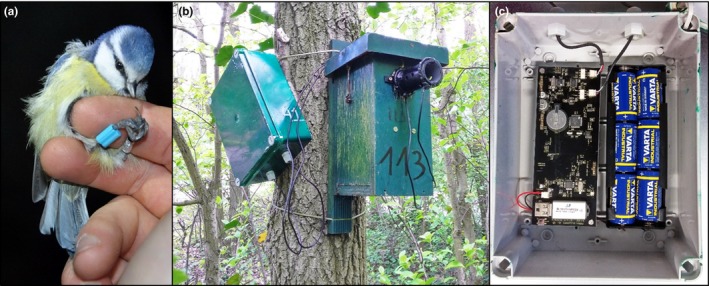
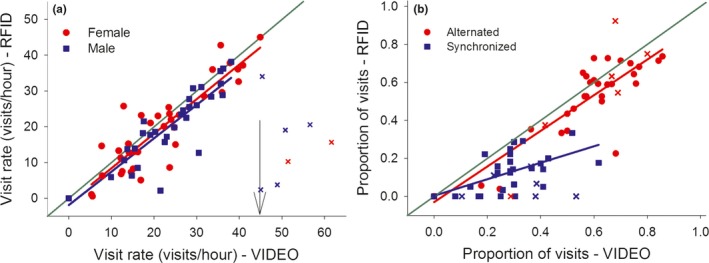
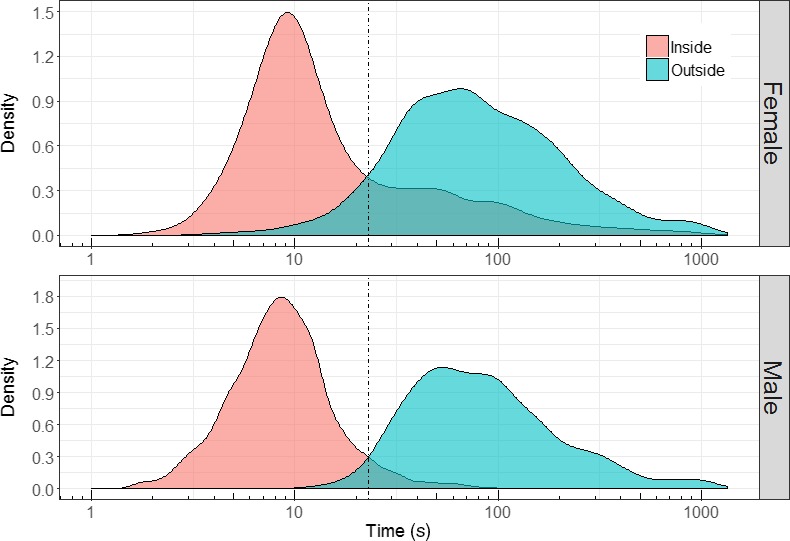
Automated animal monitoring via radio-frequency identification (RFID) technology allows efficient and extensive data sampling of individual activity levels and is therefore commonly used for ecological research. However, processing RFID data is still a largely unresolved problem, which potentially leads to inaccurate estimates for behavioral activity. One of the major challenges during data processing is to isolate independent behavioral actions from a set of superfluous, nonindependent detections. As a case study, individual blue tits () were simultaneously monitored during reproduction with both video recordings and RFID technology. We demonstrated how RFID data can be processed based on the time spent in- and outside a nest box. We then validated the number and timing of nest visits obtained from the processed RFID dataset by calibration against video recordings. The video observations revealed a limited overlap between the time spent in- and outside the nest box, with the least overlap at 23 s for both sexes. We then isolated exact arrival times from redundant RFID registrations by erasing all successive registrations within 23 s after the preceding registration. After aligning the processed RFID data with the corresponding video recordings, we observed a high accuracy in three behavioral estimates of parental care (individual nest visit rates, within-pair alternation and synchronization of nest visits). We provide a clear guideline for future studies that aim to implement RFID technology in their research. We argue that our suggested RFID data processing procedure improves the precision of behavioral estimates, despite some inevitable drawbacks inherent to the technology. Our method is useful, not only for other cavity breeding birds, but for a wide range of (in)vertebrate species that are large enough to be fitted with a tag and that regularly pass near or through a fixed antenna.
通过射频识别(RFID)技术进行自动动物监测,能够高效且广泛地采集个体活动水平的数据,因此在生态研究中被广泛应用。然而,处理RFID数据仍是一个很大程度上未解决的问题,这可能导致行为活动估计不准确。数据处理过程中的主要挑战之一,是从一组多余的、非独立的检测中分离出独立的行为动作。作为一个案例研究,在蓝山雀繁殖期间,同时使用视频记录和RFID技术对个体进行监测。我们展示了如何根据在巢箱内外停留的时间来处理RFID数据。然后,通过与视频记录校准,验证了从处理后的RFID数据集中获得的巢访问次数和时间。视频观察显示,在巢箱内外停留的时间重叠有限,两性的最小重叠时间为23秒。然后,通过删除前一次记录后23秒内的所有连续记录,从冗余的RFID记录中分离出准确的到达时间。在将处理后的RFID数据与相应的视频记录对齐后,我们在亲代抚育的三个行为估计(个体巢访问率、配对内交替和巢访问同步)中观察到了很高的准确性。我们为未来旨在在研究中应用RFID技术的研究提供了明确的指导方针。我们认为,尽管该技术存在一些不可避免的缺点,但我们建议的RFID数据处理程序提高了行为估计的精度。我们的方法不仅对其他洞巢繁殖鸟类有用,而且对各种足够大以佩戴标签且经常经过或穿过固定天线的(无)脊椎动物物种也有用。