Zhou Zhizhi, Chen Dong, Wang Xiang, Jiang Jiahuan
Key Laboratory of Biorheological Science and Technology, Ministry of Education, Bioengineering College of Chongqing University, Chongqing 400044, China.
Micromachines (Basel). 2017 Sep 21;8(10):287. doi: 10.3390/mi8100287.
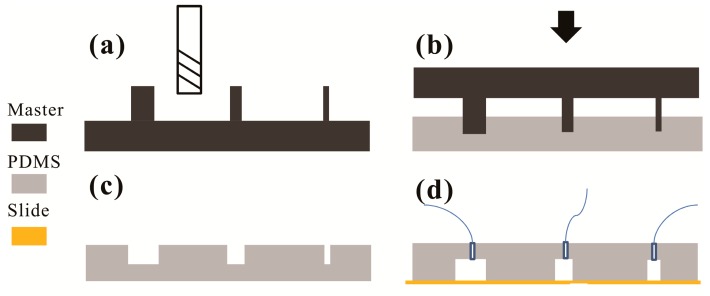
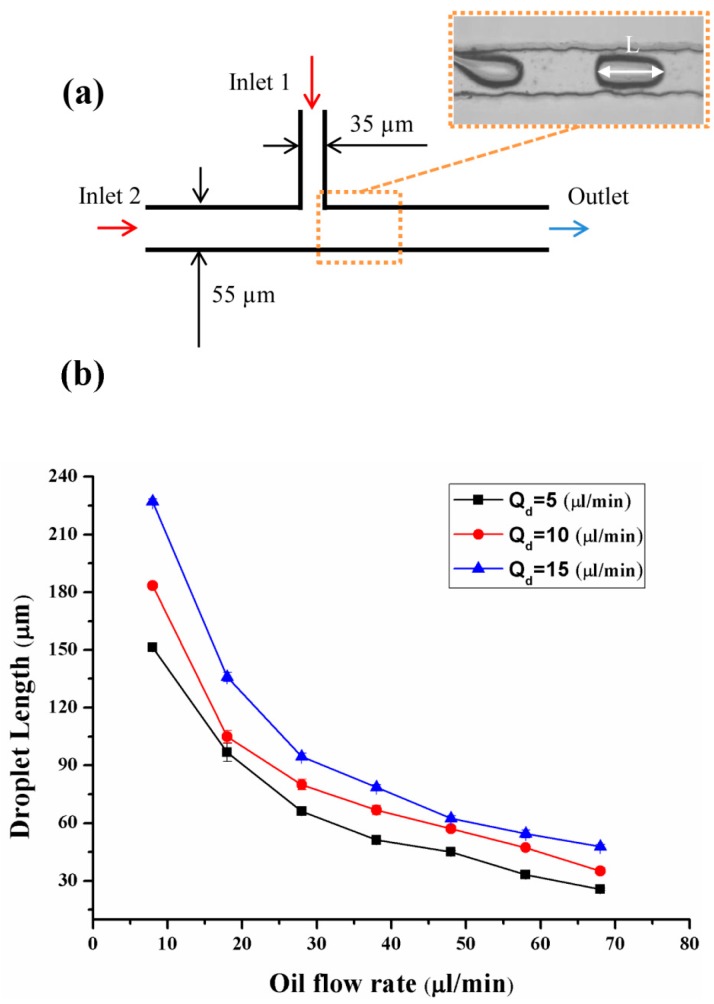
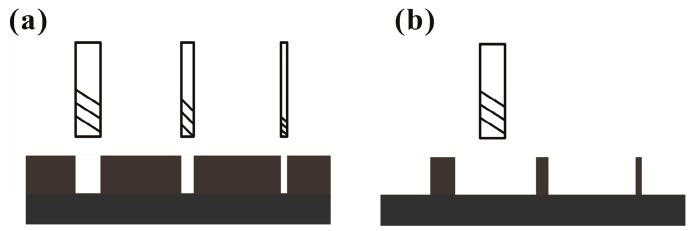
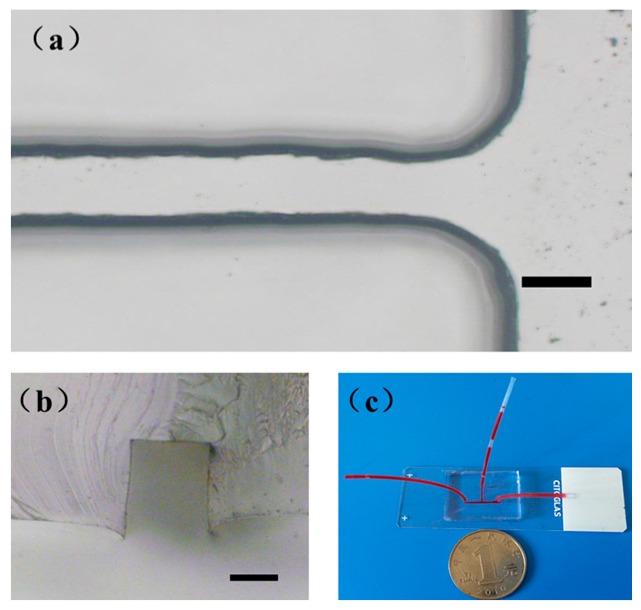
We provide a facile and low-cost method (F-L) to fabricate a two-dimensional positive master using a milling technique for polydimethylsiloxane (PDMS)-based microchannel molding. This method comprises the following steps: (1) a positive microscale master of the geometry is milled on to an acrylic block; (2) pre-cured PDMS is used to mold the microscale positive master; (3) the PDMS plate is peeled off from the master and punctured with a blunt needle; and (4) the PDMS plate is O₂ plasma bonded to a glass slide. Using this technique, we can fabricate microchannels with very simple protocols quickly and inexpensively. This method also avoids breakage of the end mill (ϕ = 0.4 mm) of the computerized numerical control (CNC) system when fabricating the narrow channels (width < 50 µm). The prominent surface roughness of the milled bottom-layer could be overcomed by pre-cured PDMS with size trade-off in design. Finally, emulsion formation successfully demonstrates the validity of the proposed fabrication protocol. This work represents an important step toward the use of a milling technique for PDMS-based microfabrication.
我们提供了一种简便且低成本的方法(F-L),用于通过铣削技术制造二维阳模,以用于基于聚二甲基硅氧烷(PDMS)的微通道成型。该方法包括以下步骤:(1)将几何形状的微尺度阳模铣削到丙烯酸块上;(2)使用预固化的PDMS对微尺度阳模进行成型;(3)将PDMS板从阳模上剥离并用钝针穿刺;(4)将PDMS板通过O₂等离子体键合到载玻片上。使用该技术,我们可以通过非常简单的方案快速且廉价地制造微通道。该方法还避免了在制造窄通道(宽度<50 µm)时计算机数控(CNC)系统的端铣刀(ϕ = 0.4 mm)损坏。通过设计中尺寸权衡的预固化PDMS可以克服铣削底层明显的表面粗糙度。最后,乳液形成成功证明了所提出制造方案的有效性。这项工作代表了朝着将铣削技术用于基于PDMS的微制造迈出的重要一步。