Carugo Dario, Lee Jeong Yu, Pora Anne, Browning Richard J, Capretto Lorenzo, Nastruzzi Claudio, Stride Eleanor
BUBBL, Institute of Biomedical Engineering, Department of Engineering Science, University of Oxford, Old Road Campus Research Building, Oxford, OX3 7DQ, UK.
School of Pharmacy, University College London (UCL), London, WC1E 6BT, UK.
Biomed Microdevices. 2016 Feb;18(1):4. doi: 10.1007/s10544-015-0027-x.
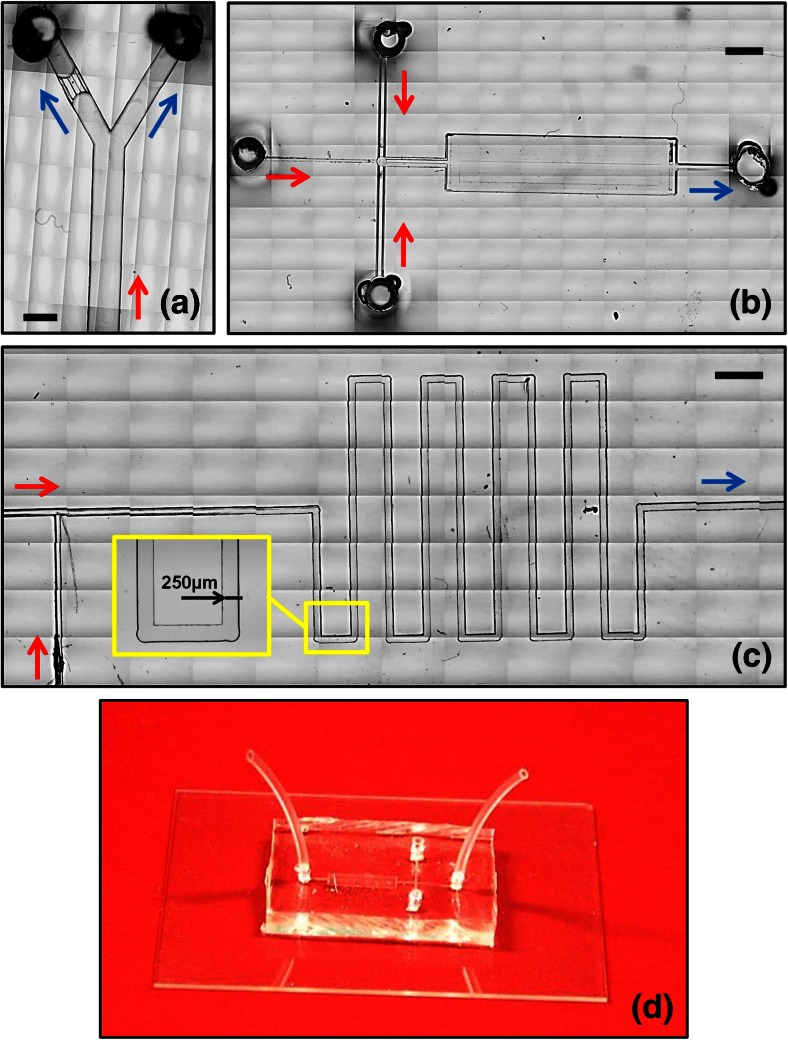
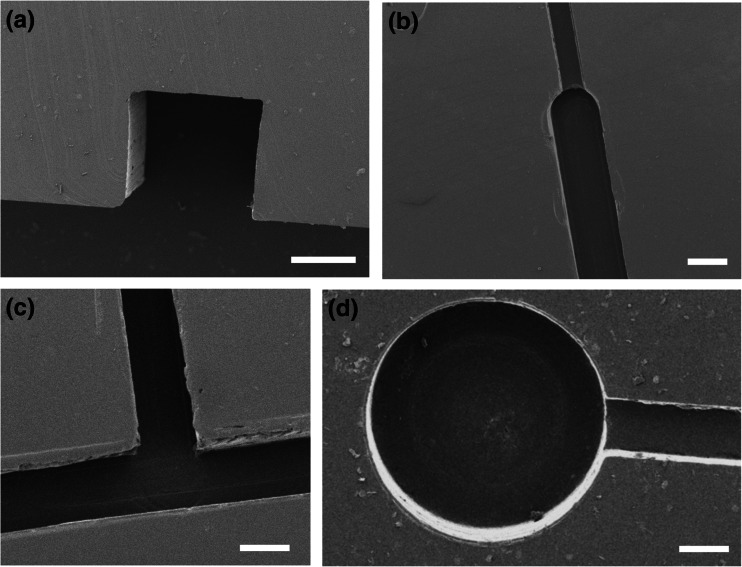
We describe a cost-effective and simple method to fabricate PDMS-based microfluidic devices by combining micromilling with replica moulding technology. It relies on the following steps: (i) microchannels are milled in a block of acrylic; (ii) low-cost epoxy adhesive resin is poured over the milled acrylic block and allowed to cure; (iii) the solidified resin layer is peeled off the acrylic block and used as a mould for transferring the microchannel architecture onto a PDMS layer; finally (iv) the PDMS layer is plasma bonded to a glass surface. With this method, microscale architectures can be fabricated without the need for advanced technological equipment or laborious and time-consuming intermediate procedures. In this manuscript, we describe and validate the microfabrication procedure, and we illustrate its applicability to emulsion and microbubble production.
我们描述了一种经济高效且简单的方法,通过将微铣削与复制成型技术相结合来制造基于聚二甲基硅氧烷(PDMS)的微流控装置。该方法依赖于以下步骤:(i)在一块丙烯酸树脂块中铣削微通道;(ii)将低成本的环氧胶粘剂树脂浇注在铣削后的丙烯酸树脂块上并使其固化;(iii)将固化的树脂层从丙烯酸树脂块上剥离下来,并用作将微通道结构转移到PDMS层上的模具;最后(iv)将PDMS层通过等离子体键合到玻璃表面。通过这种方法,可以制造微尺度结构,而无需先进的技术设备或繁琐且耗时的中间程序。在本手稿中,我们描述并验证了微制造程序,并说明了其在乳液和微气泡生产中的适用性。