Jiménez-Díaz Edgar, Cano-Jorge Mariel, Zamarrón-Hernández Diego, Cabriales Lucia, Páez-Larios Francisco, Cruz-Ramírez Aarón, Vázquez-Victorio Genaro, Fiordelisio Tatiana, Hautefeuille Mathieu
Facultad de Ciencias, Universidad Nacional Autónoma de México, CDMX 04510, Mexico.
Posgrado en Ciencias Biomédicas, Universidad Nacional Autónoma de México, CDMX 04510, Mexico.
Micromachines (Basel). 2019 Aug 30;10(9):576. doi: 10.3390/mi10090576.
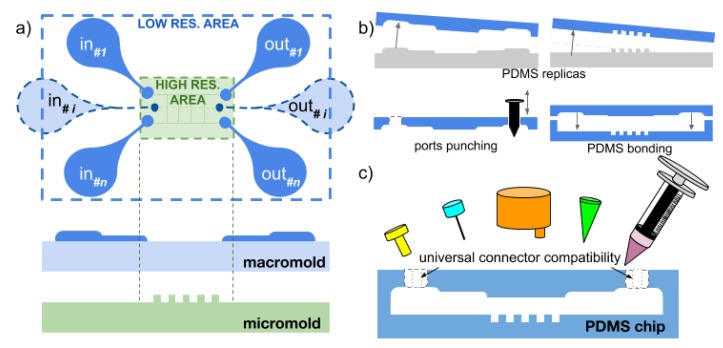
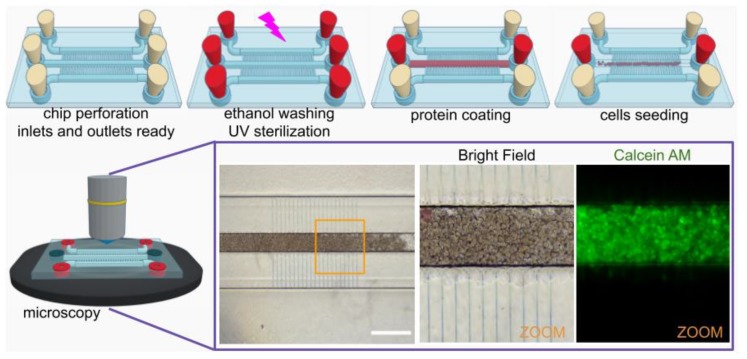
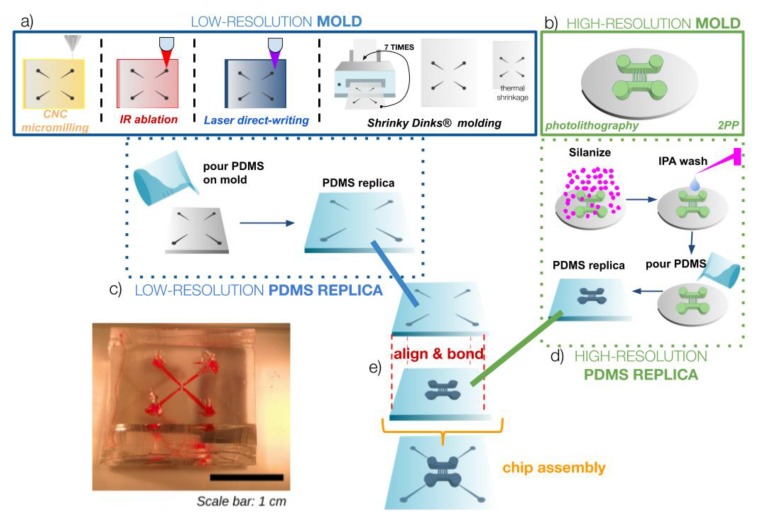
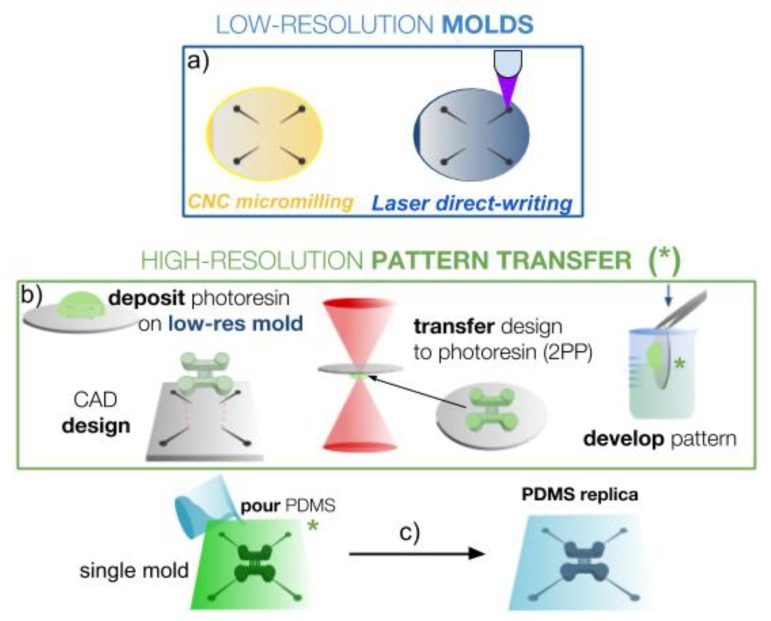
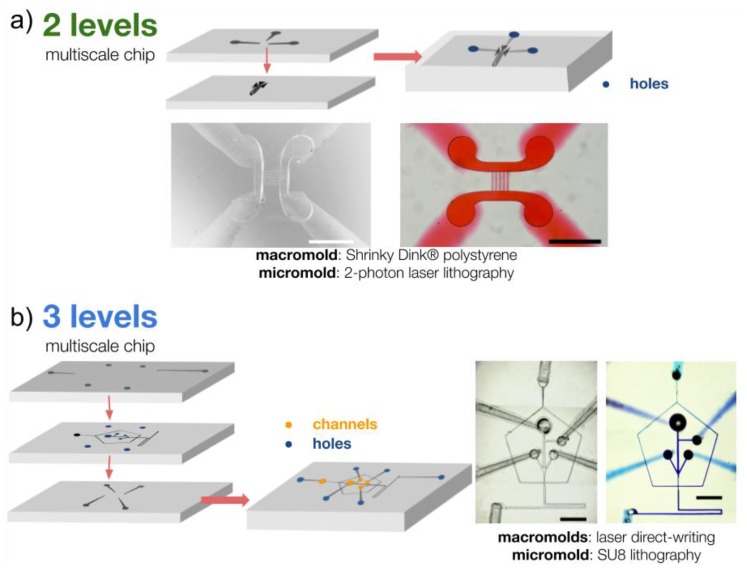
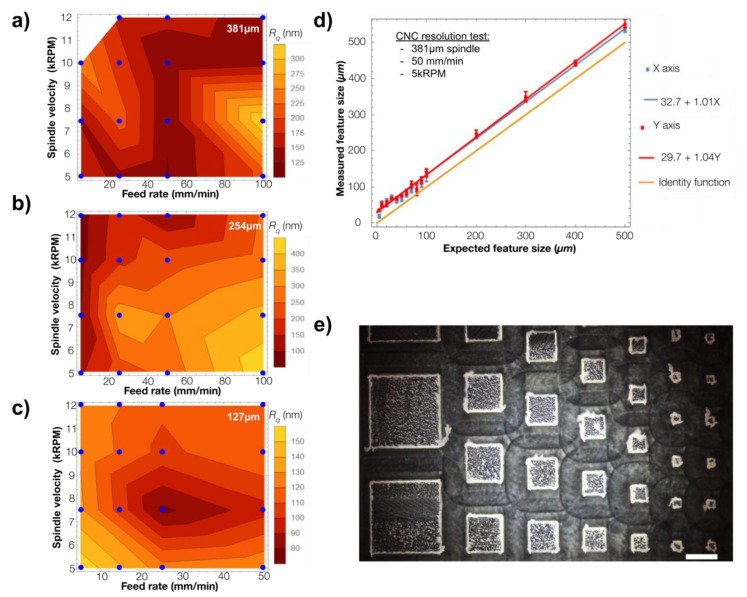
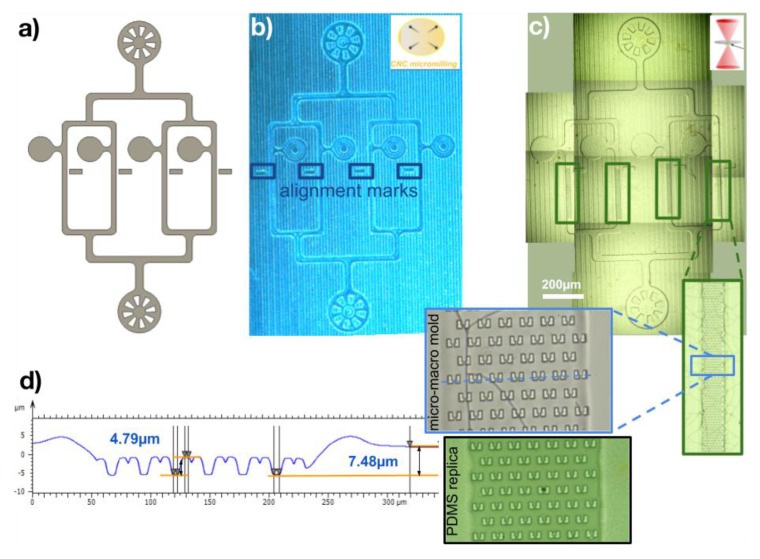
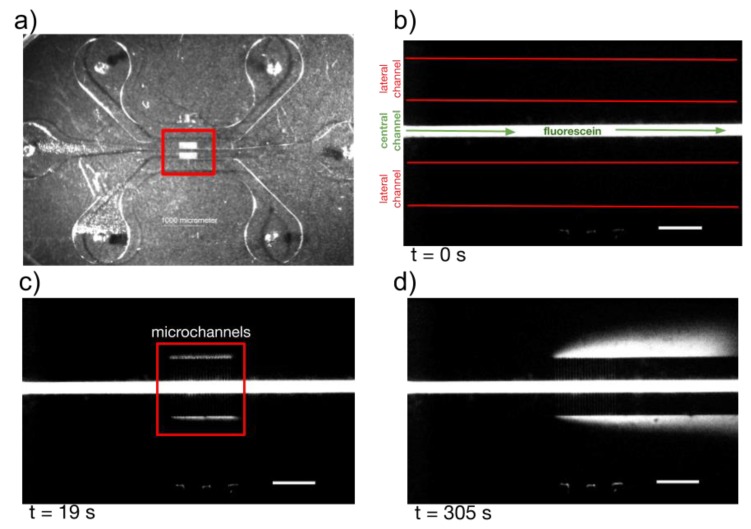
Microfluidics has become a very promising technology in recent years, due to its great potential to revolutionize life-science solutions. Generic microfabrication processes have been progressively made available to academic laboratories thanks to cost-effective soft-lithography techniques and enabled important progress in applications like lab-on-chip platforms using rapid- prototyping. However, micron-sized features are required in most designs, especially in biomimetic cell culture platforms, imposing elevated costs of production associated with lithography and limiting the use of such devices. In most cases, however, only a small portion of the structures require high-resolution and cost may be decreased. In this work, we present a replica-molding method separating the fabrication steps of low (macro) and high (micro) resolutions and then merging the two scales in a single chip. The method consists of fabricating the largest possible area in inexpensive macromolds using simple techniques such as plastics micromilling, laser microfabrication, or even by shrinking printed polystyrene sheets. The microfeatures were made on a separated mold or onto existing macromolds using photolithography or 2-photon lithography. By limiting the expensive area to the essential, the time and cost of fabrication can be reduced. Polydimethylsiloxane (PDMS) microfluidic chips were successfully fabricated from the constructed molds and tested to validate our micro-macro method.
近年来,微流控技术已成为一项极具前景的技术,因为它在革新生命科学解决方案方面具有巨大潜力。得益于具有成本效益的软光刻技术,通用微制造工艺已逐渐应用于学术实验室,并在诸如使用快速原型制作的芯片实验室平台等应用中取得了重要进展。然而,大多数设计都需要微米级特征,尤其是在仿生细胞培养平台中,这导致与光刻相关的生产成本高昂,并限制了此类设备的使用。然而,在大多数情况下,只有一小部分结构需要高分辨率,成本可能会降低。在这项工作中,我们提出了一种复制成型方法,将低(宏观)分辨率和高(微观)分辨率的制造步骤分开,然后在单个芯片中合并这两个尺度。该方法包括使用诸如塑料微铣削、激光微制造甚至通过收缩印刷聚苯乙烯片材等简单技术,在廉价的宏观模具中制造尽可能大的区域。微观特征是使用光刻或双光子光刻在单独的模具上或现有的宏观模具上制作的。通过将昂贵的区域限制在必要的部分,可以减少制造时间和成本。由构建的模具成功制造了聚二甲基硅氧烷(PDMS)微流控芯片,并进行了测试以验证我们的微宏观方法。