
打印头芯片内CMOS多路复用器喷射矩阵寻址与微滴的研究
Investigation of CMOS Multiplexer Jet Matrix Addressing and Micro-Droplets within a Printhead Chip.
作者信息
Liou Jian-Chiun, Yang Cheng-Fu
机构信息
School of Biomedical Engineering, Taipei Medical University, Taipei 11031, Taiwan.
Department of Chemical and Materials Engineering, National University of Kaohsiung, Kaohsiung 811, Taiwan.
出版信息
Micromachines (Basel). 2017 Nov 29;8(12):346. doi: 10.3390/mi8120346.
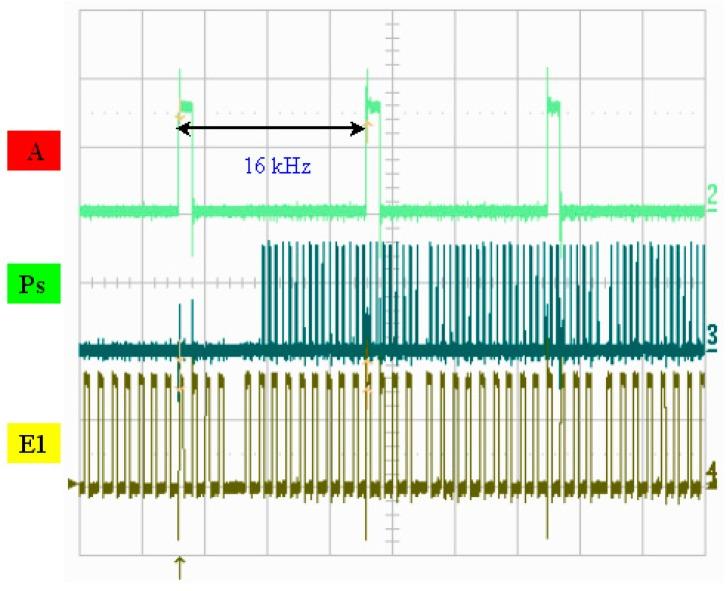
In this study, we demonstrate and investigate a new droplet injection design. We create a thermal inkjet (TIJ) printhead using an application-specific integrated circuit system and bulk micromachining technology (microelectromechanical systems). We design inkjet printhead chips with a new structure and investigate their properties. For the new structure, the integration of complementary metal-oxide-semiconductors (MOSs) and enhancement-mode devices, as well as power switches and a TIJ heater transducer, enables logic functions to be executed on-chip. This capability is used in the proposed design to address individual jets with even fewer input lines than in matrix addressing. A high number of jets (at least 896) can be addressed with only 11 input lines. E1 (Enable 1) and E2 (Enable 2) are set up dependently, and they have the ability to reverse their signals in relation to each other (i.e., if E1 is disabled, E2 is enabled and vice versa). The E1 and E2 signals each service 448 jets. If one of the MOSs is turned on, then it corresponds to a power line with a similar function. If an addressing gate terminal of the other MOS has a discharge action, then we can control a different heater to generate heating bubbles in the jet inks. The operating frequency for addressing these measurements is 18 kHz in normal mode, 26 kHz in draft mode, and 16 kHz in best mode.
在本研究中,我们展示并研究了一种新型液滴喷射设计。我们使用专用集成电路系统和体微加工技术(微机电系统)制造了一个热喷墨(TIJ)打印头。我们设计了具有新结构的喷墨打印头芯片并研究了它们的特性。对于新结构,互补金属氧化物半导体(MOS)与增强模式器件、电源开关以及TIJ加热器换能器的集成,使得逻辑功能能够在芯片上执行。在所提出的设计中,利用这一能力以比矩阵寻址更少的输入线来寻址各个喷嘴。仅用11条输入线就可以寻址大量喷嘴(至少896个)。E1(使能1)和E2(使能2)是相关设置的,并且它们能够彼此反转信号(即,如果E1禁用,则E2启用,反之亦然)。E1和E2信号各自服务448个喷嘴。如果其中一个MOS开启,那么它对应于具有类似功能的电源线。如果另一个MOS的寻址栅极端有放电动作,那么我们可以控制不同的加热器在喷射墨水中产生加热气泡。在正常模式下,用于寻址这些测量的工作频率为18 kHz,草稿模式下为26 kHz,最佳模式下为16 kHz。




 Zotero 插件