Barisam Maryam, Saidi Mohammad Said, Kashaninejad Navid, Vadivelu Raja, Nguyen Nam-Trung
Department of Mechanical Engineering, Sharif University of Technology, Tehran 11155, Iran.
Queensland Micro- and Nanotechnology Centre, Nathan Campus, Griffith University, 170 Kessels Road, Brisbane, QLD 4111, Australia.
Micromachines (Basel). 2017 Dec 11;8(12):358. doi: 10.3390/mi8120358.
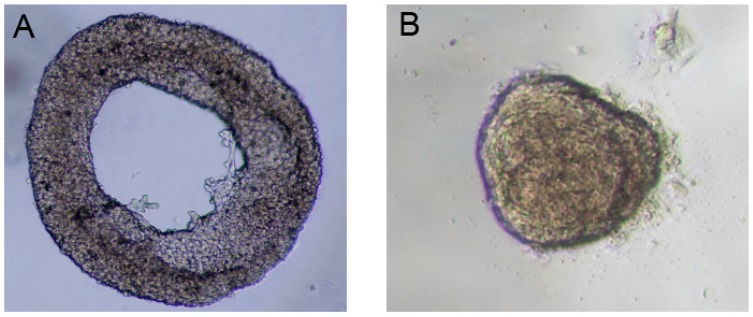
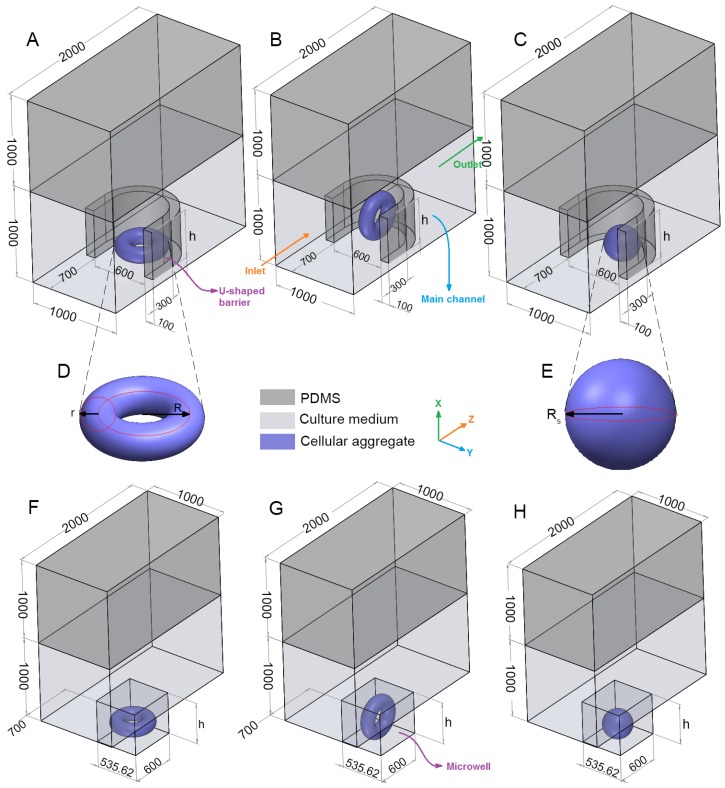
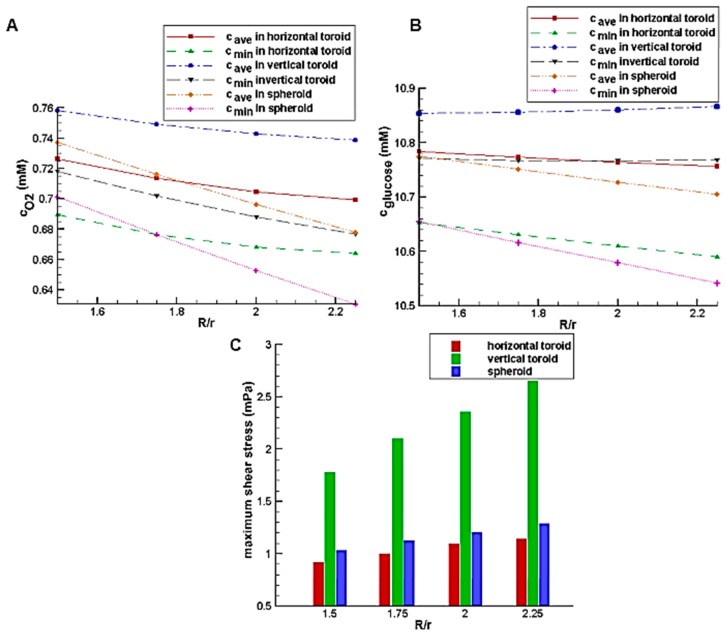
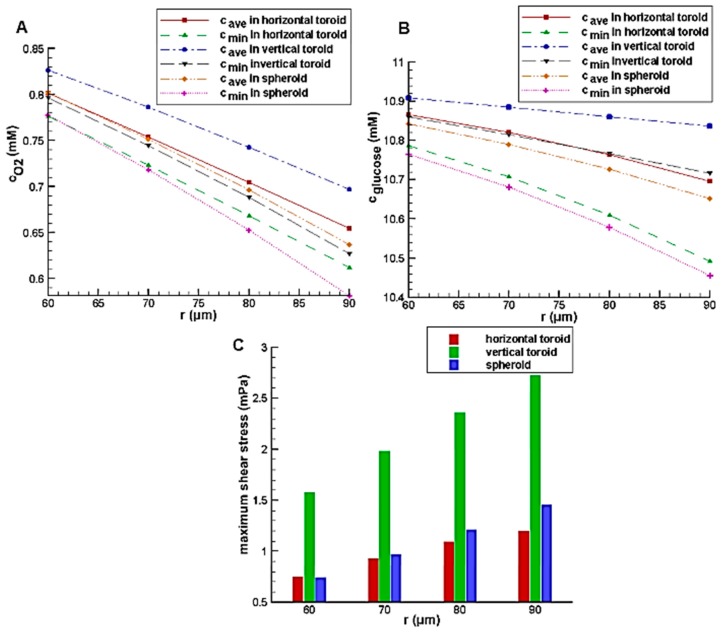
A microfluidic system provides an excellent platform for cellular studies. Most importantly, a three-dimensional (3D) cell culture model reconstructs more accurately the in vivo microenvironment of tissue. Accordingly, microfluidic 3D cell culture devices could be ideal candidates for in vitro cell culture platforms. In this paper, two types of 3D cellular aggregates, i.e., toroid and spheroid, are numerically studied. The studies are carried out for microfluidic systems containing U-shaped barrier as well as microwell structure. For the first time, we obtain oxygen and glucose concentration distributions inside a toroid aggregate as well as the shear stress on its surface and compare its performance with a spheroid aggregate of the same volume. In particular, we obtain the oxygen concentration distributions in three areas, namely, oxygen-permeable layer, multicellular aggregates and culture medium. Further, glucose concentration distributions in two regions of multicellular aggregates and culture medium are investigated. The results show that the levels of oxygen and glucose in the system containing U-shaped barriers are far more than those in the system containing microwells. Therefore, to achieve high levels of oxygen and nutrients, a system with U-shaped barriers is more suited than the conventional traps, but the choice between toroid and spheroid depends on their volume and orientation. The results indicate that higher oxygen and glucose concentrations can be achieved in spheroid with a small volume as well as in horizontal toroid with a large volume. The vertical toroid has the highest levels of oxygen and glucose concentration while the surface shear stress on its surface is also maximum. These findings can be used as guidelines for designing an optimum 3D microfluidic bioreactor based on the desired levels of oxygen, glucose and shear stress distributions.
微流控系统为细胞研究提供了一个绝佳的平台。最重要的是,三维(3D)细胞培养模型能更准确地重建组织的体内微环境。因此,微流控3D细胞培养装置可能是体外细胞培养平台的理想选择。在本文中,对两种类型的3D细胞聚集体,即环形聚集体和球形聚集体进行了数值研究。研究针对包含U形屏障以及微孔结构的微流控系统展开。我们首次获得了环形聚集体内部的氧气和葡萄糖浓度分布以及其表面的剪切应力,并将其性能与相同体积的球形聚集体进行了比较。特别地,我们获得了三个区域的氧气浓度分布,即透氧层、多细胞聚集体和培养基。此外,还研究了多细胞聚集体和培养基两个区域的葡萄糖浓度分布。结果表明,含有U形屏障的系统中的氧气和葡萄糖水平远高于含有微孔的系统。因此,为了实现高水平的氧气和营养物质,具有U形屏障的系统比传统阱更合适,但环形聚集体和球形聚集体之间的选择取决于它们的体积和取向。结果表明,小体积的球形聚集体以及大体积的水平环形聚集体中可以实现更高的氧气和葡萄糖浓度。垂直环形聚集体的氧气和葡萄糖浓度水平最高,而其表面的剪切应力也最大。这些发现可作为基于所需的氧气、葡萄糖和剪切应力分布水平设计最佳3D微流控生物反应器的指导原则。