Department of Biochemistry, University of Wisconsin-Madison, Madison, WI 53706.
Biomolecular Mass Spectrometry and Proteomics, Utrecht University, Utrecht, Netherlands.
Mol Cell Proteomics. 2019 Feb;18(2):308-319. doi: 10.1074/mcp.RA118.001124. Epub 2018 Nov 6.
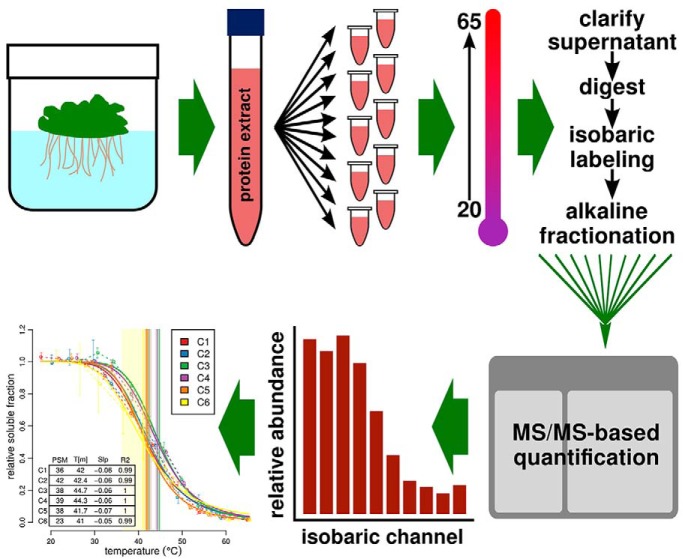
Modern tandem MS-based sequencing technologies allow for the parallel measurement of concentration and covalent modifications for proteins within a complex sample. Recently, this capability has been extended to probe a proteome's three-dimensional structure and conformational state by determining the thermal denaturation profile of thousands of proteins simultaneously. Although many animals and their resident microbes exist under a relatively narrow, regulated physiological temperature range, plants take on the often widely ranging temperature of their surroundings, possibly influencing the evolution of protein thermal stability. In this report we present the first in-depth look at the thermal proteome of a plant species, the model organism By profiling the melting curves of over 1700 Arabidopsis proteins using six biological replicates, we have observed significant correlation between protein thermostability and several known protein characteristics, including molecular weight and the composition ratio of charged to polar amino acids. We also report on a divergence of the thermostability of the core and regulatory domains of the plant 26S proteasome that may reflect a unique property of the way protein turnover is regulated during temperature stress. Lastly, the highly replicated database of Arabidopsis melting temperatures reported herein provides baseline data on the variability of protein behavior in the assay. Unfolding behavior and experiment-to-experiment variability were observed to be protein-specific traits, and thus this data can serve to inform the design and interpretation of future targeted assays to probe the conformational status of proteins from plants exposed to different chemical, environmental and genetic challenges.
现代串联 MS 测序技术允许在复杂样本中同时测量蛋白质的浓度和共价修饰。最近,这种能力已经扩展到通过同时确定数千种蛋白质的热变性曲线来探测蛋白质组的三维结构和构象状态。尽管许多动物及其居住的微生物存在于相对较窄、受调节的生理温度范围内,但植物承受着周围环境经常广泛变化的温度,这可能影响蛋白质热稳定性的进化。在本报告中,我们首次深入研究了植物物种模型生物的热蛋白质组。通过使用六个生物学重复对超过 1700 种拟南芥蛋白质的熔融曲线进行分析,我们观察到蛋白质热稳定性与几个已知的蛋白质特性之间存在显著相关性,包括分子量和带电荷与极性氨基酸的组成比例。我们还报告了植物 26S 蛋白酶体核心和调节域的热稳定性差异,这可能反映了在温度胁迫下蛋白质周转调控方式的独特特性。最后,本文报告的拟南芥融解温度的高度重复数据库为该测定中蛋白质行为的可变性提供了基线数据。我们观察到蛋白质的展开行为和实验间的可变性是蛋白质特异性的特征,因此该数据可以为设计和解释未来针对不同化学、环境和遗传挑战下植物暴露的蛋白质构象状态的靶向测定提供信息。