Department of Virology, Veterinary Research Institute, Hudcova 70, CZ-62100, Brno, Czech Republic.
Institute of Parasitology, Biology Centre of the Czech Academy of Sciences, Branisovska 31, CZ-37005, Ceske Budejovice, Czech Republic.
Emerg Microbes Infect. 2018 Nov 7;7(1):175. doi: 10.1038/s41426-018-0177-z.
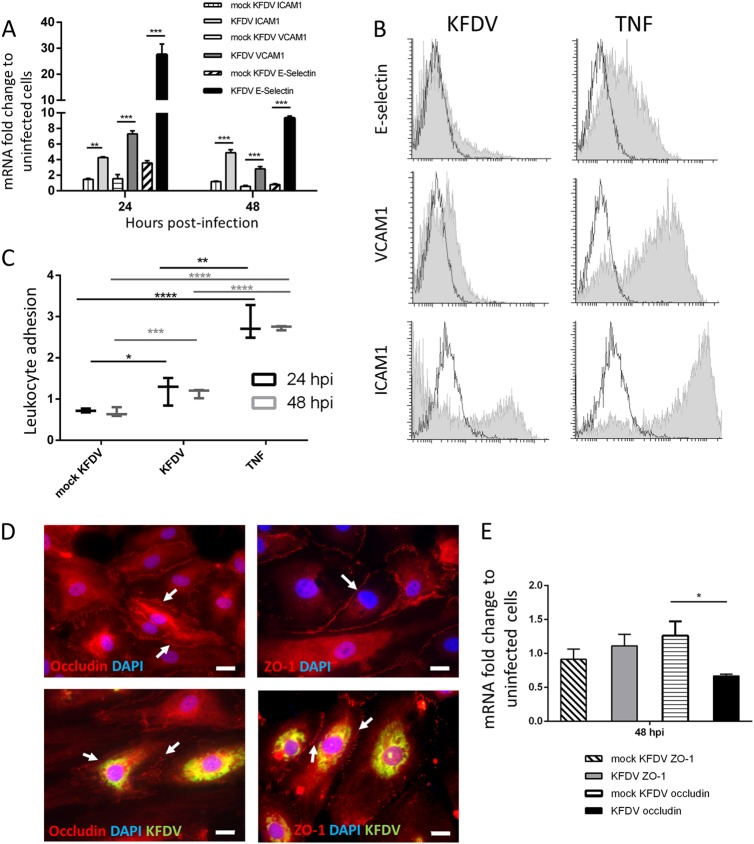
Kyasanur Forest disease virus (KFDV) is a highly pathogenic tick-borne flavivirus enzootic to India. In humans, KFDV causes a severe febrile disease. In some infected individuals, hemorrhagic manifestations, such as bleeding from the nose and gums and gastrointestinal bleeding with hematemesis and/or blood in the stool, have been reported. However, the mechanisms underlying these hemorrhagic complications remain unknown, and there is no information about the specific target cells for KFDV. We investigated the interaction of KFDV with vascular endothelial cells (ECs) and monocyte-derived dendritic cells (moDCs), which are key targets for several other hemorrhagic viruses. Here, we report that ECs are permissive to KFDV infection, which leads to their activation, as demonstrated by the upregulation of E-selectin, intercellular adhesion molecule 1, and vascular cell adhesion molecule 1 at the mRNA and protein levels. Increased expression of these adhesive molecules correlated with increased leukocyte adhesion. Infected ECs upregulated the expression of interleukin (IL)-6 but not IL-8. Additionally, moDCs were permissive to KFDV infection, leading to increased release of IL-6 and tumor necrosis factor-α. Supernatants from KFDV-infected moDCs caused EC activation, as measured by leukocyte adhesion. The results indicate that ECs and moDCs can be targets for KFDV and that both direct and indirect mechanisms can contribute to EC activation.
基孔肯雅热病毒(KFDV)是一种高度致病性的蜱传黄病毒,在印度流行。在人类中,KFDV 引起严重的发热疾病。在一些感染个体中,已报告有出血表现,如鼻出血、牙龈出血以及呕血和/或大便中有血。然而,这些出血并发症的机制尚不清楚,也没有关于 KFDV 特定靶细胞的信息。我们研究了 KFDV 与血管内皮细胞(EC)和单核细胞衍生的树突状细胞(moDC)的相互作用,这些细胞是其他几种出血病毒的关键靶细胞。在这里,我们报告说 EC 允许 KFDV 感染,这导致它们的激活,如 mRNA 和蛋白质水平上调 E-选择素、细胞间黏附分子 1 和血管细胞黏附分子 1 所示。这些黏附分子的表达增加与白细胞黏附增加相关。感染的 EC 上调白细胞介素(IL)-6 的表达,但不上调 IL-8。此外,moDC 允许 KFDV 感染,导致 IL-6 和肿瘤坏死因子-α的释放增加。来自 KFDV 感染的 moDC 的上清液导致 EC 激活,如白细胞黏附所测量。结果表明,EC 和 moDC 可以成为 KFDV 的靶细胞,并且直接和间接机制都可以促进 EC 激活。