Oing Theodore, Prescott Julie
School of Education and Psychology, University of Bolton, Bolton, United Kingdom.
JMIR Serious Games. 2018 Nov 7;6(4):e10965. doi: 10.2196/10965.
Although traditional forms of therapy for anxiety-related disorders (eg, cognitive behavioral therapy, CBT) have been effective, there have been long-standing issues with these therapies that largely center around the costs and risks associated with the components comprising the therapeutic process. To treat certain types of specific phobias, sessions may need to be held in public, therefore risking patient confidentiality and the occurrence of uncontrollable circumstances (eg, weather and bystander behavior) or additional expenses such as travel to reach a destination. To address these issues, past studies have implemented virtual reality (VR) technologies for virtual reality exposure therapy (VRET) to provide an immersive, interactive experience that can be conducted privately and inexpensively. The versatility of VR allows various environments and scenarios to be generated while giving therapists control over variables that would otherwise be impossible in a natural setting. Although the outcomes from these studies have been generally positive despite the limitations of legacy VR systems, it is necessary to review these studies to identify how modern VR systems can and should improve to treat disorders in which anxiety is a key symptom, including specific phobias, posttraumatic stress disorder and acute stress disorder, generalized anxiety disorder, and paranoid ideations.
The aim of this review was to establish the efficacy of VR-based treatment for anxiety-related disorders as well as to outline how modern VR systems need to address the shortcomings of legacy VR systems.
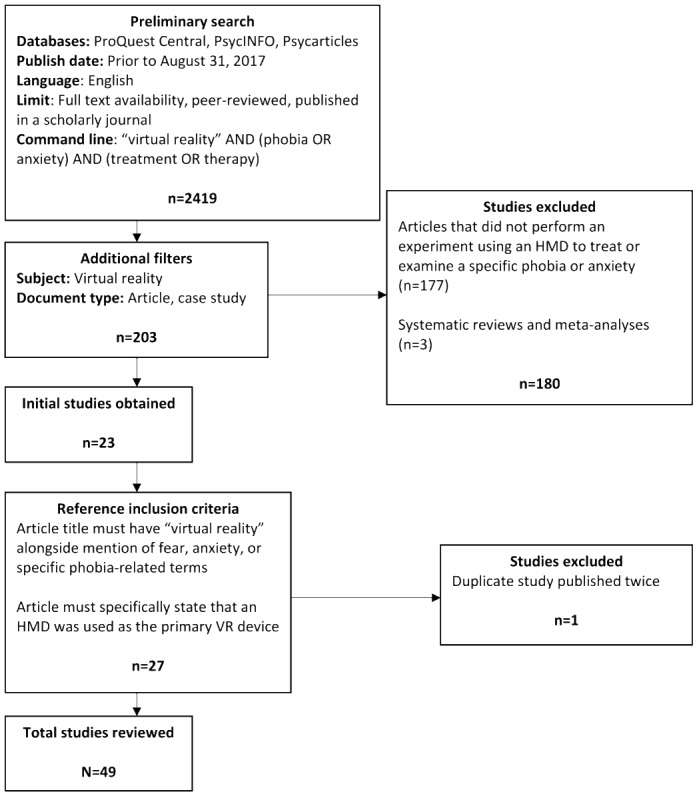
A systematic search was conducted for any VR-related, peer-reviewed articles focused on the treatment or assessment of anxiety-based disorders published before August 31, 2017, within the ProQuest Central, PsycINFO, and PsycARTICLES databases. References from these articles were also evaluated.
A total of 49 studies met the inclusion criteria from an initial pool of 2419 studies. These studies were a mix of case studies focused solely on VRET, experimental studies comparing the efficacy of VRET with various forms of CBT (eg, in vivo exposure, imaginal exposure, and exposure group therapy), and studies evaluating the usefulness of VR technology as a diagnostic tool for paranoid ideations. The majority of studies reported positive findings in favor of VRET despite the VR technology's limitations.
Although past studies have demonstrated promising and emerging efficacy for the use of VR as a treatment and diagnostic tool for anxiety-related disorders, it is clear that VR technology as a whole needs to improve to provide a completely immersive and interactive experience that is capable of blurring the lines between the real and virtual world.
尽管用于治疗焦虑相关障碍的传统疗法(如认知行为疗法,CBT)已被证明有效,但这些疗法长期存在一些问题,主要集中在构成治疗过程的各个组成部分所涉及的成本和风险上。为了治疗某些特定类型的恐惧症,治疗可能需要在公共场所进行,因此存在患者隐私泄露以及出现无法控制的情况(如天气和旁观者行为)的风险,或者产生额外费用,如前往治疗地点的差旅费。为了解决这些问题,过去的研究采用了虚拟现实(VR)技术进行虚拟现实暴露疗法(VRET),以提供一种可以私下且低成本进行的沉浸式、交互式体验。VR的多功能性允许生成各种环境和场景,同时让治疗师能够控制在自然环境中原本无法控制的变量。尽管这些研究的结果总体上是积极的,尽管传统VR系统存在局限性,但有必要对这些研究进行回顾,以确定现代VR系统如何以及应该如何改进,以治疗以焦虑为关键症状的障碍,包括特定恐惧症、创伤后应激障碍和急性应激障碍、广泛性焦虑障碍以及偏执观念。
本综述的目的是确定基于VR的治疗对焦虑相关障碍的疗效,并概述现代VR系统需要如何解决传统VR系统的缺点。
在ProQuest Central、PsycINFO和PsycARTICLES数据库中,对2017年8月31日前发表的、专注于基于焦虑障碍的治疗或评估的任何与VR相关的、经过同行评审的文章进行系统检索。还对这些文章的参考文献进行了评估。
在最初的2419项研究中,共有49项研究符合纳入标准。这些研究包括仅专注于VRET的案例研究、比较VRET与各种形式的CBT(如现场暴露、想象暴露和暴露组疗法)疗效的实验研究,以及评估VR技术作为偏执观念诊断工具的有用性的研究。尽管VR技术存在局限性,但大多数研究报告了支持VRET的积极结果。
尽管过去的研究已经证明VR作为焦虑相关障碍的治疗和诊断工具具有有前景且不断显现的疗效,但很明显,整个VR技术需要改进,以提供一种能够模糊现实世界和虚拟世界界限的完全沉浸式和交互式体验。
