Rheumatology Unit-Department of Emergence Medicine and Transplantation (DETO), University of Bari "Aldo Moro", 70124 Bari, Italy.
Mediators Inflamm. 2018 Oct 14;2018:2453265. doi: 10.1155/2018/2453265. eCollection 2018.
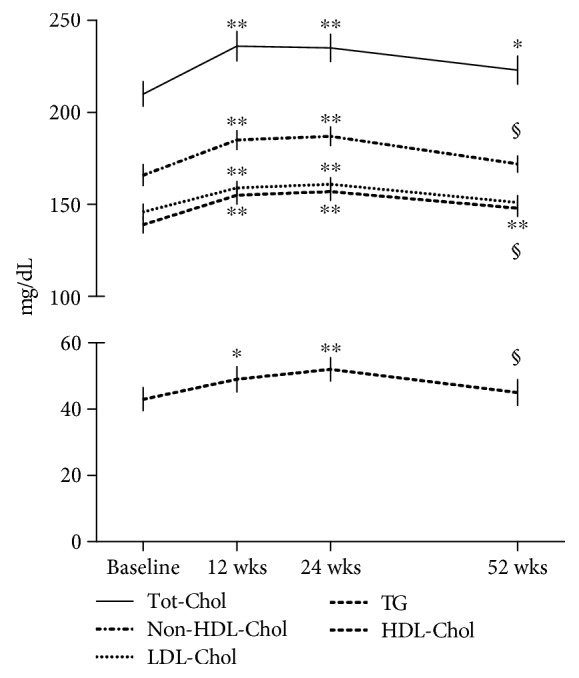
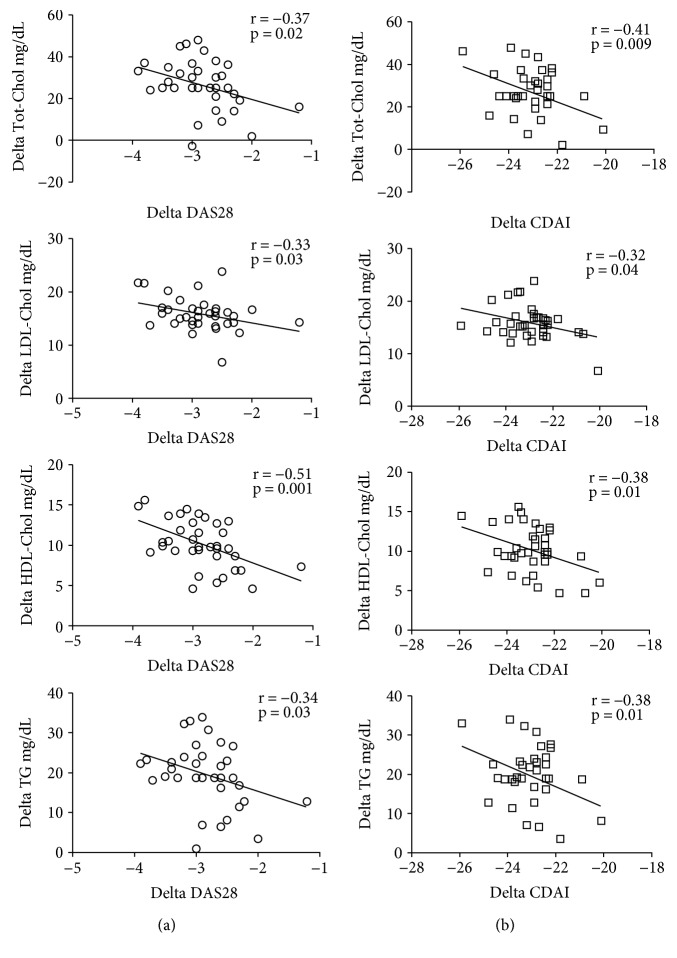
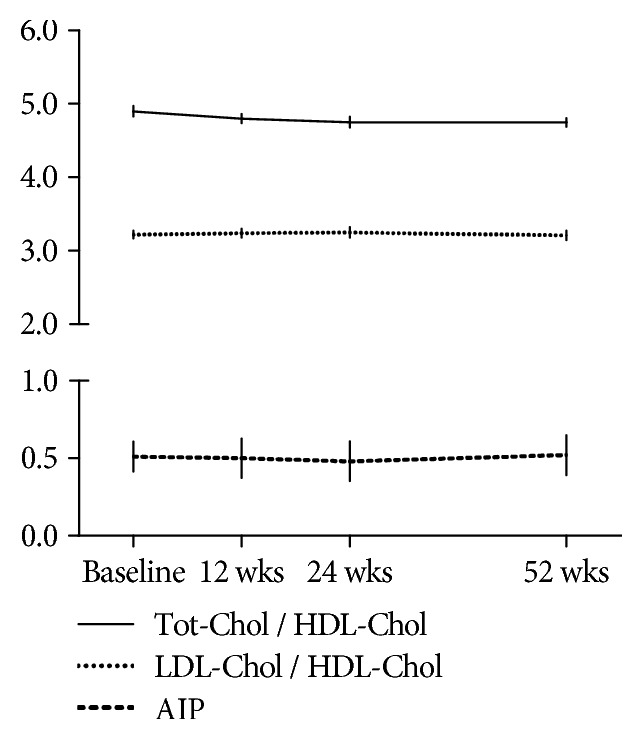
Rheumatoid arthritis (RA) patients are at high risk of cardiovascular (CV) events, and the chronic inflammatory state may generate quantitative and qualitative changes in lipoprotein fractions. The anti-IL-6 receptor tocilizumab (TCZ), even if effective in inflammation and joint damage prevention, determined significant alterations to RA patients' lipid levels in randomized controlled trials, but real-world data are lacking. We evaluated the changes in lipid fraction levels and disease activity in a longitudinal cohort of RA patients on long-term treatment with tocilizumab (TCZ) in a community setting. We retrospectively selected 40 naïve-biologic RA patients on treatment with intravenous TCZ compared to 20 RA patients on methotrexate treatment as the control group. Total cholesterol (Tot-Chol), low-density lipoproteins (LDL), high-density lipoprotein (HDL), and triglyceride (TG) levels were measured at the baseline and at 12, 24, and 52 weeks thereafter. At the same points, 28-joint disease activity score (DAS28), clinical disease activity index (CDAI), and EULAR clinical responses were also assessed. During the first 24 weeks, we observed in TCZ-treated patients a progressive statistically significant ( < 0.001) increase in Tot-Chol, LDL, HDL, and TG, which returned close to the baseline at 52 weeks. But no changes in the lipid-related CV risk indices Tot-Chol/HDL and LDL/HDL ratios and the atherogenic index (log TG/HDL) were detectable. Notably, we observed a statistically significant negative correlation between changes in lipid fractions and DAS28 or CDAI. The prolonged treatment with TCZ was associated to a transient increase in cholesterol's fractions during the first 6 months of treatment, with inverse correlation to disease activity, but with no impact on surrogate lipid indices of atherogenic risk. These findings may aid clinicians in interpreting the RA patient's lipid profile in daily clinical practice.
类风湿关节炎(RA)患者发生心血管(CV)事件的风险较高,慢性炎症状态可能导致脂蛋白亚类发生定量和定性变化。抗白细胞介素-6 受体托珠单抗(TCZ)即使在预防炎症和关节损伤方面有效,但在随机对照试验中也确定了 RA 患者的血脂水平发生了显著变化,但缺乏真实世界的数据。我们在社区环境中对长期接受 TCZ 治疗的 RA 患者进行了一项纵向队列研究,评估了脂质亚类水平和疾病活动度的变化。我们回顾性选择了 40 名接受静脉注射 TCZ 治疗的初治生物制剂 RA 患者作为治疗组,并与 20 名接受甲氨蝶呤治疗的 RA 患者作为对照组。在基线时以及此后的 12、24 和 52 周时测量总胆固醇(Tot-Chol)、低密度脂蛋白(LDL)、高密度脂蛋白(HDL)和甘油三酯(TG)水平。在相同的时间点,还评估了 28 关节疾病活动评分(DAS28)、临床疾病活动指数(CDAI)和 EULAR 临床反应。在最初的 24 周内,我们观察到 TCZ 治疗的患者 Tot-Chol、LDL、HDL 和 TG 逐渐显著增加(<0.001),但在 52 周时接近基线。但 Tot-Chol/HDL 和 LDL/HDL 比值以及致动脉粥样硬化指数(log TG/HDL)等与血脂相关的 CV 风险指数无变化。值得注意的是,我们观察到脂质亚类的变化与 DAS28 或 CDAI 之间存在统计学显著的负相关。TCZ 的长期治疗与治疗的前 6 个月内胆固醇亚类的短暂增加相关,与疾病活动度呈负相关,但对致动脉粥样硬化风险的替代血脂指标没有影响。这些发现可能有助于临床医生在日常临床实践中解释 RA 患者的血脂谱。