Lv Zengpeng, Xing Kun, Li Guang, Liu Dan, Guo Yuming
State Key Laboratory of Animal Nutrition, College of Animal Science and Technology, China Agricultural University, Beijing, China.
Front Physiol. 2018 Oct 24;9:1493. doi: 10.3389/fphys.2018.01493. eCollection 2018.
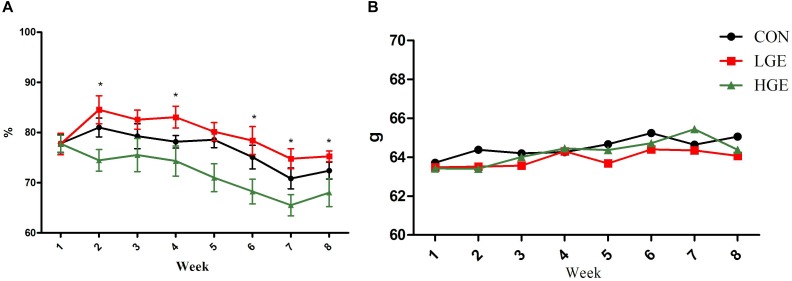
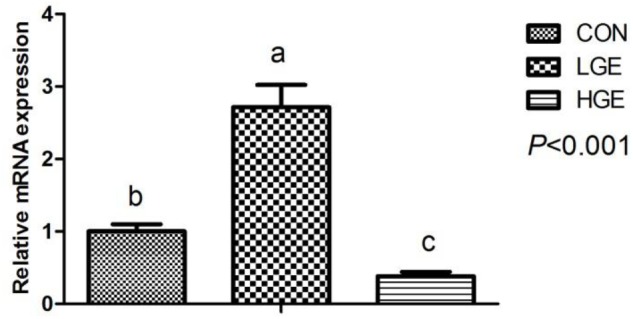
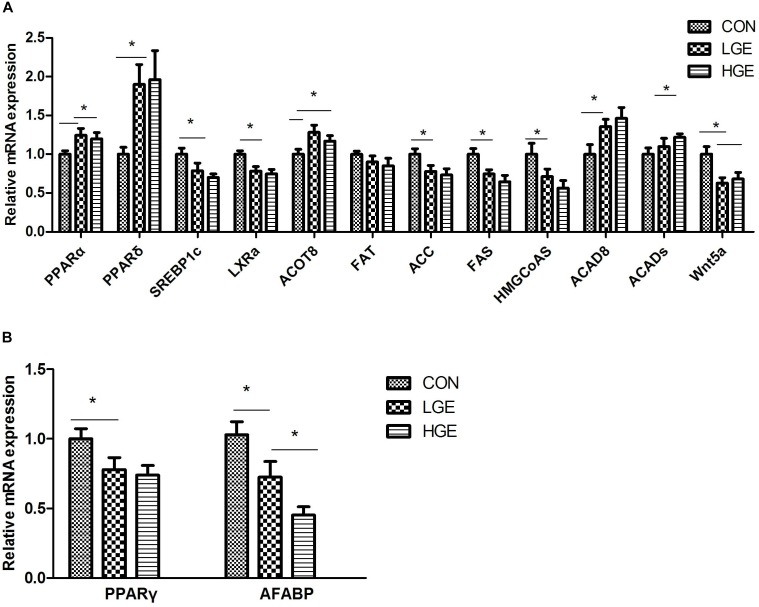
This study investigated the molecular mechanism underlying the effect of dietary genistein (GEN) on fatty liver syndrome (FLS) in laying hens. Hens in the control group (CG) were fed a high-energy and low-choline (HELC) diet to establish the FLS model. The livers of the FLS hens were friable and swollen from hemorrhage. Hepatic steatosis and inflammatory cell infiltration were present around the liver blood vessels. Hens in the low-genistein (LGE) and high-genistein (he) groups were fed GEN at 40 and 400 mg/kg doses, respectively, as supplements to the HELC diet. GEN at 40 mg/kg significantly increased gonadotropin-releasing hormone (GnRH) mRNA expression in the hypothalamus, the serum estrogen (E2) level, and the laying rate, whereas 400 mg/kg of GEN decreased GnRH expression and the laying rate without significantly affecting E2, suggesting that high-dose GEN adversely affected the reproductive performance. Either high- or low-dose GEN treatment could alleviate metabolic disorders and inflammatory responses in FLS hens. GEN significantly decreased the serum ALT, creatinine, triglyceride (TG), total cholesterol (TC), and free fatty acid (FFA) levels. Accordingly, the TG and long-chain fatty acid (LCFA) levels, including long-chain saturated fatty acids (LSFAs) and monounsaturated fatty acids (MUFAs), and the n-6:n-3 polyunsaturated fatty acid (PUFA) ratio in the liver were reduced after the GEN treatments, whereas the levels of C22:0, n-3 family fatty acids, C20:3n6, and C20:4n6 were increased. These results indicated that dietary GEN downregulated the expression of genes related to fatty acid synthesis [sterol regulatory element-binding protein 1 (SREBP1c), liver X receptor alpha (LXRα), fatty acid synthase (FAS), and acetyl coenzyme A synthetase (ACC)] and the fatty acid transporter (FAT). Furthermore, GEN treatments upregulated the transcription of genes related to fatty acid β-oxidation [peroxisome proliferator-activated receptor (PPAR)α, PPARδ, ACOT8, ACAD8, and ACADs] in the liver and reduced PPARγ and AFABP expression in abdominal fat. Dietary GEN alleviated inflammatory cell infiltration in the livers of FLS hens and downregulated TNF-α, IL-6, and IL-1β expression. Moreover, GEN treatment increased SOD activity and decreased malondialdehyde activity in the liver. In conclusion, GEN supplementation in the feed inhibited fatty acid synthesis and enhanced β-oxidation in the liver through the PPAR-ACAD/ACOT and PPAR-LXRα-SREBP1c-ACC/FAS/FAT pathways. Dietary GEN alleviated metabolic disorder and inflammation in the FLS hens by improving the antioxidant capacity and fatty acid profile.
本研究探讨了日粮染料木黄酮(GEN)对蛋鸡脂肪肝综合征(FLS)影响的分子机制。对照组(CG)母鸡饲喂高能低胆碱(HELC)日粮以建立FLS模型。FLS母鸡的肝脏脆弱且因出血而肿胀。肝血管周围存在肝脂肪变性和炎性细胞浸润。低染料木黄酮(LGE)组和高染料木黄酮(HGE)组母鸡分别以40和400 mg/kg剂量的GEN作为HELC日粮的补充剂。40 mg/kg的GEN显著增加下丘脑促性腺激素释放激素(GnRH)mRNA表达、血清雌激素(E2)水平和产蛋率,而400 mg/kg的GEN降低GnRH表达和产蛋率,且对E2无显著影响,表明高剂量GEN对繁殖性能有不利影响。高剂量或低剂量GEN处理均可缓解FLS母鸡的代谢紊乱和炎症反应。GEN显著降低血清谷丙转氨酶(ALT)、肌酐、甘油三酯(TG)、总胆固醇(TC)和游离脂肪酸(FFA)水平。因此,GEN处理后肝脏中TG和长链脂肪酸(LCFA)水平,包括长链饱和脂肪酸(LSFA)和单不饱和脂肪酸(MUFA)以及n-6:n-3多不饱和脂肪酸(PUFA)比值降低,而C22:0、n-3家族脂肪酸、C20:3n6和C20:4n6水平升高。这些结果表明,日粮GEN下调了与脂肪酸合成相关基因[固醇调节元件结合蛋白1(SREBP1c)、肝脏X受体α(LXRα)、脂肪酸合酶(FAS)和乙酰辅酶A合成酶(ACC)]以及脂肪酸转运蛋白(FAT)的表达。此外,GEN处理上调了肝脏中与脂肪酸β氧化相关基因[过氧化物酶体增殖物激活受体(PPAR)α、PPARδ、ACOT8、ACAD8和ACADs]的转录,并降低腹部脂肪中PPARγ和AFABP的表达。日粮GEN减轻了FLS母鸡肝脏中的炎性细胞浸润,并下调肿瘤坏死因子-α(TNF-α)、白细胞介素-6(IL-6)和白细胞介素-1β(IL-1β)的表达。此外,GEN处理增加了肝脏中的超氧化物歧化酶(SOD)活性并降低了丙二醛活性。总之,饲料中添加GEN通过PPAR-ACAD/ACOT和PPAR-LXRα-SREBP1c-ACC/FAS/FAT途径抑制肝脏脂肪酸合成并增强β氧化。日粮GEN通过提高抗氧化能力和改善脂肪酸谱减轻了FLS母鸡的代谢紊乱和炎症。