Conde-Sieira Marta, Chivite Mauro, Míguez Jesús M, Soengas José L
Laboratorio de Fisioloxía Animal, Departamento de Bioloxía Funcional e Ciencias da Saúde, Facultade de Bioloxía and Centro de Investigación Mariña, Universidade de Vigo, Vigo, Spain.
Front Endocrinol (Lausanne). 2018 Oct 23;9:631. doi: 10.3389/fendo.2018.00631. eCollection 2018.
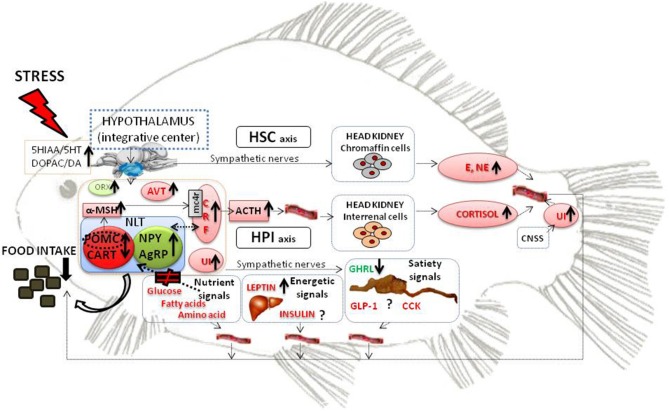
The homeostatic regulation of food intake relies on a complex network involving peripheral and central signals that are integrated in the hypothalamus which in turn responds with the release of orexigenic or anorexigenic neuropeptides that eventually promote or inhibit appetite. Under stress conditions, the mechanisms that control food intake in fish are deregulated and the appetite signals in the brain do not operate as in control conditions resulting in changes in the expression of the appetite-related neuropeptides and usually a decreased food intake. The effect of stress on the mechanisms that regulate food intake in fish seems to be mediated in part by the corticotropin-releasing factor (CRF), an anorexigenic neuropeptide involved in the activation of the HPI axis during the physiological stress response. Furthermore, the melanocortin system is also involved in the connection between the HPI axis and the central control of appetite. The dopaminergic and serotonergic systems are activated during the stress response and they have also been related to the control of food intake. In addition, the central and peripheral mechanisms that mediate nutrient sensing capacity and hence implicated in the metabolic control of appetite are inhibited in fish under stress conditions. Finally, stress also affects peripheral endocrine signals such as leptin. In the present minireview, we summarize the knowledge achieved in recent years regarding the interaction of stress with the different mechanisms that regulate food intake in fish.
食物摄入的稳态调节依赖于一个复杂的网络,该网络涉及外周和中枢信号,这些信号在下丘脑整合,下丘脑继而通过释放促食欲或抑食欲神经肽做出反应,最终促进或抑制食欲。在应激条件下,鱼类控制食物摄入的机制失调,大脑中的食欲信号不像在对照条件下那样发挥作用,导致食欲相关神经肽的表达发生变化,通常食物摄入量会减少。应激对鱼类食物摄入调节机制的影响似乎部分由促肾上腺皮质激素释放因子(CRF)介导,CRF是一种抑食欲神经肽,在生理应激反应中参与下丘脑-垂体-肾上腺(HPI)轴的激活。此外,黑皮质素系统也参与HPI轴与食欲中枢控制之间的联系。多巴胺能和5-羟色胺能系统在应激反应中被激活,它们也与食物摄入的控制有关。此外,在应激条件下,鱼类中介导营养感知能力并因此参与食欲代谢控制的中枢和外周机制受到抑制。最后,应激还会影响外周内分泌信号,如瘦素。在本综述中,我们总结了近年来关于应激与调节鱼类食物摄入的不同机制之间相互作用所取得的知识。