Wu Zhiqiang, Liu Bo, Du Jiang, Zhang Junpeng, Lu Liang, Zhu Guangjian, Han Yelin, Su Haoxiang, Yang Li, Zhang Shuyi, Liu Qiyong, Jin Qi
MOH Key Laboratory of Systems Biology of Pathogens, Institute of Pathogen Biology, Chinese Academy of Medical Sciences & Peking Union Medical College, Beijing, China.
Key Laboratory of Zoonosis of Liaoning Province, College of Animal Science and Veterinary Medicine, Shenyang Agricultural University, Shenyang, China.
Front Microbiol. 2018 Oct 24;9:2562. doi: 10.3389/fmicb.2018.02562. eCollection 2018.
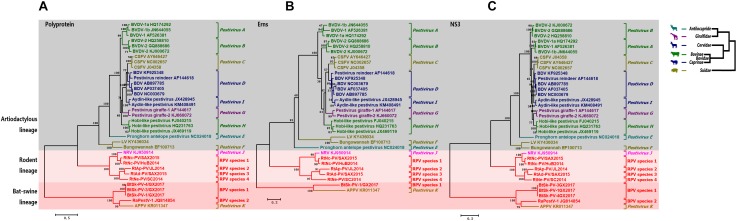
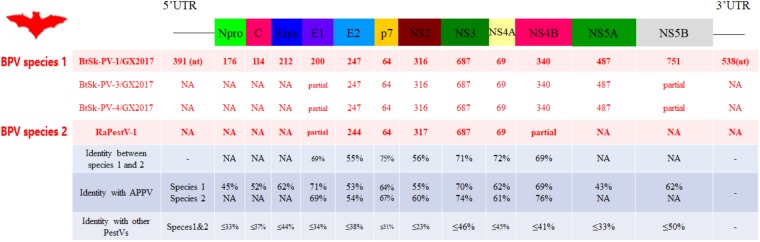
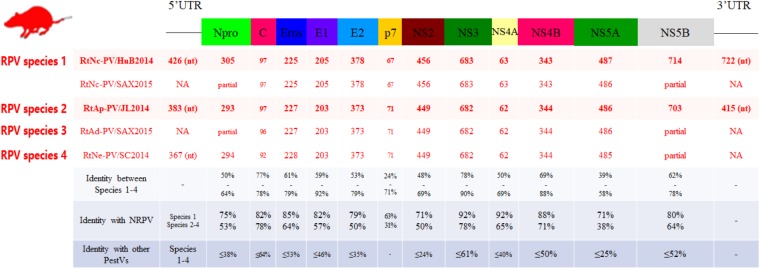
Bats and rodents are widely distributed worldwide and can be native or intermediate reservoirs of many important zoonotic viruses. Pestiviruses are a group of virus species of the genus under the family that can infect a wide variety of artiodactylous hosts, including swine and ruminants. Two classic types of pestiviruses, bovine viral diarrhea virus and classical swine fever virus, are important causative agents of mild-to-severe disease in bovine and swine hosts, respectively, and cause tremendous economic losses in these industries. Recent reports revealed that bats and rodents could also act as natural hosts of pestiviruses and an atypical porcine pestivirus, which cause disease in piglets, showed a close genetic relationship with a specific bat pestivirus, RaPestV-1. This study aimed to describe the detection and characterization of novel pestiviruses from bats and rodents in different locations by analyzing the available bat and rodent virome data from throughout China. Two bat pestivirus species and four rodent pestivirus species that are distinct from other known viruses were identified and sequenced. These viruses were identified from two bat species and four rodent species in different Chinese provinces. There were two distinct lineages present in these viruses, that differ from artiodactylous pestivirus. These findings expand our understanding of the genetic diversity of pestiviruses in bats and rodents and suggest the presence of a diverse set of pestiviruses in non-artiodactylous hosts. This study may provide new insight for the prevention of future viral disease outbreaks originating from bats and rodents.
蝙蝠和啮齿动物广泛分布于世界各地,可能是许多重要人畜共患病毒的天然宿主或中间宿主。瘟病毒是黄病毒科瘟病毒属的一组病毒,可感染包括猪和反刍动物在内的多种偶蹄目宿主。两种经典的瘟病毒,牛病毒性腹泻病毒和经典猪瘟病毒,分别是牛和猪宿主中轻度至重度疾病的重要病原体,并给这些行业造成巨大经济损失。最近的报告显示,蝙蝠和啮齿动物也可能是瘟病毒的天然宿主,一种导致仔猪发病的非典型猪瘟病毒与一种特定的蝙蝠瘟病毒RaPestV-1显示出密切的遗传关系。本研究旨在通过分析来自中国各地的蝙蝠和啮齿动物病毒组数据,描述不同地区蝙蝠和啮齿动物中新型瘟病毒的检测和特征。鉴定并测序了两种与其他已知病毒不同的蝙蝠瘟病毒和四种啮齿动物瘟病毒。这些病毒是在中国不同省份的两种蝙蝠和四种啮齿动物中鉴定出来的。这些病毒存在两个不同的谱系,与偶蹄目瘟病毒不同。这些发现扩展了我们对蝙蝠和啮齿动物中瘟病毒遗传多样性的理解,并表明在非偶蹄目宿主中存在多种瘟病毒。本研究可能为预防未来源自蝙蝠和啮齿动物的病毒性疾病爆发提供新的见解。