Aiso Toshiko, Ohtsuka Kouki, Ueda Makiko, Karita Shin, Yokoyama Takuma, Takata Saori, Matsuki Naoko, Kondo Haruhiko, Takizawa Hajime, Okada Annabelle A, Watanabe Takashi, Ohnishi Hiroaki
Department of Medical Technology, Faculty of Health Sciences, Kyorin University, Tokyo 181-8612, Japan.
Department of Laboratory Medicine, School of Medicine, Kyorin University, Tokyo 181-8611, Japan.
Oncol Lett. 2018 Nov;16(5):6643-6651. doi: 10.3892/ol.2018.9464. Epub 2018 Sep 20.
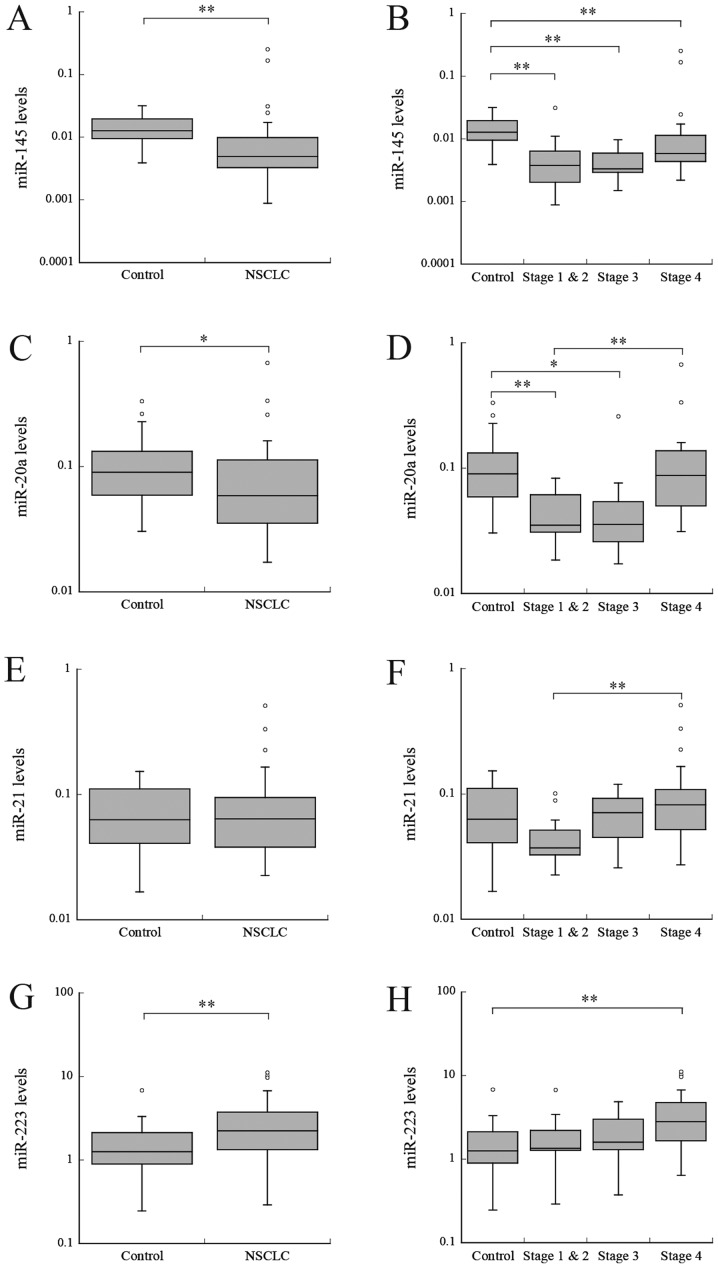
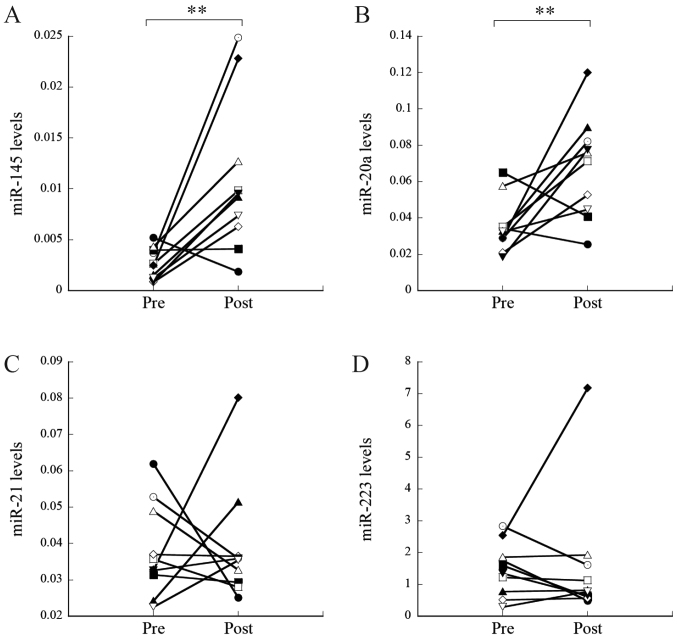
Circulating microRNAs (miRNAs) are promising markers for cancer diagnosis and prognosis. Numerous studies evaluating miRNAs as markers for non-small cell lung cancer (NSCLC) have been conducted in recent years; however, the majority of candidate markers proposed via individual studies were inconsistent and no marker miRNAs for the diagnosis of early stage NSCLC have been established. In the present study, miR-145, miR-20a, miR-21 and miR-223, which were previously reported as candidate diagnostic markers of NSCLC, were re-evaluated. The serum levels of these miRNAs were quantified in 56 patients with stage I-IV NSCLC using the TaqMan microRNA assays and separately compared the levels at each stage with those in 26 control patients. The level of miR-145 was significantly reduced in patients with NSCLC, regardless of clinical stage, and its level increased following tumor resection in patients with stage I-II disease. These results indicate that miR-145 is relevant as a diagnostic marker for stages I-IV NSCLC. Additionally, the levels of miR-20a and miR-21 demonstrated notable differences among patients at different clinical stages. These miRNAs distinguished patients in a number of, but not all, stages of NSCLC from cancer-free control patients. These results indicated that it is essential to analyze miRNA levels at each stage separately in order to evaluate marker miRNAs for NSCLC diagnosis.
循环微RNA(miRNA)是癌症诊断和预后的有前景的标志物。近年来,已经开展了许多评估miRNA作为非小细胞肺癌(NSCLC)标志物的研究;然而,通过个别研究提出的大多数候选标志物并不一致,并且尚未建立用于早期NSCLC诊断的标志物miRNA。在本研究中,对先前报道为NSCLC候选诊断标志物的miR-145、miR-20a、miR-21和miR-223进行了重新评估。使用TaqMan微RNA分析对56例I-IV期NSCLC患者的这些miRNA血清水平进行定量,并将每个阶段的水平分别与26例对照患者的水平进行比较。无论临床分期如何,NSCLC患者中miR-145的水平均显著降低,I-II期疾病患者肿瘤切除后其水平升高。这些结果表明,miR-145作为I-IV期NSCLC的诊断标志物具有相关性。此外,miR-20a和miR-21的水平在不同临床分期的患者中表现出显著差异。这些miRNA在NSCLC的多个(但不是所有)阶段能够区分患者与无癌对照患者。这些结果表明,为了评估用于NSCLC诊断的标志物miRNA,分别分析每个阶段的miRNA水平至关重要。