Langham Erika, McCalman Janya, Redman-MacLaren Michelle, Hunter Ernest, Wenitong Mark, Britton Amelia, Rutherford Katrina, Saunders Vicki, Ungar Michael, Bainbridge Roxanne
Centre for Indigenous Health Equity Research, School of Health, Medical and Applied Science, Central Queensland University, Cairns, QLD, Australia.
Cairns Institute, James Cook University, Cairns, QLD, Australia.
Front Public Health. 2018 Oct 23;6:299. doi: 10.3389/fpubh.2018.00299. eCollection 2018.
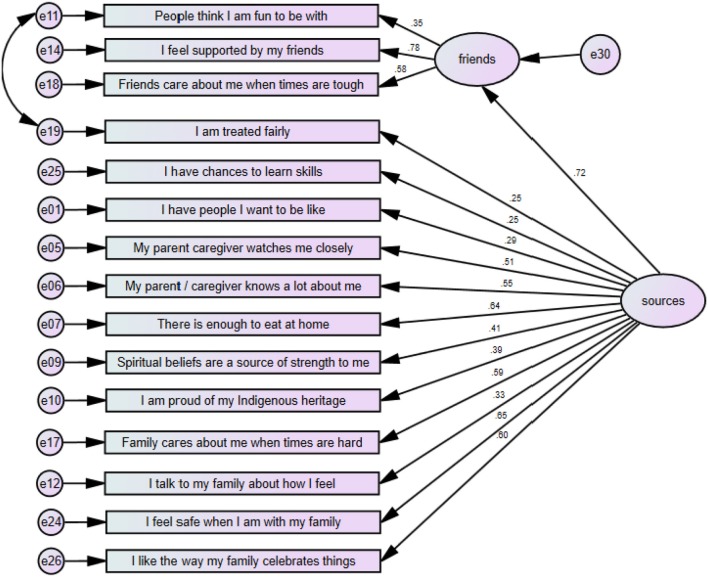
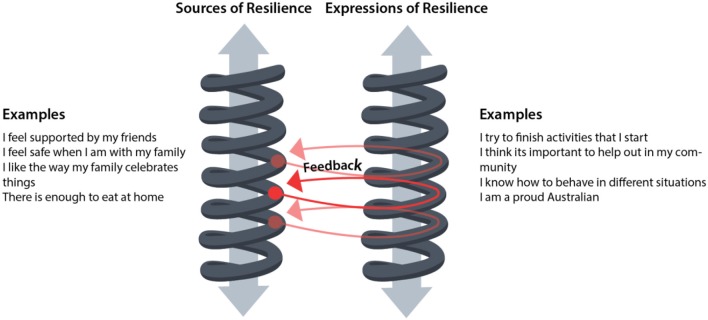
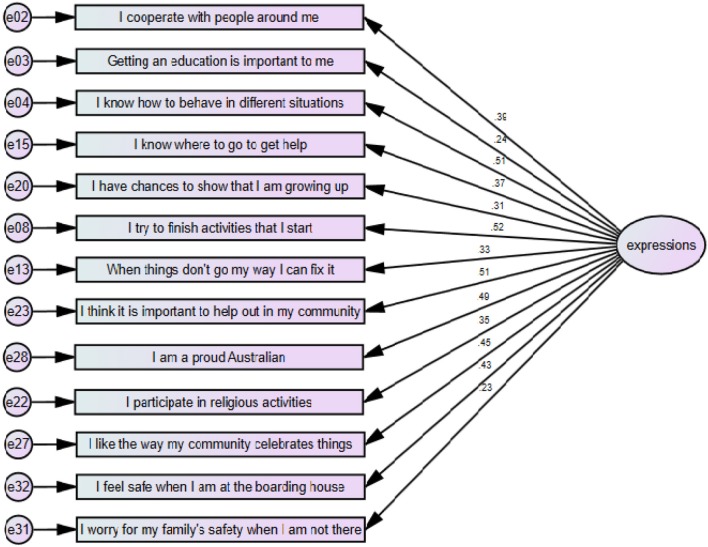
Resilience is a strengths-based construct that is useful for understanding differences in health and wellbeing among youth. There are a range of validated survey instruments available to measure resilience for Aboriginal and Torres Strait Islander (hereafter respectfully Indigenous) youth. However, standard international instruments should only be used if they have been subjected to a rigorous cross-cultural adaptation process and psychometric evaluation in the target population to ensure their validity. The aim of the study was to validate an adapted Child and Youth Resilience Measure (CYRM-28) within a sample of Indigenous Australian boarding school students. The CYRM-28, augmented with an additional 11 site specific items was administered to a purposive sample of Australian Indigenous boarding school students ( = 233) as part of the broader T4S survey instrument that captures demographic information and measures resilience, psychological distress and risk, and service usage. Confirmatory factor analysis was undertaken to verify the relationship between the observed variables with the theoretical constructs of the CYRM-28 and previous findings on the factor structure. Cronbach alpha was also calculated to assess the internal consistency of the CYRM-28 within this sample. Survey data were not a good fit for any previously identified models of the CYRM-28, although the inclusion of a site-specific variable improved the overall fit statistics. Two separate scales were confirmed that capture the sources and expressions of resilience for Indigenous Australian boarding school students. This structure is different to previous findings in relation to the CYRM-28, but consistent with conceptualizations of resilience as a dynamic process. The findings are useful in guiding the future use of the CYRM-28 instrument, explorations of Indigenous youth resilience, and for services working with Indigenous youth in out of home care situations. They highlight contextual differences in the measurement of resilience and the importance of validating standard instruments that have been subjected to rigorous cross-cultural adaptation processes. The two scales offer practical guidance to human services working with Indigenous youth on strategies to build and monitor resilience in Indigenous Australian youth and contribute to the emergent understanding of their resilience.
复原力是一个基于优势的概念,有助于理解青少年在健康和幸福方面的差异。有一系列经过验证的调查工具可用于测量原住民和托雷斯海峡岛民(以下简称原住民)青少年的复原力。然而,只有在标准国际工具经过严格的跨文化适应过程并在目标人群中进行了心理测量评估以确保其有效性之后,才应使用这些工具。本研究的目的是在澳大利亚原住民寄宿学校学生样本中验证改编后的儿童和青少年复原力量表(CYRM-28)。作为更广泛的T4S调查工具的一部分,CYRM-28增加了11个特定地点的项目,被应用于澳大利亚原住民寄宿学校学生的目标样本(n = 233),该调查工具收集人口统计信息并测量复原力、心理困扰和风险以及服务使用情况。进行了验证性因素分析,以验证观察变量与CYRM-28的理论结构以及先前关于因素结构的研究结果之间的关系。还计算了Cronbach α系数,以评估CYRM-28在该样本中的内部一致性。调查数据与CYRM-28之前确定的任何模型都不太匹配,尽管纳入特定地点变量改善了整体拟合统计量。确认了两个单独的量表,它们捕捉了澳大利亚原住民寄宿学校学生复原力的来源和表现形式。这种结构与之前关于CYRM-28的研究结果不同,但与将复原力视为一个动态过程的概念一致。这些发现有助于指导CYRM-28工具的未来使用、对原住民青少年复原力的探索,以及为在家庭外照顾环境中与原住民青少年合作的服务机构提供帮助。它们突出了复原力测量中的背景差异以及验证经过严格跨文化适应过程的标准工具的重要性。这两个量表为与原住民青少年合作的人类服务机构提供了实用指导,帮助他们制定在澳大利亚原住民青少年中建立和监测复原力的策略,并有助于增进对他们复原力的理解。