Department of Pediatrics, Faculty of Medicine and Health, Örebro University Hospital, S-701 85, Örebro, Sweden.
Faculty of Medicine and Health, School of Medical Sciences, Örebro University, Örebro, Sweden.
BMC Pediatr. 2018 Nov 8;18(1):349. doi: 10.1186/s12887-018-1322-5.
Preterm infants are especially vulnerable to pain. The intensive treatment often necessary for their survival unfortunately includes many painful interventions and procedures. Untreated pain can lead to both short- and long-term negative effects. The challenge of accurately detecting pain has been cited as a major reason for lack of pain management in these non-verbal patients. The Premature Infant Pain Profile (PIPP) is one of the most extensively validated measures for assessing procedural pain in premature infants. A revised version, PIPP-R, was recently published and is reported to be more user-friendly and precise than the original version. The aims of the study were to develop translated versions of the PIPP-R in Finnish, Icelandic, Norwegian, and Swedish languages, and to establish their content validity through a cultural adaptation process using cognitive interviews.
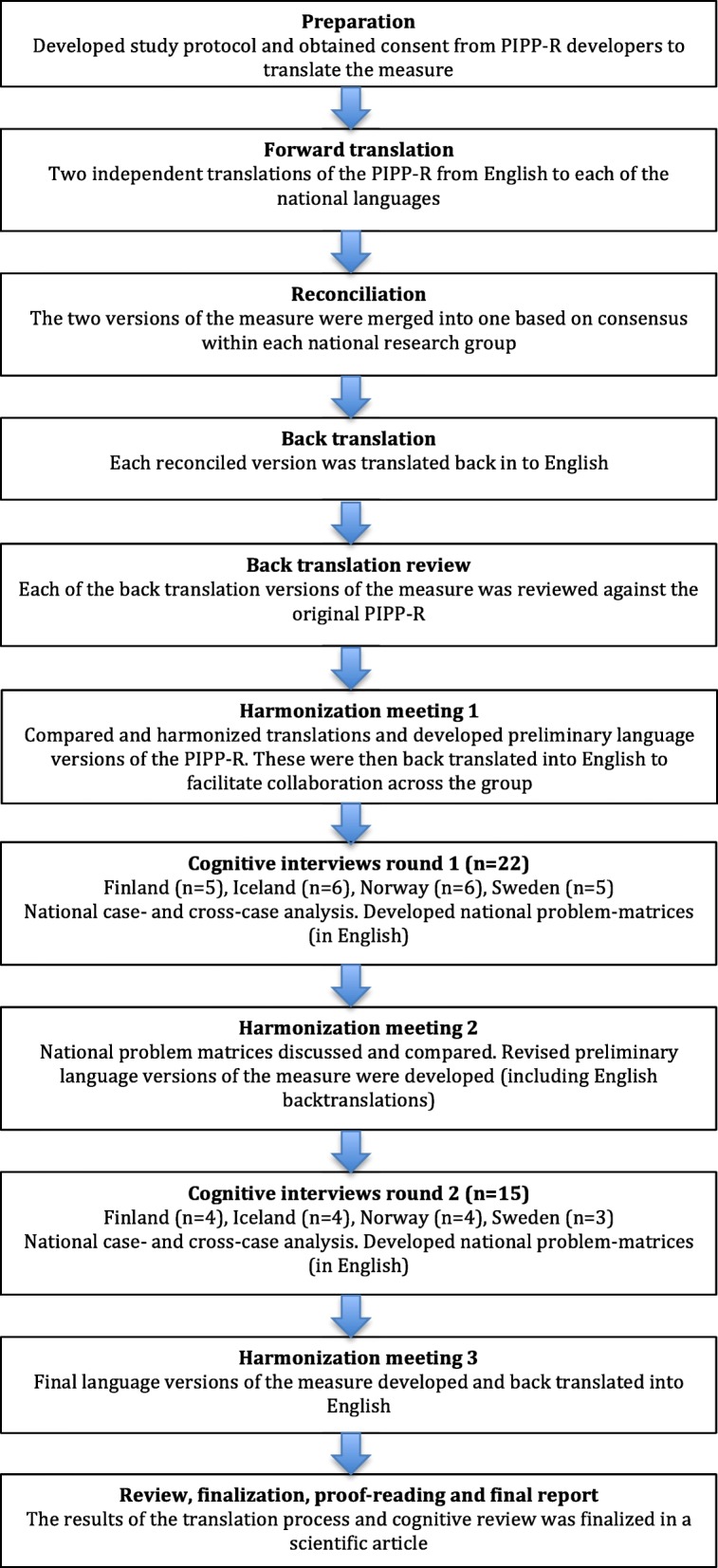
PIPP-R was translated using the recommendations from the International Society for Pharmacoeconomics and Outcomes Research and enhanced with cognitive interviews. The respondent nurse was given a copy of the translated, national version of the measure and used this together with a text describing the infant in the film to assess the pain of an infant in a short film. During the assessment the nurse was asked to verbalize her thought process (thinking aloud) and upon completion the interviewer administered probing questions (verbal probing) from a structured interview guide. The interviews were recorded, transcribed, and analyzed using a structured matrix approach.
The systematic approach resulted in translated and culturally adapted versions of PIPP-R in the Finnish, Icelandic, Norwegian and Swedish languages. During the cultural adaptation process several problems were discovered regarding how the respondent understood and utilized the measure. The problems were either measure problems or other problems. Measure problems were solved by a change in the translated versions of the measure, while for other problems different solutions such as education or training were suggested.
This study have resulted in translations of the PIPP-R that have content validity, high degree of clinical utility and displayed beginning equivalence with each other and the original version of the measure.
早产儿特别容易感到疼痛。为了维持他们的生命,经常需要对他们进行强化治疗,而这些治疗往往会带来许多痛苦的干预和程序。未经治疗的疼痛会导致短期和长期的负面后果。无法准确检测到疼痛,这被认为是这些无法言语的患者疼痛管理不善的主要原因之一。早产儿疼痛行为量表(PIPP)是评估早产儿程序性疼痛的最广泛验证的量表之一。最近发布了一个经过修订的版本,即 PIPP-R,据报道,该版本比原始版本更易用且更精确。本研究的目的是用文化适应过程(使用认知访谈)开发 PIPP-R 的芬兰语、冰岛语、挪威语和瑞典语翻译版本,并通过该过程建立其内容效度。
根据国际药物经济学和结果研究学会的建议对 PIPP-R 进行翻译,并通过认知访谈进行增强。受访者护士拿到翻译后的、本国版本的量表,并用这份量表和描述短片中婴儿的文字一起评估短片中婴儿的疼痛。在评估过程中,护士被要求说出她的思维过程(边想边说),完成后,访谈者会根据结构化访谈指南提出探究性问题(口头探究)。访谈被记录、转录,并使用结构化矩阵方法进行分析。
这种系统的方法产生了芬兰语、冰岛语、挪威语和瑞典语的 PIPP-R 翻译和文化适应版本。在文化适应过程中,发现了受访者理解和使用量表的一些问题。这些问题要么是量表问题,要么是其他问题。量表问题通过改变量表的翻译版本得到解决,而对于其他问题,建议采取不同的解决方案,如教育或培训。
本研究产生的 PIPP-R 翻译具有内容效度、高度的临床实用性,并与原始版本的量表显示出一定的等价性。