Pettersson Miriam, Olsson Emma, Ohlin Andreas, Eriksson Mats
Department of Paediatrics Faculty of Medicine and Health Örebro University Örebro Sweden.
Faculty of Medicine and Health School of Medical Sciences Örebro University Örebro Sweden.
Paediatr Neonatal Pain. 2019 Sep 13;1(1):15-20. doi: 10.1002/pne2.12006. eCollection 2019 Sep.
The aim of this study was to test the hypothesis that neonatal hip examination causes pain in newborns. Pain assessment using instruments such as the Premature Infant Pain Profile-Revised (PIPP-R) scale is recommended, but recently physiological and neurophysiological measures, for example, near-infrared spectroscopy (NIRS) and galvanic skin response (GSR), have been used as well.
Heart auscultation and hip examination were performed, and the response of the newborn was registered by NIRS optodes, GSR electrodes, and a pulse oximeter probe attached to the infant. The face of the newborn was filmed. Heart auscultation was used as a nonpainful reference.
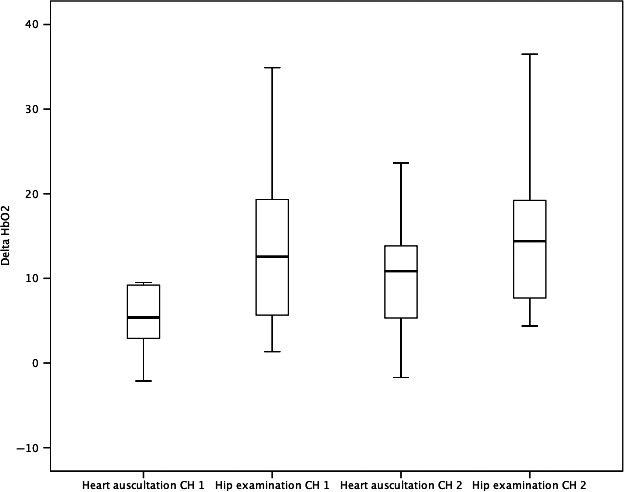
The pain scores for hip examination were higher than for the heart auscultation. Near-infrared spectroscopy showed a significant higher increase from baseline in oxygenated hemoglobin (HbO) on both sides of the cortex at hip examination compared with at heart auscultation ( = .011 and = .017). Mean PIPP-R scores for the hip examination compared with heart auscultation increased from 3.0 to 8.1 ( = .000). The GSR analyses of hip examination compared with heart auscultation showed a significant increase in area under small peaks during the hip examination ( = .016), however, not when measured in peaks per second ( = .104). Interrater reliability was calculated for the NIRS interpretations, with an intraclass correlation coefficient (ICC) range of 0.93-1.0 ( = .000).
Pain in newborns can have negative consequences, and pain prevention and treatment are therefore important. We conclude that neonatal hip examinations are painful and that the pain should be treated, for example, with oral sweet solution. This is a change from present routines during neonatal hip examination and is hoped to lead to a change in national guidelines.
本研究的目的是检验新生儿髋关节检查会给新生儿带来疼痛这一假设。建议使用诸如修订版早产儿疼痛量表(PIPP-R)等工具进行疼痛评估,但最近也采用了生理和神经生理测量方法,例如近红外光谱(NIRS)和皮肤电反应(GSR)。
进行心脏听诊和髋关节检查,并通过NIRS光极、GSR电极以及连接在婴儿身上的脉搏血氧仪探头记录新生儿的反应。对新生儿的面部进行拍摄。将心脏听诊作为无痛参照。
髋关节检查的疼痛评分高于心脏听诊。近红外光谱显示,与心脏听诊相比,髋关节检查时两侧皮质的氧合血红蛋白(HbO)较基线水平有显著更高的增加(分别为P = 0.011和P = 0.017)。髋关节检查与心脏听诊相比,平均PIPP-R评分从3.0增加到8.1(P = 0.000)。髋关节检查与心脏听诊相比的GSR分析显示,髋关节检查期间小峰值下的面积有显著增加(P = 0.016),然而,以每秒峰值测量时则无显著增加(P = 0.104)。计算了NIRS解读的评分者间信度,组内相关系数(ICC)范围为0.93 - 1.0(P = 0.000)。
新生儿疼痛可能会产生负面后果,因此疼痛预防和治疗很重要。我们得出结论,新生儿髋关节检查是疼痛的,这种疼痛应进行治疗,例如使用口服糖水。这与目前新生儿髋关节检查的常规做法不同,希望能导致国家指南的改变。